Description
Product Features
The FBM230 P0926GU is a professional field communication integration module developed by FOXBORO, tailored for I/A Series distributed control systems. Serving as a core data interaction gateway between field intelligent devices and DCS host systems, this module realizes stable serial signal transmission and multi-device protocol adaptation. It adopts independent channel isolation design and industrial-grade communication optimization technology, effectively solving common industrial problems such as serial signal interference, data packet loss and incompatible device protocols. Featuring flexible protocol compatibility, reliable long-distance transmission performance and rugged industrial adaptability, it provides stable and efficient communication support for automated production and process monitoring in various industrial fields.
1. Four-channel Independent Serial Communication Design: Equipped with four independent universal serial ports, the module supports simultaneous access of multiple field devices without channel mutual interference. Each channel operates independently in terms of signal receiving, data processing and protocol parsing, greatly improving the on-site device access density and communication expansion capability of a single module.
2. Multi-protocol Universal Compatibility: It integrates mainstream industrial communication protocol parsing functions, including Modbus RTU and other common serial protocols. It is compatible with various field intelligent instruments, sensors and execution equipment, realizing seamless data docking and information interaction between different brand devices and FOXBORO DCS systems, with extremely strong device adaptability.
3. Channel Isolation & Anti-interference Performance: Every serial communication channel adopts professional electrical isolation protection design, which effectively isolates mutual signal interference between channels and prevents surge current and static impact from damaging internal circuits. It complies with industrial EMC electromagnetic compatibility standards, maintaining stable data transmission in strong electromagnetic interference industrial environments.
4. Stable Long-distance Data Transmission: Supports RS-232/RS-422/RS-485 multi-mode serial signal transmission, with optimized signal amplification and error correction algorithms. It ensures low-bit-error and stable data transmission in long-distance wiring scenarios, avoiding data distortion and transmission interruption caused by long-line signal attenuation.
5. Intelligent Operation Diagnosis & Fault Recovery: Built-in real-time communication status monitoring function, which automatically judges channel connection status, data transmission abnormality and protocol matching errors. It feeds back fault information in real time and supports automatic reconnection and fault reset functions, reducing manual intervention and improving system operation continuity.
6. Rugged Industrial Environmental Adaptability: Designed according to industrial G3 environmental protection standards, the module has excellent dust-proof, moisture-proof, anti-corrosion and temperature resistance capabilities. It can operate stably in high-temperature, high-humidity and dusty harsh industrial scenarios, adapting to long-term uninterrupted operation of on-site control equipment.
7. High System Matching & Easy Expansion: Fully adapted to FOXBORO I/A Series DCS system architecture, supporting hot plugging and online configuration. Users can flexibly adjust communication parameters and protocol modes according to on-site device types and process requirements, realizing rapid system expansion and equipment access, with low engineering transformation cost.
8. Low Power Consumption & High Operational Reliability: Adopting optimized circuit integration design and high-quality industrial components, the module features low operating power consumption and low heat generation. It has passed strict industrial aging tests, with ultra-low failure rate, ensuring long-term stable communication operation of industrial control systems.
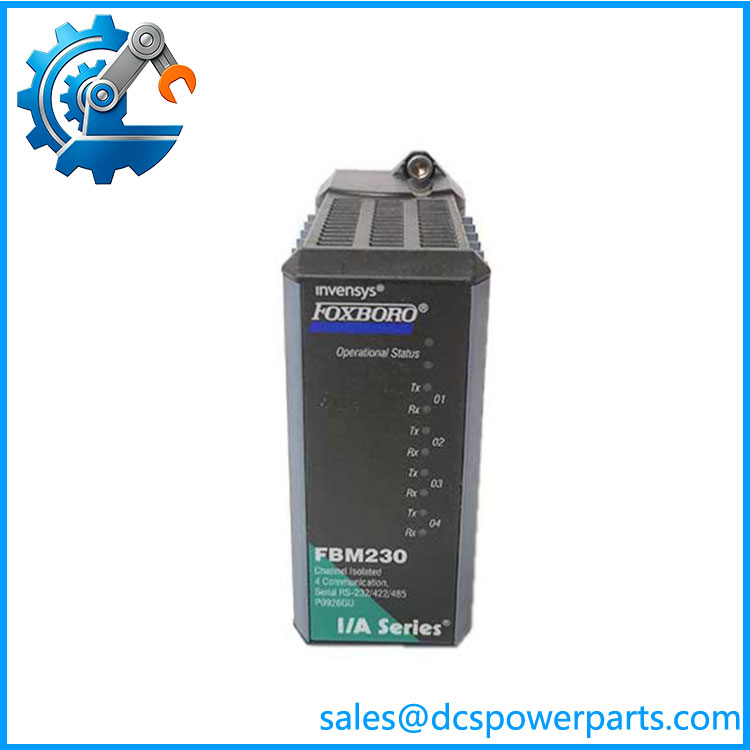
FBM230
Product Parameters
|
Parameter Item
|
Technical Specification
|
|
Product Model
|
FBM230 P0926GU
|
|
Brand
|
FOXBORO
|
|
Product Type
|
Four-port Isolated Serial Communication Module
|
|
Applicable System
|
FOXBORO I/A Series Distributed Control System
|
|
Communication Channel
|
4 Independent Isolated Serial Ports
|
|
Supported Interface
|
RS-232, RS-422, RS-485
|
|
Communication Protocol
|
Modbus RTU and other mainstream industrial serial protocols
|
|
Transmission Performance
|
High-speed serial transmission, support long-distance stable signal output
|
|
Isolation Performance
|
Single-channel independent electrical isolation, anti-crosstalk and anti-surge
|
|
Diagnostic Function
|
Real-time communication status monitoring, fault alarm and automatic reconnection
|
|
Environmental Grade
|
Industrial G3 anti-corrosion and anti-aging grade
|
|
Working Temperature
|
-20℃ ~ +70℃
|
|
Storage Temperature
|
-40℃ ~ +85℃
|
|
Working Humidity
|
5% – 95% RH (non-condensing)
|
|
Installation Method
|
Standard DCS cabinet rack plug-in installation
|
|
Operating Mode
|
Support 24/7 continuous industrial operation, hot pluggable
|
Product Usage Method
1. Pre-installation Inspection: Check the appearance integrity, terminal interface and circuit status of the FBM230 P0926GU module before installation. Confirm no shell damage, interface deformation or component aging. Verify that the module model matches the on-site FOXBORO I/A system to ensure system compatibility and normal communication docking.
2. Static Protection & Environment Preparation: Complete installation in a dry, dust-free and well-ventilated industrial control cabinet. Wear professional anti-static protective equipment to prevent static discharge from damaging the module’s internal communication chips and isolation circuits. Ensure the cabinet environment meets industrial installation standards to avoid environmental interference affecting communication stability.
3. Module Installation & Positioning: Align the module with the standard slot of the DCS rack, insert it smoothly and lock the fixing buckle firmly. Ensure reliable contact between the module and the backplane bus to prevent poor contact caused by equipment vibration, which may lead to communication interruption and data abnormality.
4. Field Wiring & Access: Connect field device serial signal lines, system bus lines and grounding lines in strict accordance with official wiring specifications. Distinguish different serial interface types (RS-232/422/485) for classified wiring, ensure firm wiring and correct sequence, and avoid wrong connection and signal short-circuit faults.
5. System Parameter Configuration: After installation and wiring, connect the upper configuration software. Set communication baud rate, protocol type, channel address and transmission parameters according to the actual parameters of on-site access devices. Complete parameter download and system matching to ensure normal data interaction between the module and field equipment.
6. Power-on Debugging & Communication Test: Perform segmented power-on inspection to activate the module’s self-diagnosis function. Check the channel status indicators to confirm normal operation of each communication port. Test data receiving and transmitting functions of each channel to verify stable and error-free communication transmission.
7. Daily Operation & Routine Maintenance: After the debugging is qualified, the module can be put into formal industrial operation. Regularly check module operating temperature, wiring firmness and communication log data, clean surface dust regularly, and eliminate potential communication faults to ensure long-term stable operation of the DCS communication system.
Product Application Fields
1. Petrochemical Industry: Widely used in DCS control systems of oil refining, chemical production and natural gas processing plants. It realizes serial data communication access for various on-site instruments, flow meters and pressure sensors, ensuring real-time and accurate transmission of production process data and supporting stable operation of chemical automated production.
2. Power Industry: Applied in power plant automated control and monitoring systems, including thermal power and new energy power stations. It is responsible for data interaction between field power monitoring instruments, execution equipment and DCS host, providing reliable communication guarantee for power generation process regulation and equipment safety monitoring.
3. Metallurgy & Heavy Industry: Suitable for automated control systems of metallurgical smelting, steel rolling and heavy machinery production lines. Adapting to harsh industrial environments with high dust and strong electromagnetic interference, it realizes stable long-term communication connection of on-site process equipment and ensures continuous operation of production lines.
4. Oil & Gas Transmission Engineering: Deployed in monitoring and control systems of long-distance oil and gas pipelines and compression stations. It accesses various field monitoring devices and transmission equipment, supports unattended remote monitoring and data transmission, and improves the intelligent management level of oil and gas transmission.
5. General Industrial Automation: Universally applicable to pharmaceutical, environmental protection, water treatment and manufacturing automation industries. It solves multi-device serial communication access problems for industrial control systems, improves system expansion flexibility, and provides stable communication support for intelligent industrial process control.