Description
Foxboro FDC280 Field Device Controller
Product Introduction
Foxboro FDC280 is a distributed field-mounted controller designed for integrating PLCs, drives, meters, packaged equipment, and other intelligent field devices into a Foxboro Evo process automation system. Unlike a conventional protocol gateway that simply converts messages, the FDC280 executes control logic, regulatory control, timing, sequencing, data acquisition, alarm detection, and notification internally. Schneider Electric’s product specification identifies it as a controller that can perform these functions while communicating directly with Ethernet and serial field devices.
Foxboro FDC280 uses a dual-core ARM System-on-Chip architecture. One computational environment handles control software and Foxboro Evo Control Network communications, while the second handles device-integration functions. The controller can support up to 256 field devices and scan as many as 8,000 field points with a minimum 100 ms scan time. The documented architecture also supports up to 8,252 configured blocks, making the FDC280 suitable for distributed equipment integration where moving every device connection back to conventional FBM hardware would add unnecessary cabinet wiring.
Foxboro FDC280 provides four serial ports that can be independently configured for RS-232, RS-422, or RS-485. On the Ethernet side, the baseplate provides connections for 10/100 Mbps or 1 Gbps field-device networks. Schneider Electric documents Modbus TCP Master and Modbus RTU drivers and also supports downloadable protocol drivers for other supported device types. Optional fault-tolerant operation uses two modules in a dedicated baseplate, with synchronized primary/shadow operation. This architecture makes the exact controller image, driver version, baseplate, network adapters, and field-device protocol configuration important parts of any replacement project.
Technical Specifications
| Parameter | Specification |
|---|---|
| Product Model | |
| Manufacturer / Brand | Foxboro / Schneider Electric |
| Product Type | Field Device Controller |
| System | Foxboro Evo Process Automation System |
| Processor | Dual-core ARM System-on-Chip |
| Error Detection | ECC single-bit correction/detection and multiple-bit detection |
| Maximum Field Devices | 256 |
| Maximum Field Points | 8,000 |
| Minimum Field Scan Time | 100 ms |
| Maximum Configured Blocks | 8,252 |
| Block Execution | Up to 16,000 blocks/s |
| Minimum Block Processing Cycle | 100 ms |
| Serial Ports | 4 |
| Serial Standards | RS-232 / RS-422 / RS-485 |
| Serial Port Configuration | Individually selectable |
| Serial Transmission Rates | 300 to 115,200 baud |
| Ethernet Field Interface | 10/100 Mbps or 1 Gbps copper Ethernet |
| Control Network | 100 Mbps Ethernet via copper/fiber adapter |
| Protocols | Driver-dependent; Modbus TCP Master and Modbus RTU documented |
| Control Functions | Regulatory, logic, timing, sequential control |
| Data Functions | Data acquisition, alarm detection, alarm notification |
| Power Supply | 24 VDC typical |
| Maximum Module Consumption | 8.5 W |
| Fault-Tolerant Configuration | Two modules |
| Operating Temperature | −20 to +60°C |
| Storage Temperature | −40 to +70°C |
| Relative Humidity | 5–95%, noncondensing |
| Contamination Rating | ISA S71.04 Class G3 |
| Operating Altitude | Up to 3,000 m |
| Vibration | 0.5 g, 5–500 Hz |
| Mounting | Dedicated 2-position baseplate, DIN rail |
| Module Height | 105 mm; 116 mm including mounting lugs |
| Module Width | 51.8 mm |
| Module Depth | 147 mm |
| Module Weight | 0.8 kg maximum |
| Security Certification | ISASecure EDSA Level 1 |
| Hazardous Area | Class I Div. 2 / ATEX Zone 2 under specified installation conditions |
Specifications are taken primarily from Schneider Electric/Foxboro PSS 31H-2FDC280.
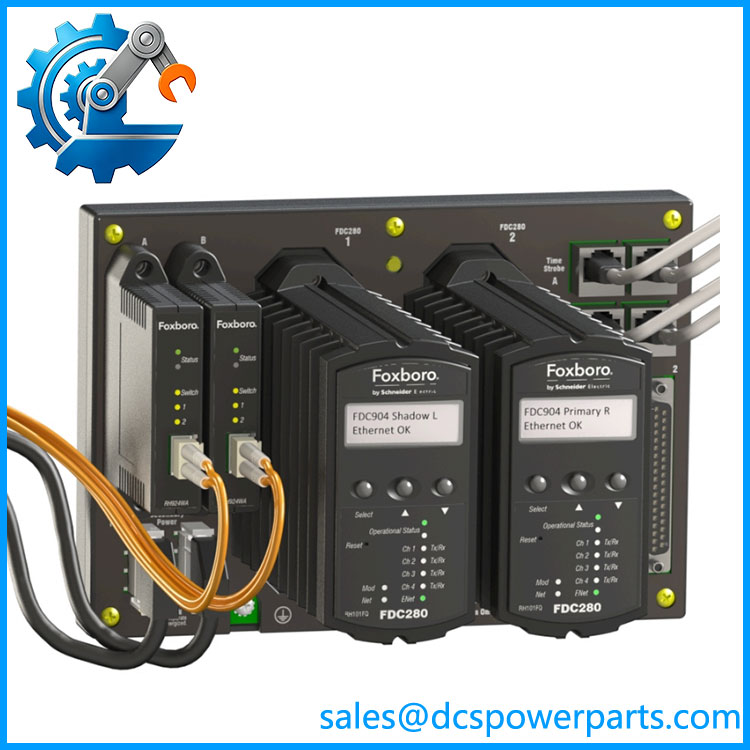
FDC280
Main Features and Engineering Considerations
More Than a Protocol Gateway
The most important distinction with is that it is a controller with device-integration capabilities. It executes regulatory, logic, timing, and sequential control internally. It also performs data acquisition and alarm processing. Treating it as a passive Modbus gateway will lead to an incomplete understanding of the installed architecture.
Ethernet and Serial Integration
The can communicate with Ethernet field devices directly or use protocol-specific gateways for serial devices. Its four serial ports can individually operate as RS-232, RS-422, or RS-485. For RS-485, the specification allows up to 32 devices per port and up to 128 serial devices across four ports.
The Ethernet side supports 10/100 Mbps or 1 Gbps connections to field-device networks. The controller connects to the Foxboro Evo Control Network through dedicated copper or fiber network adapters. These are separate communication paths and should not be treated as interchangeable Ethernet interfaces.
Driver-Based Architecture
The protocol is not permanently defined by the word “.” Schneider Electric documents Modbus TCP Master and Modbus RTU Serial drivers and states that multiple driver instances, protocol versions, and protocols can run on the controller. Driver configuration is therefore part of the system configuration.
A replacement module with the correct hardware but an incorrect controller image or driver configuration can produce a technically healthy controller that still does not communicate with the plant devices.
Optional Fault-Tolerant Pair
A fault-tolerant installation uses two controller modules in a dedicated baseplate. The modules synchronize and operate as Primary and Shadow controllers. The Core 1 control environment provides fault-tolerant operation, while Core 2 device-integration processing operates redundantly.
One important distinction from a procurement standpoint is that Schneider Electric describes the field-device side as redundant, rather than fully fault-tolerant in the same sense as the control-network side. The network topology and field-device port architecture therefore still matter.
Distributed Installation
The is intended for field mounting in dedicated enclosures and can be installed remotely from the central controller location. The controller uses a dedicated baseplate and network adapters, allowing field-device integration to occur closer to the equipment.
This can reduce long serial cable runs and conventional FBM wiring, but it shifts some engineering responsibility toward Ethernet design, IP addressing, protocol drivers, switch configuration, and device diagnostics.
Application Scenarios
- PLC integration into Foxboro DCS
- Variable-frequency drive integration
- Packaged equipment interfaces
- Motor control system integration
- Intelligent electrical equipment
- Modbus TCP device integration
- Modbus RTU multi-drop networks
- Distributed equipment monitoring
- Remote field-device data acquisition
- Distributed process control
- Alarm and status acquisition
- Equipment skids with multiple intelligent devices
- Foxboro Evo modernization projects
Engineer’s Guide: Field Pitfalls
1. Do not order only the controller module.
The depends on a dedicated baseplate, control-network adapter, field-device network connections, and appropriate termination assemblies. The complete assembly must be checked against the existing installation.
2. Check whether the installation is simplex or fault tolerant.
A single and a two-module Primary/Shadow installation have different hardware requirements and baseplate arrangements.
3. Verify the protocol driver.
Modbus TCP and Modbus RTU are documented, but the controller can support multiple downloadable drivers. The installed driver and configuration should be identified before replacement.
4. Do not confuse the control-network Ethernet with field-device Ethernet.
The uses network adapters for the Foxboro Evo Control Network and separate baseplate connections for field-device Ethernet. These networks have different functions.
5. Check serial termination hardware.
RS-232, RS-422, and RS-485 use different electrical arrangements. Cable type, termination assembly, baud rate, parity, addressing, and topology must match the configured driver.
6. Confirm the Foxboro software generation.
The product specification states that the requires Foxboro Evo Control Core Services version 9.3 or later. Firmware/image compatibility should be checked against the actual host system before commissioning.
7. Do not use the maximum point count as an automatic sizing rule.
The stated 8,000-point capacity is subject to block-count, scan-period, driver, and application loading constraints. Schneider Electric provides separate sizing guidance for this reason.
Frequently Asked Questions
What is the Foxboro ?
The is a field-mounted controller and field-device integration module for the Foxboro Evo Process Automation System. It performs control functions as well as Ethernet and serial device integration.
Is an I/O module?
Not in the conventional FBM sense. It integrates external intelligent field devices and performs control internally rather than providing conventional analog or discrete termination channels.
Does support Modbus?
Yes. Schneider Electric documents both Modbus TCP Master and Modbus RTU Serial drivers for the . Other supported protocols can be provided through downloadable drivers.
How many serial ports does have?
The has four serial ports, with each port individually configurable for RS-232, RS-422, or RS-485.
How many field devices can one support?
The published maximum is 256 field devices and up to 8,000 field points, subject to the system’s sizing rules.
Does support redundancy?
Yes. Two modules can operate as a fault-tolerant pair in the dedicated baseplate.
What power supply does require?
The controller uses 24 VDC, with the published maximum consumption of 8.5 W per non-redundant module. The baseplate itself specifies a redundant 24 VDC input arrangement.
What is the operating temperature?
The module is specified for −20 to +60°C, with 5–95% noncondensing relative humidity. The module is conformally coated and rated for ISA S71.04 Class G3 harsh environments.
Procurement Note
For an exact replacement, identify more than the controller’s front-panel model. Record the controller part number, hardware revision, image/software version, letterbug, baseplate type, copper or fiber control-network adapter, serial termination assemblies, field-device protocols, and whether the system uses a Primary/Shadow pair.
For a Modbus installation, document the TCP device IP addresses and ports or the RTU baud/parity/addressing configuration before removing the existing controller. For serial networks, photograph the termination assembly and wiring because RS-232, RS-422, and RS-485 are not interchangeable simply because they use the same controller port.
The module itself is only one part of the field-device integration architecture. The controller image, driver set, baseplate, network adapters, termination hardware, and Foxboro system version should all be checked before treating a spare as a drop-in replacement. Schneider Electric specifically identifies Control Core Services v9.3 or later as a requirement for operation.