Description
Product Overview
The Foxboro FCP280 RH924YA is a distributed Field Control Processor designed for the EcoStruxure Foxboro DCS platform. It executes regulatory control, logic, timing, sequential operations, data acquisition, alarm detection, and alarm notification in conjunction with connected Fieldbus Modules (FBMs). Schneider Electric identifies the FCP280 as a fault-tolerant-capable controller that can coexist with earlier generations of Foxboro automation hardware, making it particularly relevant to DCS modernization projects where existing field infrastructure cannot simply be discarded.
At the fieldbus level, the Foxboro FCP280 RH924YA can accept up to four PIO channels, with each 200 Series FBM chain using a 2 Mbps HDLC fieldbus. The controller can support up to 128 200 Series FBMs, although practical system limits depend on FBM type, fieldbus loading, and the specific combination of legacy and newer I/O. The FCP280 connects to the Foxboro DCS control network through 100 Mbps Ethernet using the appropriate copper or fiber network adapter.
The Foxboro FCP280 RH924YA is not simply a communication gateway. It is the control processor responsible for executing the configured process-control database. Its self-hosting capability allows the processor to boot with a valid control database even when the host workstation is unavailable, although control-function editing cannot be performed in that condition. For high-availability applications, two FCP280 modules can be installed as a fault-tolerant pair on the dedicated baseplate.
Product Introduction
A controller replacement becomes difficult when a plant still depends on established FBM field wiring and long-running control strategies. addresses that situation by combining distributed control execution with direct fieldbus connectivity, supporting four PIO channels and up to 128 200 Series FBMs under the documented architecture.
For a Foxboro DCS controller upgrade, the baseplate and network adapter are just as important as the processor itself. The RH924YA module measures approximately 105 × 51.8 × 147 mm and weighs up to 0.8 kg as a single non-fault-tolerant module.
Key Technical Specifications
| Parameter | Value |
|---|---|
| Manufacturer | Foxboro / Schneider Electric |
| Model | |
| Product Type | Field Control Processor |
| DCS Platform | EcoStruxure Foxboro DCS |
| Controller Function | Regulatory, logic, timing, sequential control |
| Fieldbus Ports | 4 PIO channels |
| 200 Series Fieldbus | 2 Mbps HDLC |
| Control Network | 100 Mbps Ethernet |
| Network Media | Copper or fiber through appropriate adapter |
| 200 Series FBM Capacity | Up to 128, subject to architecture/loading |
| 100 Series FBM Support | Supported in specified mixed/legacy configurations |
| Self-Hosting | Yes |
| Fault-Tolerant Operation | Yes, with two processor modules and appropriate baseplate |
| Online Image Upgrade | Supported for fault-tolerant configurations |
| Mounting | Dedicated 2-position baseplate |
| Module Height | 105 mm / 116 mm including mounting lugs |
| Width | 51.8 mm |
| Depth | 147 mm |
| Maximum Single-Module Weight | 0.8 kg |
| Part Number | RH924YA |
| Required Software | Foxboro DCS Control Core Services; exact release compatibility must be verified |
| Display | Local LCD/status display |
The physical dimensions, mounting arrangement, RH924YA identification, network adapters, and fault-tolerant configuration are documented in the product specification.
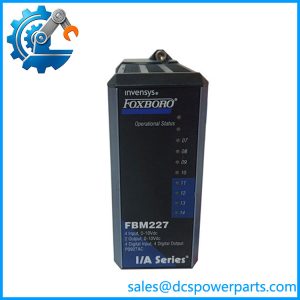
Important: identifies the processor itself. Related items such as the horizontal baseplate RH924YL, vertical baseplate RH924YF, dual-cable baseplate RH100JX, fiber adapter RH924WA, and copper adapter RH924UQ have separate part numbers and should not be confused with the controller module.
Related Products
- FCP270 P0917YZ — Earlier Foxboro Field Control Processor generation. Relevant when planning migration from an older FCP architecture; direct replacement requires checking FBM, fieldbus, and software dependencies.
- RH924YL — Horizontal-mounted baseplate. Required when the installation uses horizontal mounting.
- RH924YF — Vertical-mounted baseplate for cabinets requiring vertical controller installation.
- RH100JX — Dual-cable baseplate supporting the corresponding redundant fieldbus arrangement.
- RH924WA — Fiber network adapter for connecting the to the Foxboro control network through fiber infrastructure.
- RH924UQ — Copper network adapter for 100 Mbps Ethernet connection using copper cabling.
- RH928CV — Twinaxial fieldbus splitter used for specified fieldbus connection architectures, particularly when interfacing applicable legacy FBM arrangements.
- RH924ZJ — Redundant-module fieldbus cable adapter used when an occupies the middle of a 200 Series baseplate chain.
- FBM201 / P0914SQ — Example of a 200 Series Fieldbus Module that can operate within the fieldbus architecture. The exact FBM population must be checked against the controller’s fieldbus loading.
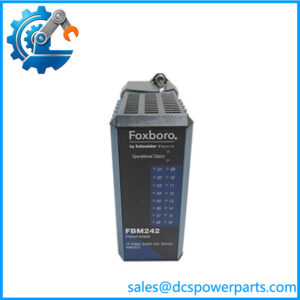
- FBM202 / P0926EQ — Another 200 Series FBM compatible with the architecture; its I/O function differs from other FBM variants.
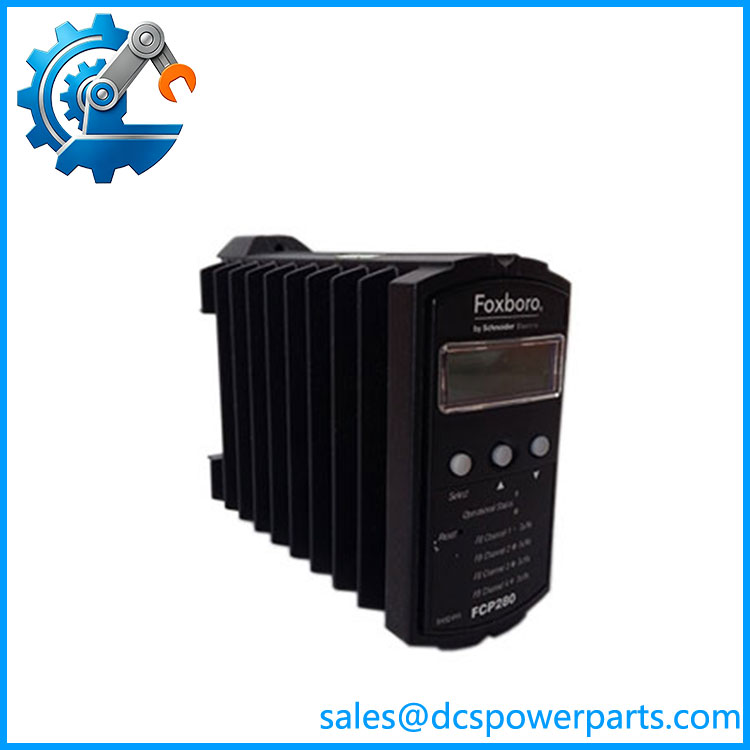
FCP280 RH924YA
Frequently Asked Questions
What is Foxboro used for?
The is a DCS field control processor, not merely an I/O communication module.
It performs:
- Regulatory control
- Logic execution
- Timing
- Sequential control
- Data acquisition
- Alarm detection
- Alarm notification
- Communication with connected FBMs
Schneider Electric describes the as performing these functions together with Foxboro DCS fieldbus modules.
How many FBMs can support?
The documented architecture allows the to support up to 128 200 Series FBMs. Mixed 100 Series/200 Series installations have additional restrictions, including limits on the number of 100 Series FBMs and the fieldbus architecture used.
Do not treat “128 FBMs” as an unconditional plant-design number. Actual loading depends on:
- FBM type.
- Number of PIO channels.
- 100/200 Series combination.
- Fieldbus configuration.
- Control strategy and processing load.
- Legacy migration requirements.
Can I replace an older FCP270 with ?
was specifically designed to support migration from earlier Foxboro automation generations, but the replacement is not simply a processor-for-processor swap. Schneider Electric states that can coexist with earlier-generation Foxboro hardware.
When retaining legacy FBMs, check the fieldbus speed, required adapters, baseplate arrangement, software release, and controller database.
For installations retaining 100 Series FBMs, additional fieldbus equipment may be required. This is one of the areas where a physical replacement can look straightforward on paper and become complicated during commissioning.
Can I hot-swap the ?
Do not assume that a single can be removed from an operating system without considering the control architecture.
The supports fault-tolerant operation using two processor modules, and Schneider Electric documents online image upgrade capability for fault-tolerant configurations.
If the plant uses a redundant pair, the replacement procedure can be materially different from replacing a standalone controller. Confirm controller state, redundancy health, baseplate type, and site maintenance procedure before removing hardware.
Will replacing erase my DCS control logic?
Replacing the processor hardware does not inherently mean the control database is lost.
The real issue is restoring the correct controller image/database and confirming that the replacement hardware is accepted by the installed Foxboro DCS software environment.
Before replacement, document:
- Controller identification
- Hardware revision
- Software release
- Control database version
- Network configuration
- PIO configuration
- FBM inventory
- Redundancy state
A replacement processor should be treated as a controlled DCS maintenance activity, not as a simple module exchange.
Does support firmware v3.1?
There is no safe way to declare compatibility from “v3.1” alone.
The relevant checks include the hardware revision, installed Foxboro DCS Control Core Services release, control database, FBM generations, and network configuration. Current Schneider Electric documentation identifies the as part of the EcoStruxure Foxboro DCS architecture, while older product documentation covers earlier releases.
For a legacy replacement, match the installed system software and hardware revision before loading an image.
How should I verify a New Surplus ?
For a DCS controller, a power-on test is not enough.
Recommended acceptance procedure:
- Verify nameplate.
- Record serial number and hardware revision.
- Inspect the connector and mounting interface.
- Install on the correct baseplate.
- Verify power-up and LCD/status indications.
- Verify Ethernet network communication.
- Verify PIO fieldbus communication.
- Confirm FBM recognition.
- Load or validate the approved controller image/database.
- Test redundant operation if the plant uses a fault-tolerant pair.
- Confirm control execution and alarm handling.
- Record the complete test results.
The is a controller, so “LEDs are normal” is not an adequate acceptance test. A technically sound surplus inspection should demonstrate that the processor can communicate with the intended fieldbus and execute the site’s approved control configuration.