Description
Foxboro FBM232 P0926GW Field Device System Integrator Module
Product Introduction
The Foxboro FBM232 P0926GW is a Field Device System Integrator (FDSI) module designed to connect Ethernet-based field devices with a Foxboro distributed control system. Unlike conventional Foxboro FBM analog or discrete I/O modules, the FBM232 is primarily a communication and data-integration device. Foxboro documentation identifies it as a 10/100 Mbps Ethernet FDSI module that connects to a single copper Ethernet network and exchanges data with external field devices.
The Foxboro FBM232 P0926GW supports 10 Mbps and 100 Mbps Ethernet communication and can interface with individual field devices or multiple devices through an Ethernet hub or switch. Published technical information specifies support for up to 64 field devices and as many as 2,000 Distributed Control Interface (DCI) connections. The module can handle analog and digital data represented through the DCI architecture, allowing Ethernet-connected equipment to appear as usable process data within the Foxboro control environment.
The Foxboro FBM232 P0926GW requires 24 VDC power and has a maximum power consumption of approximately 7 W. The physical module mounts on a modular baseplate, with the baseplate capable of DIN-rail or 19-inch rack installation. Foxboro documentation specifies approximately 284 g module weight and dimensions of 102 mm high, 45 mm wide, and 104 mm deep. For replacement work, the important checks are the exact FBM model, P0926GW part number, baseplate compatibility, Ethernet topology, software driver configuration, and DCS database mapping.
Technical Specifications
| Parameter | Specification |
|---|---|
| Product Model | FBM232 |
| Part Number | P0926GW |
| Manufacturer / Brand | Foxboro / Invensys |
| Current Brand Context | Schneider Electric Foxboro |
| Product Type | Field Device System Integrator (FDSI) Module |
| Primary Function | Ethernet field-device integration |
| Ethernet Speed | 10 Mbps / 100 Mbps |
| Ethernet Interface | Copper Ethernet |
| Connector | RJ-45 |
| Ethernet Network | Single 10/100 Mbps network |
| Maximum Field Devices | Up to 64, application dependent |
| DCI Capacity | Up to 2,000 DCI connections |
| Data Types | Analog and digital DCI data |
| Power Supply | 24 VDC, +5% / -10% |
| Maximum Power Consumption | 7 W |
| Heat Dissipation | 7 W maximum |
| Mounting | Modular baseplate |
| Baseplate Installation | DIN rail or 19-inch rack with appropriate mounting kit |
| Module Dimensions | 102 × 45 × 104 mm approximately |
| Module Weight | 284 g approximately |
| Cable Connection | Up to 100 m Ethernet cable length |
| Ethernet Connector Cable | RJ-45 |
| Communication Protocol | UDP/IP or TCP/IP through downloadable I/O software drivers |
| Operating Accuracy | Not applicable as a communication module |
The 10/100 Mbps Ethernet interface, physical dimensions, 284 g weight, baseplate mounting, and cable/connector information come directly from the available technical documentation. The 64-device and 2,000-DCI figures are supported by additional technical references.
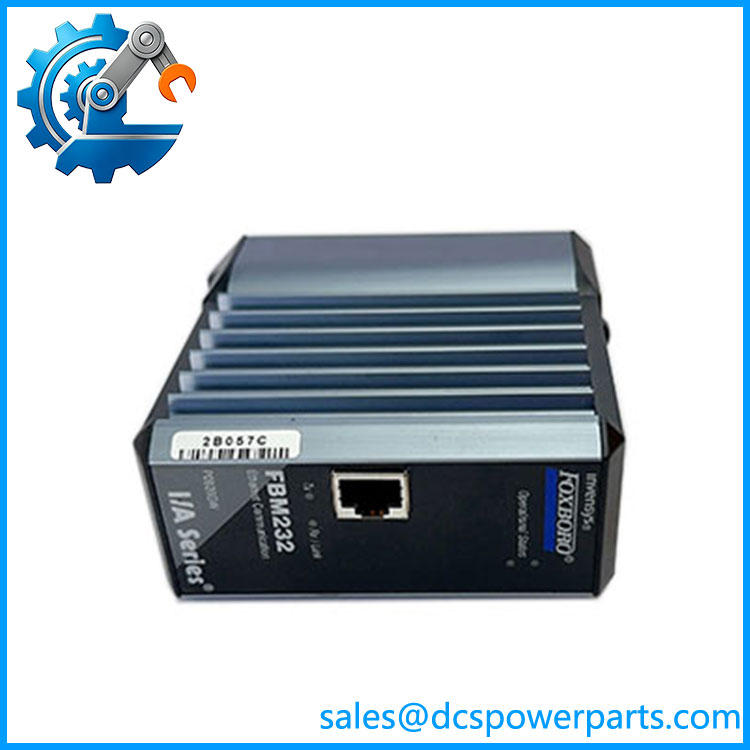
FBM232 P0926GW
Main Features and Engineering Considerations
1. FDSI Architecture Rather Than Conventional I/O
The most important identification point is that is an FDSI module. It should not be confused with Foxboro analog input, analog output, or discrete I/O FBMs.
The module provides an Ethernet communication path between external field equipment and the Foxboro DCS control database. The actual field-device data is handled through the communication driver and DCI architecture rather than through conventional screw-terminal analog channels.
2. 10/100 Mbps Copper Ethernet
The supports both 10 Mbps and 100 Mbps copper Ethernet. The documented interface uses an RJ-45 connection, with cable runs from the module to a hub, switch, or device documented at up to 100 m.
For an existing plant, inspect the Ethernet topology before replacement. Record the switch port, IP configuration, connected equipment, cable routing, and network segmentation. A physically compatible module can still fail to communicate if the network configuration is not reproduced correctly.
3. Multiple Field Devices Through Ethernet Infrastructure
The module can communicate with up to 64 field devices when Ethernet switches or hubs are used. This provides a way to bring data from multiple Ethernet-capable devices into the Foxboro DCS without dedicating a conventional I/O channel to every external device.
The actual usable capacity should be evaluated against communication scan rates, driver requirements, device response times, network loading, and DCI database configuration. “64 devices” should therefore be treated as a documented capacity rather than a guarantee that every possible combination will perform identically.
4. Downloadable I/O Software Drivers
The architecture uses downloadable I/O software drivers to support external device communication. Published references identify Ethernet-based protocols such as TCP/IP and UDP/IP, with protocol-specific integration depending on the installed driver and Foxboro configuration.
This is a key replacement consideration. Installing the hardware alone does not reproduce the complete communication function. The corresponding software driver, DCI definitions, device addressing, and control-system configuration must also be available.
5. Modular Baseplate Installation
The mounts on a modular baseplate rather than directly functioning as a standalone DIN-rail Ethernet switch. Foxboro documentation specifies that the baseplate can be mounted horizontally or vertically on a DIN rail, or horizontally in a 19-inch rack using the appropriate mounting kit.
Before ordering a replacement, confirm the installed baseplate and connector arrangement. Do not assume that a generic Ethernet module with similar dimensions will mechanically or electrically interface with the Foxboro baseplate.
6. Power Requirements
The documented maximum consumption is approximately 7 W, with a 24 VDC supply specified at +5% / -10%.
For an operating DCS cabinet, verify the actual cabinet power-distribution arrangement, including redundant supply architecture where applicable. The should be evaluated as part of the complete Foxboro node rather than as an isolated Ethernet device.
Application Scenarios
- Foxboro DCS field-device integration
- Ethernet-connected process instrumentation
- Third-party controller integration
- Smart field equipment communication
- Motor-control and packaged-equipment data integration
- Analyzer and skid-package interfaces
- Industrial Ethernet data acquisition
- Legacy Foxboro I/A Series installations
- Process plants requiring Ethernet-to-DCS data integration
Engineer’s Guide: Field Pitfalls
Do not mistake for an analog input card. Some low-quality product listings incorrectly describe it as an analog input module with 4–20 mA channels. That description conflicts with the actual documentation, which identifies the unit as a Field Device System Integrator module with a 10/100 Mbps Ethernet interface.
Verify the software driver. The hardware is only one part of the integration. The appropriate downloadable I/O driver and DCI configuration are required for the connected device protocol.
Record the existing network configuration. Before replacing the module, document IP addressing, Ethernet switch port, connected device, cable routing, and network topology.
Check the baseplate. The is designed to mount on a Foxboro modular baseplate. Do not assume that a generic Ethernet interface module can use the existing mechanical or electrical connection.
Do not assume every Ethernet protocol is automatically supported. Protocol support depends on the installed/downloaded I/O software driver and system configuration. The hardware’s Ethernet capability alone does not establish compatibility with every TCP/IP-based device.
Check DCI loading. The documented capacity can reach 2,000 DCI connections, but actual system performance depends on device count, data volume, update rates, network behavior, and driver configuration.
Verify the exact suffix. is the spare/part number associated with . Do not substitute another FBM communication module solely because it also provides Ethernet.
Frequently Asked Questions
What is Foxboro ?
It is a Field Device System Integrator (FDSI) module providing Ethernet communication between field devices and the Foxboro DCS.
Is an analog input module?
No. The is an Ethernet communication/FDSI module. Listings that describe as an 8-channel analog input card are inconsistent with the available documentation.
What Ethernet speed does support?
It supports 10 Mbps and 100 Mbps Ethernet communication over copper connections.
How many field devices can communicate with?
Published specifications state up to 64 field devices, typically through Ethernet switches or hubs.
How many DCI connections can it support?
The documented capacity is up to 2,000 DCI connections.
What power supply does require?
The published specification is 24 VDC, +5% / -10%, with maximum consumption of approximately 7 W.
How is installed?
The module mounts on a Foxboro modular baseplate. The baseplate can be installed horizontally or vertically on DIN rail, or horizontally in a 19-inch rack with the appropriate mounting hardware.
What is the maximum Ethernet cable distance?
The available Foxboro technical document specifies 1 m to 100 m from the module to the hub, switch, or device, using RJ-45 connections.
Procurement Note
For purchasing and maintenance records, specify:
Foxboro — — Field Device System Integrator (FDSI) Module — 10/100 Mbps Copper Ethernet — Foxboro DCS.
Before approving a replacement, verify the model, part number, modular baseplate, Ethernet topology, software driver, DCI configuration, connected-device count, network addressing, and 24 VDC power arrangement.
The most important procurement warning is simple: do not classify as an analog I/O card. Its documented function is Ethernet-based field-device integration, and successful replacement depends on both the hardware and the Foxboro software/database configuration.