Description
Product Overview
FBM230 P0926GU is the general-purpose serial gateway of the Foxboro DCS, and it is deliberately the least specialised module in the cabinet. It carries no protocol of its own. What it carries is four serial ports, each individually configurable in software for RS-232, RS-422 or RS-485, plus a driver image downloaded from a protocol library at commissioning. The hardware is the same in every application; the identity of the module — Modbus RTU master, a vendor-specific weighing or analyser protocol, a batching controller dialect, a custom driver built for one plant — lives in the software loaded onto it. That is the point of the Field Device System Integrator concept, and it is also the single fact most often missed when a spare is ordered against a part number alone.
Inside the Foxboro architecture, FBM230 is the door through which non-Foxboro equipment enters the control database. Its data becomes ordinary DCI blocks — binary, integer, real, packed and string inputs and outputs — configured exactly like any other control block, so a serial device from an OEM that has never heard of Foxboro appears to the operator as a normal tag with normal alarming and normal historisation. It does this over the redundant 2 Mbps module fieldbus, accepting either path, and it does it up to 2000 DCI connections and at a fastest block period of 500 ms.
The P0926GU suffix matters at exactly one point in the process: choosing between single and redundant. The four-port serial family exists in two members — FBM230 P0926GU, which is single, and FBM231 P0926GV, which is redundant with Master/Tracker operation and can bond its ports into a single logical port carrying redundant cabling. Port count is identical; the difference is what happens when a cable, a converter or a serial card fails. Buyers who assume the two are interchangeable because both have four ports discover the distinction at the worst possible moment, usually during the outage the redundant pair was installed to survive.
Two sizing details deserve attention before any order, because they decide whether one module is enough. Device capacity depends on the physical layer: 64 devices on RS-485 multidrop at up to 16 per port, but only four devices when connecting RS-232 or RS-422 directly. And throughput is a supervisory figure, not a control one — 500 ms is the fastest allowed block period, so this module integrates devices into the plant database; it does not close a fast loop through the DCS.
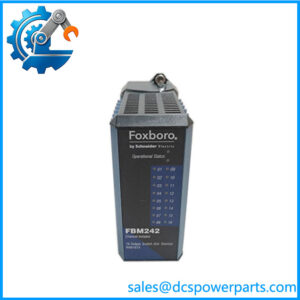
Physically the module is a compact extruded-aluminium block of 102 mm by 45 mm by 104 mm, about 284 g, mounted on a modular baseplate that takes four or eight FBMs on DIN rail or in a 19-inch rack, with redundant independent 24 VDC supplies and connections for the module fieldbus. It can be removed and replaced without disturbing field termination cabling, power or communication cabling — which is why the termination assembly, not the module, is the part that determines how much work a swap actually involves.
The security of the electrical interface is handled at the termination assembly: four DB-25 connectors for RS-232 with a bank of 24 DIP switches per port to match pinouts, three-tier compression or ring-lug terminals for RS-422 and RS-485, and switch-selectable termination resistors per port. The module itself provides galvanic isolation on each channel with a 600 VAC one-minute withstand to earth — a rating for transient survival, explicitly not a licence to connect hazardous voltages, which the manufacturer warns against in bold terms.
Technical Specifications
| Parameter | Value |
|---|---|
| Module part number | P0926GU |
| Module type | Field Device System Integrator (FDSI), four serial ports, single |
| Ports | 4, each individually software-configurable for RS-232, RS-422 or RS-485 |
| Baud rates and format | 300, 600, 1200, 2400, 4800, 9600, 19200, 38400, 57600, 115200; 8-bit characters, odd/even/no parity, 1 or 2 stop bits |
| Device capacity | Up to 64 devices on RS-485 (16 per port), or up to 4 direct-connect RS-232 / RS-422 devices |
| DCI capacity | Up to 2000 DCI connections; approximately 2000 analog values or 64000 digital values, packed up to 32 points per connection |
| Fastest ECB block period | 500 ms |
| Module fieldbus | Redundant 2 Mbps module fieldbus; compatible with FCM100Et, FCM100E, FCP270, FCP280 |
| Power | 24 VDC, +5 % / −10 %, redundant inputs; 7 W maximum consumption and dissipation |
| Channel isolation | Galvanic isolation per channel, referenced to earth; 600 VAC withstand for one minute (not for permanent connection to hazardous voltages) |
| Operating temperature | Rev A to L: −20 to +70 °C; Rev M and later: 0 to +70 °C |
| Humidity and contamination | 5 to 95 % non-condensing; Class G3 (harsh) per ISA S71.04 |
| Dimensions and mass | 102 mm high (114 mm with mounting lugs) × 45 mm wide × 104 mm deep; 284 g approximate |
| Mounting | Modular baseplate, 4- or 8-module, DIN rail or 19-inch rack (PSS 31H-2SBASPLT) |
| Termination assembly | Ring lug P0926PA (363 g) or compression screw RH926GH (supersedes P0926GH, 272 g); four DB-25 plus three-tier terminals, 24 DIP switches per port |
| Regulatory | UL/UL-C Class I Div 2 Groups A–D T4; DEMKO Ex nA IIC T4 Zone 2; IECEx; EN 61326-1:2013 Class A, EMC Directive 2014/30/EU |
| Calibration | Not required for module or termination assembly |
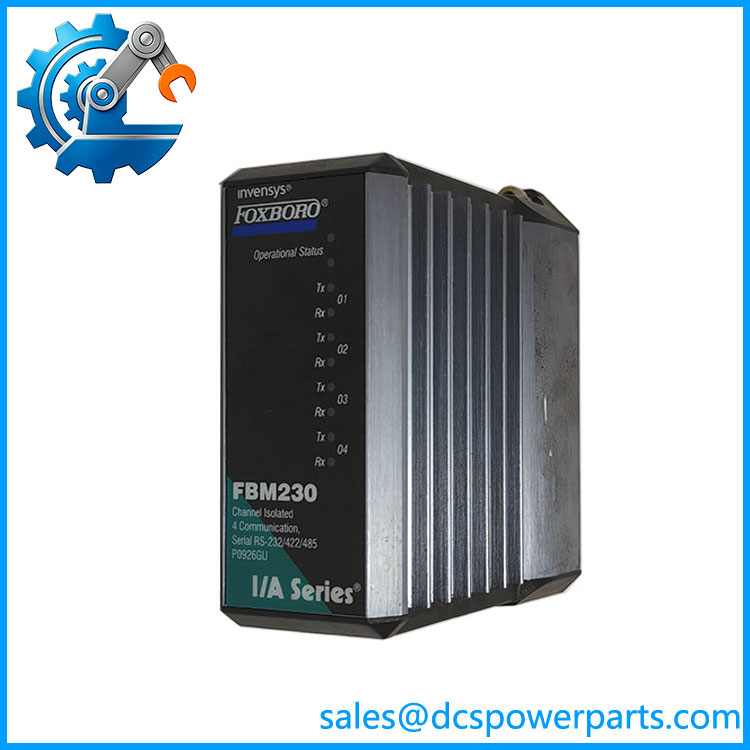
P0926GU FBM230
Key Features and Advantages
Protocol as software, not as hardware: the module accepts a driver image from a protocol library, and custom drivers can be built for devices with no standard dialect. One part number, P0926GU, can therefore serve dozens of unrelated device types across a plant — and a single spare covers all of them, provided the driver is restored with it.
Per-port interface selection: each of the four ports is independently configured for RS-232, RS-422 or RS-485, so a single module can front a mix of devices that no single interface standard would cover. That removes the usual need for one gateway per protocol family and the cabinet space that goes with it.
Device density on RS-485: 16 devices per port and 64 per module on twisted-pair shielded multidrop is a genuine engineering advantage in a plant where dozens of analysers, drives or meters sit on one cable run. The counterpart is the constraint that direct RS-232 or RS-422 connections allow only four devices.
Data absorbed as native blocks: everything the module collects becomes BIN, BINR, BOUT, IIN, IOUT, PAKIN, PAKOUT, PLSOUT, RIN, RINR, ROUT, STRIN or STROUT blocks, configured like any other control block. No separate gateway database, no parallel addressing scheme, no second alarm system for the integrated equipment.
Survivable placement in the cabinet: redundant 2 Mbps module fieldbus with either-path acceptance, redundant 24 VDC inputs, and replacement without disturbing field termination, power or communication cabling. A module swap is a slot operation rather than a wiring operation.
Honest limits: 500 ms is the floor for block period, which makes this a supervisory integration module rather than a fast control path; and the single variant has no Master/Tracker redundancy, so cable or port failure is an outage, not a switchover.
Applications
Balance-of-plant device integration: analysers, weigh scales, batching controllers, tank gauging, power meters and standalone skids that speak a serial dialect and belong in the plant database but were never designed for DCS connectivity. The module puts their data into normal tags with normal alarming.
Serial-to-DCS retrofit in brownfield plants: existing RS-485 instrument loops that already run down cable trays are brought into the Foxboro database without replacing the instruments or the wiring — the module terminates at a TA on the DIN rail and the multidrop bus continues to the devices as it always has.
Multi-vendor skid integration: OEM packages arrive with their own controller and a serial port, and the plant needs the package’s data inside its own historian and trend system. FBM230 is the usual answer, with a driver matched to whatever the skid vendor implemented.
Redundant-serial architectures: where a serial link must survive a cable or card failure, the pair is built with FBM231 P0926GV instead — both feeding a single logical port with redundant cabling — while FBM230 P0926GU remains the right choice for non-critical, cost-sensitive points.
Legacy protocol bridging: plants running out-of-production devices whose protocol has no modern gateway can still be integrated, because custom drivers can be developed and downloaded rather than requiring a new interface box.
Where it does not fit: Ethernet device integration, which belongs to FBM232 P0926GW or FBM233 P0926GX; HART instrument integration, which belongs to FBM202 P0926EQ; and any application needing a control-loop closure faster than 500 ms.
Related Products
FBM231 P0926GV — the redundant four-port serial sibling; Master/Tracker operation, ports bondable into one logical redundant port. Same port count, different failure behaviour; not interchangeable with . FBM232 P0926GW — single-port Ethernet FDSI; choose it instead when the device speaks over TCP/IP rather than serial. FBM233 P0926GX — redundant Ethernet FDSI; the network counterpart of FBM231’s redundancy model. FBM202 P0926EQ — HART field device integrator; the analogue-instrument route where HART, not serial, is the interface. P0926PA — ring-lug termination assembly for the four ports; RH926GH is the compression-screw equivalent and supersedes P0926GH. The TA determines the wiring work at swap time. RH928AW / RH928AX / RH928AY / RH928AZ — Type 5 LSZH termination cables at 1, 2, 3 and 5 m, superseding P0928AW through P0928AZ; module-to-TA length is fixed to this range. FCM100Et / FCM100E / FCP270 / FCP280 — the fieldbus masters and controllers the module communicates with over the redundant 2 Mbps module fieldbus. Modular baseplate (PSS 31H-2SBASPLT) — four- or eight-module carrier with redundant supply terminals and fieldbus connections; the mechanical prerequisite for any FBM installation.
Installation and Maintenance
Before installation: confirm the module revision, because it decides the temperature rating — Rev A to L is specified from −20 °C, Rev M and later from 0 °C, and a cold-start cabinet can therefore accept one and not the other. Confirm the termination assembly type against the site (ring lug P0926PA or compression RH926GH), because the same module with the wrong TA is a wiring job. Verify baseplate slot assignment and the redundant 24 VDC supply polarity, check that the 2 Mbps fieldbus cabling is in place, and confirm the driver and its configuration are available before the module goes in — the hardware is useless without the XML device configuration files and the correct driver image.
Installation: set the per-port DIP switches on the TA for termination resistors and, on RS-232 ports, for the required DB-25 signal pinout; these are physical settings that no software configuration overrides. Match baud rate, parity and stop bits per port to the device, respect the cable limits — 15 m for RS-232 and 1200 m for RS-422/RS-485 — and never connect these channels to circuits above 30 VAC or 60 VDC, since the 600 VAC withstand rating is a transient-survival figure and not an operating range.
Maintenance: no calibration is required for the module or the TA. Use the front-panel LEDs — module status plus transmit and receive per port — as the first diagnostic step, which usually separates a dead port from a dead device within a minute. Back up the XML port and device configuration files as a maintenance artifact in their own right, because a replacement arrives as a blank gateway and the configuration, not the electronics, is what carries the plant’s integration. Keep one module and the matching TA in stores; a failed serial gateway silently stops updating tags while everything around it looks healthy.
Warranty and Quality
Every module is supplied as the single, non-redundant four-port serial Field Device System Integrator of the Foxboro 200 Series and is identified against the current product specification PSS 41H-2S230, revision of May 2025, which lists the module part number as in its Part Numbers section. Units are inspected for connector and backplane-interface condition, extruded housing and label integrity, LED function, and revision marking, with the revision recorded because it determines the published operating temperature range. Verification covers power-up behaviour and fieldbus communication where a compatible baseplate and fieldbus master are available; no driver licence, protocol image or configuration file is included or asserted, since those belong to the site. A 12-month repair, replacement or refund commitment applies. Technical support covers the distinctions this part actually turns on: being single where P0926GV is redundant, four-port serial being a different product from Ethernet P0926GW / P0926GX, why 64 devices applies only on RS-485, and why a replacement module is only as good as the configuration files restored onto it.