Description
FOXBORO FBM207 P0914TD Voltage Monitor / Contact Sense Input Module
Key Technical Specifications
| Parameter | Specification |
|---|---|
| Product Model | FBM207 P0914TD |
| Part Number | FBM207 P0914TD |
| Manufacturer | FOXBORO / Schneider Electric |
| Product Type | 16-channel voltage monitor / contact-sense input |
| Input Channels | 16 |
| Channel Isolation | Galvanically isolated inputs |
| Voltage Monitor Input | 15–60 VDC ON-state; 0–5 VDC OFF-state |
| Typical Input Current | 1.4 mA at 5–60 VDC |
| Pulse Counting | 0–250 Hz without missing pulses |
| Input Filter | No filter, 4, 8, 16, or 32 ms |
| Module Fieldbus | Redundant 2 Mbps module Fieldbus |
| Module Supply | 24 VDC +5% / -10% |
| Power Consumption | Approximately 5 W |
| Operating Temperature | -20 to +60°C |
| Storage Temperature | -40 to +70°C |
| Relative Humidity | 5–95%, non-condensing |
| Module Dimensions | 102 mm H × 45 mm W × 104 mm D |
| Module Weight | Approximately 284 g |
| Field Connection | 37-pin male D-sub termination cable |
| Maximum Termination Cable Length | Up to 30 m |
| Mounting | Modular baseplate, DIN rail or 19-inch rack with appropriate mounting kit |
Foxboro documentation identifies /b/c as 16-channel DC voltage monitor or contact-sense modules. For the standard , the voltage-monitor function accepts 15–60 VDC as the ON-state and 0–5 VDC as the OFF-state; the associated termination assembly determines how higher field voltages are conditioned.
Product Introduction
The FOXBORO is a 16-channel isolated discrete input interface module used in Foxboro I/A Series and Foxboro Evo process control systems. Its job is to detect field contact states or externally powered DC voltage conditions and transfer those states into the DCS through the module Fieldbus. Each input channel is independently isolated, making the module suitable for industrial discrete monitoring where field wiring may be exposed to different electrical potentials.
The FOXBORO can also support pulse counting and configurable input filtering, so it is not limited to simple ON/OFF status indication. It communicates with the associated FCM or FCP through a redundant 2 Mbps module Fieldbus. For plant maintenance, the termination assembly is just as important as the FBM itself because Foxboro uses different TAs for different field-voltage and contact-sensing arrangements.
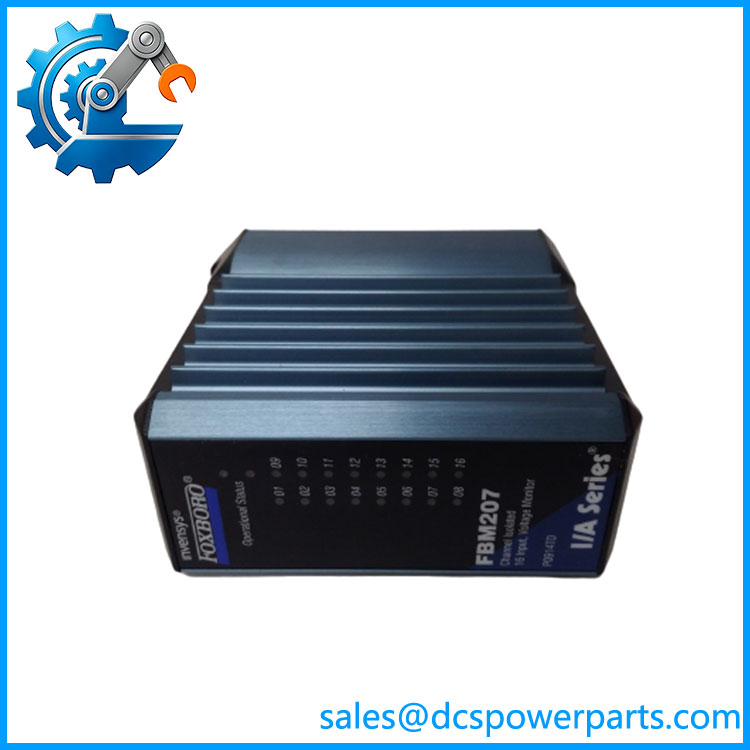
FBM207 P0914TD
Application Scenarios & Field Pitfalls — The Engineer’s Perspective
Engineering Pain Point
A discrete input problem in a Foxboro DCS is often blamed on the FBM before the field circuit and termination assembly are checked. With the , the module, termination assembly, cable, field supply, and configured input function form one signal path. A failed fuse, incorrect TA, broken termination cable, or unsuitable voltage source can produce symptoms that look like an FBM hardware failure.
Typical Applications
- Motor and equipment status monitoring — Starter auxiliary contacts, running/tripped indications, and equipment permissives.
- Valve and actuator feedback — Open/closed limit switches and discrete position contacts.
- Process switch monitoring — Pressure, level, flow, temperature, and other discrete process switches.
- Alarm and interlock inputs — Plant alarms, permissives, trips, and sequence-related discrete signals.
- Pulse counting — Applicable pulse signals can be processed at rates up to 250 Hz without missing pulses under the documented conditions.
Technical Pitfalls
- Do not classify as an analog input module. The OEM documentation identifies as a 16-channel discrete voltage monitor/contact-sense module. Several online listings incorrectly describe as an 8-channel analog input or RTD/thermocouple module.
- The termination assembly determines the field interface. Foxboro provides different TAs for 60 VDC, 120 VAC/125 VDC, and 240 VAC voltage-monitor applications. Higher-voltage inputs use additional signal conditioning, including attenuation and optical isolation.
- Do not confuse with FBM207b or FBM207c. The variants have different contact-sense excitation arrangements. Foxboro documentation identifies FBM207b with 24 VDC contact sensing and FBM207c with 48 VDC contact sensing.
- Check the input filter configuration. The documented filtering options are no filtering, 4, 8, 16, or 32 ms. This matters when monitoring mechanical contacts that exhibit contact bounce or when detecting relatively short pulses.
- Redundancy requires the correct baseplate arrangement. Redundant installations use adjacent odd/even baseplate positions such as 1/2, 3/4, 5/6, or 7/8.
- Cable length is not unlimited. Foxboro specifies termination-cable lengths up to 30 m (98 ft). Longer field wiring should be evaluated against the complete termination and signal-conditioning arrangement rather than assuming the standard installation limits still apply.
Related Products
- FOXBORO FBM207b P0914WH — Contact-sense variant using 24 VDC excitation.
- FOXBORO FBM207c P0917GY — Contact-sense variant using 48 VDC excitation.
- FOXBORO FCM — Associated Fieldbus Communication Module architecture.
- FOXBORO FCP — Associated Fieldbus Controller architecture.
- FOXBORO P0926ZY — Redundant adapter associated with -family installations.
- FOXBORO Modular Baseplate — Required mounting/backplane hardware for installation.
- FOXBORO FBM201 — Different FBM function; do not substitute based only on physical appearance.
- FOXBORO Termination Assemblies — Application-specific field termination hardware for voltage/contact inputs.
Procurement Note
For a replacement request, specify FOXBORO exactly. Do not purchase only by the generic “” designation when the installed unit is being replaced in an operating plant. Confirm the termination assembly part number, field-voltage class, cable type, baseplate position, redundancy arrangement, and configured input function before installation.
For used or refurbished inventory, inspect the 37-pin connector, mounting hardware, front indicators, housing, and module label. A power-on check alone is not sufficient for a critical DCS spare. Where practical, test representative channels with the correct termination assembly and verify discrete-state detection, filtering, pulse counting if required, and communication with the associated Foxboro control hardware.