Description
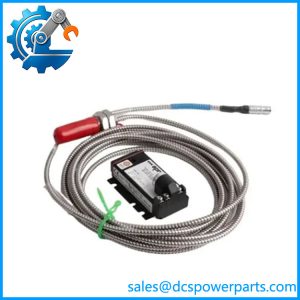
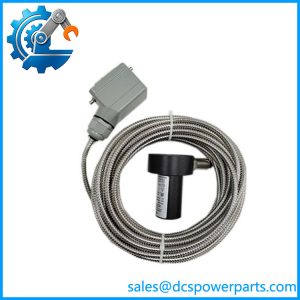
EPRO PR6424/011-140 | 16 mm Eddy Current Sensor | Turbine Shaft Vibration & Position Monitoring
Key Technical Specifications
| Parameter | Specification |
|---|---|
| Product Model | /011-140 |
| Manufacturer | EPRO / Emerson |
| Product Type | 16 mm Eddy Current Sensor |
| Measurement Principle | Non-contact eddy-current |
| Tip Diameter | 16.0 mm |
| Sensitivity | 4 V/mm (101.6 mV/mil) |
| Sensitivity/Linearity | ≤ ±1.5% |
| Static Position Range | ±2.0 mm |
| Dynamic Measurement Range | 0–1,000 μm peak-to-peak |
| Frequency Range | 0–20 kHz |
| Nominal Center Air Gap | Approximately 2.7 mm |
| Sensor Body Thread | M18 × 1.5 |
| Recommended Shaft Diameter | ≥80 mm |
| Target Material | Ferromagnetic steel |
| Operating Temperature | Up to 180°C for earlier specification; current specification lists -35°C to +150°C |
| Maximum Sensor Head Pressure | 10,000 hPa / 145 psi |
| Shock & Vibration | 5 g at 60 Hz, 25°C |
| Cable Material | PTFE |
| Required Converter | CON011, CON021, or CON041 depending on connector/interface configuration |
The current Emerson specification sheet gives the a -35°C to +150°C operating range, while earlier Emerson documentation specified -35°C to +180°C. For an installed legacy system, the actual sensor revision and environmental specification should therefore be checked rather than mixing ratings from different document generations.
Product Introduction
The EPRO /011-140 is a 16 mm eddy-current sensor designed for non-contact measurement of shaft movement in critical rotating machinery. It is used to monitor radial and axial displacement, shaft position, eccentricity, and vibration on steam turbines, gas turbines, hydro turbines, compressors, pumps, and fans. Its 4 V/mm sensitivity and 0–20 kHz frequency capability make it suitable for dynamic machinery-monitoring applications.
The EPRO /011-140 is a sensor rather than a complete monitoring channel. It requires a compatible EPRO signal converter, such as CON021, to provide the excitation and signal-conditioning interface. The converter selection, probe cable configuration, mechanical mounting, target material, and probe gap all affect the final measurement performance.
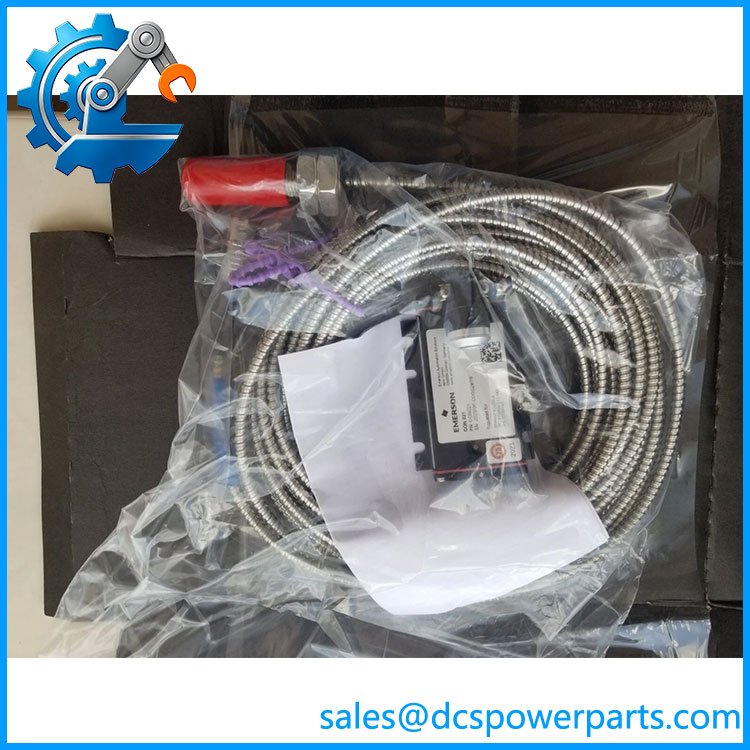
PR6424011-140
Application Scenarios & Field Pitfalls — The Engineer’s Perspective
Engineering Pain Point
A proximity-probe replacement can appear straightforward until the installed probe, extension cable, converter, mounting hardware, and monitoring rack are checked as one measurement chain. A probe with the same nominal diameter is not automatically a valid replacement if its sensitivity, cable length, connector, thread, or converter compatibility differs.
The is intended for large rotating shafts, with Emerson specifying a recommended shaft diameter of at least 80 mm. It is therefore commonly associated with large turbomachinery where shaft position and vibration measurements are part of the machine protection or condition-monitoring system.
Typical Applications
- Steam turbines — Radial shaft vibration and axial displacement monitoring.
- Gas turbines — Shaft position, eccentricity, and vibration measurement.
- Hydro turbines — Large-shaft displacement and vibration monitoring.
- Compressors and pumps — Non-contact shaft-motion measurement for rotating-equipment protection.
Technical Pitfalls to Avoid
1. The converter is part of the measurement system.
The does not operate as a conventional standalone 4–20 mA transmitter. Emerson specifies compatible signal converters including CON011, CON021, and CON041. Verify the converter before replacing the probe.
2. Set the probe gap correctly.
The nominal center air gap is approximately 2.7 mm. Probe positioning directly affects the operating point and available linear measurement range. Do not use a generic proximity-probe installation gap without checking the specific system documentation.
3. Confirm the target material.
The specified target is ferromagnetic steel, with 42 Cr Mo4 given as the standard target material in Emerson documentation. Changing shaft material or surface condition can affect the eddy-current response.
4. Check the cable length and connector.
The /011-140 configuration is a specific ordering variant, and complete systems can use different cable lengths and converter arrangements. A probe body that appears identical can still produce a different measurement chain if the cable configuration does not match.
5. Do not mix temperature ratings from different revisions.
Older documentation lists operation to 180°C, while the current Emerson specification sheet lists -35°C to +150°C. For a high-temperature turbine application, use the specification applicable to the exact sensor revision being purchased.
Related Products
- EPRO /011-140 + CON021 — Complete sensor and converter combination for measurement channels.
- EPRO CON021 — Eddy-current signal converter designed for PR6422, PR6423, , PR6425, and PR6426 sensor families.
- EPRO CON011 — Compatible signal-converter option for applicable configurations.
- EPRO CON041 — Screw-terminal converter option for applicable EPRO eddy-current sensor installations.
- EPRO /011-040 — Same 16 mm sensor family with a different ordering configuration; verify cable and connector details before substitution.
- EPRO PR6423 — 8 mm eddy-current sensor family intended for different mechanical installation requirements.
- EPRO PR6425 — 16 mm eddy-current sensor family designed for substantially higher temperature applications; not a direct substitute without checking the converter and mechanical requirements.
- EPRO PR6426 — Larger 16 mm-class eddy-current measurement family for specific shaft-position applications.
- EPRO MMS 6000 — Machinery monitoring platform commonly associated with EPRO measurement chains; verify the individual monitoring module and channel configuration.
Procurement note: For , match the complete ordering code, sensor thread, cable length, connector, converter type, and probe revision. If replacing an installed channel, keeping the existing probe/converter combination consistent is usually safer than selecting a replacement solely by probe diameter or sensitivity.