Description
Damcos MAS 2600 PDCR 941-1102-5 1381421
Product Overview
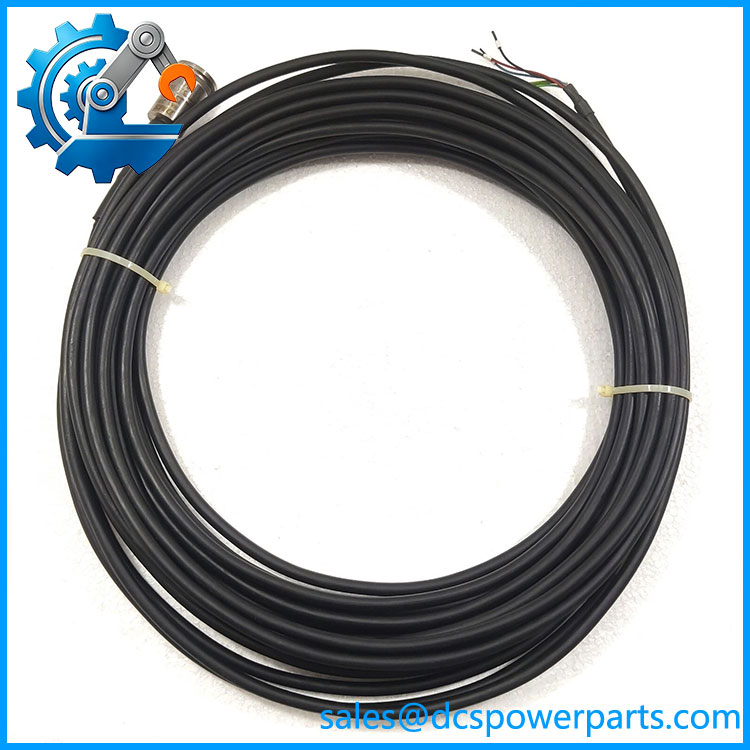
The Damcos MAS 2600 PDCR 941-1102-5 is part of a marine tank-level measurement system designed around hydrostatic pressure rather than radar or ultrasonic measurement. The MAS 2600 consists of a pressure transducer, amplifier, and interconnecting cable. The transducer uses a silicon micro-strain-gauge sensing element behind a welded isolation diaphragm, with the sensing assembly housed in titanium. Pressure generated by the liquid column changes the Wheatstone-bridge output, which is then converted by the amplifier into a conventional 4–20 mA signal. Damcos documentation identifies the system specifically for level measurement in ballast, oil, service, and fresh-water tanks.
The Damcos MAS 2600 PDCR 941-1102-5 belongs to a marine automation architecture rather than a conventional PLC sensor family. Its analog output can be integrated into a ship’s monitoring, alarm, automation, or tank-management system, while the submerged transducer provides the actual hydrostatic measurement. The MAS 2600 documentation specifies gauge and absolute transducer variants, optional Pt100 temperature sensing, programmable or differential amplifier versions, and multiple mounting arrangements. The transducer is rated IP68, while the amplifier enclosure is IP56.
For procurement, the critical point is the complete transmitter configuration. The PDCR 941-1102-5 designation identifies the transducer, but the MAS 2600 ordering structure separately defines transducer type, pressure range, temperature sensor, cable length, mounting, amplifier box, and amplifier PCB. A replacement pressure sensor that physically fits the installation can still be wrong if its pressure range or cable/configuration differs from the original. Public listings associate PDCR 941-1102-5 with MAS 2600 assemblies, including one listing showing a MAS 2600-G40-18-0/0P configuration, but this should be confirmed against the actual nameplate before treating those options as belonging to serial 1381421.
Product Introduction
Marine tank level measurement is unforgiving when the sensor range does not match the tank geometry. The MAS 2600 uses a submerged pressure transducer and converts hydrostatic head into a 4–20 mA signal, giving the ship’s automation system a straightforward analog measurement without requiring a separate radar transmitter.
The PDCR 941-1102-5 is therefore more than a generic pressure sensor. It is part of a configured MAS 2600 measurement chain, and the transducer range, venting arrangement, cable, amplifier settings, and tank-specific calibration all matter during a legacy replacement.
Key Technical Specifications
| Parameter | Specification |
|---|---|
| Product Model | Damcos MAS 2600 |
| Transducer Model | PDCR 941-1102-5 |
| Identification Number | 1381421 |
| Product Type | Tank contents / level transmitter |
| Measurement Principle | Hydrostatic pressure |
| Output | 4–20 mA DC |
| Electrical Configuration | 2-wire, loop-powered |
| Supply Voltage | 17–33 VDC |
| Transducer Material | Titanium Grade 2 housing |
| Diaphragm Material | Titanium Grade 4 |
| Transducer Protection | IP68 |
| Amplifier Protection | IP56 |
| Transducer Versions | Gauge / Absolute |
| Temperature Sensor | Optional Pt100 |
| Gauge Family Ranges | 0–3.5 / 0–7 / 0–16 / 0–35 mH₂O |
| Absolute Family Ranges | 0–20.394 / 0–35.690 mH₂O |
| Accuracy | ±0.25% F.S. at 20°C |
| Stability | Max. ±0.1% / year |
| Total Error Band | ±2.0% F.S. at −20 to +80°C |
| Overload Capability | Minimum 4× transducer range without calibration change |
| Burst Pressure | 6× transducer range |
| Amplifier Temperature | −20 to +80°C |
| Standard Cable Temperature | −20 to +80°C |
| High-Temperature Cable | −20 to +125°C in safe-area applications |
| Hazardous-Area Classification | Ex ia IIC T4 documented for applicable configuration |
| Marine Type Approvals | DNV, GL, LRS, MRS, BV, RINA, KRS, ABS, PRS |
The pressure range shown above is the MAS 2600 family range, not a claim that every listed range belongs to the specific PDCR 941-1102-5 / 1381421 unit. The exact installed range must be taken from the sensor nameplate or original tank-system documentation.
MAS 2600
Major Features / Practical Advantages
Hydrostatic Tank-Level Measurement
The MAS 2600 measures liquid level indirectly through hydrostatic pressure. This approach is particularly appropriate for shipboard ballast and service tanks where the sensor can be installed at a low point and the pressure head represents liquid height. The manual specifically describes the measurement as the liquid height between the diaphragm and the liquid surface, with vent-pipe height also affecting gauge-transmitter selection.
Titanium Wetted Construction
The transducer uses a titanium housing and titanium diaphragm. That construction is significant in marine service because the sensor may be exposed to seawater, tank liquids, and corrosive environments. The transducer is fully welded, and the documented construction uses a sealed sensing element behind the isolation diaphragm.
Conventional 4–20 mA Integration
The MAS 2600 produces a 4–20 mA DC, two-wire loop-powered output, making it straightforward to integrate into marine automation, tank monitoring, alarm, and control systems. The transmitter supply range is documented as 17–33 VDC, with loop-load limitations determined by the available supply voltage.
Programmable Measurement Range
The programmable MAS 2600 amplifier can divide a selected transducer range into multiple usable sub-ranges. For the gauge transmitter, Damcos documents four basic transducer ranges and eight selectable measurement ranges where applicable. This means the transmitter’s physical pressure range and its configured 4–20 mA measurement range should be considered separately during replacement.
Gauge and Absolute Versions
The MAS 2600 architecture supports both gauge and absolute measurement. Gauge versions compensate atmospheric pressure through a breather arrangement, while absolute versions reference vacuum internally and are particularly useful where the amplifier may be exposed to flooding or open-deck conditions.
Marine Certification
The documented MAS 2600 family carries approvals from several marine classification organizations, including DNV, GL, LRS, BV, RINA, KRS, ABS, and PRS. Hazardous-area use is also documented for applicable configurations under Ex ia IIC T4. The approval status of an individual replacement should still be checked against its nameplate and certificate configuration rather than assumed from the product family alone.
Long Cable Installation
The MAS 2600 supports relatively long transducer-to-amplifier cable runs. The 2017 documentation specifies up to 300 m in safe-area applications, while hazardous-area installations have shorter limits depending on standard or high-temperature cable. This is important when replacing a sensor on an existing vessel because cable length and hazardous-area installation constraints can affect the permissible configuration.
Related Products
- Damcos MAS 2600-G40-18-0/0P — A documented MAS 2600 assembly configuration associated in public surplus records with the PDCR 941-1102-5 designation; verify the physical nameplate before using it as an exact replacement reference.
- Damcos MAS 2600-G30-10-0/0P — Gauge MAS 2600 configuration using the 16 mH₂O transducer family and a 10 m cable.
- Damcos MAS 2600-G20-05-0/0P — Gauge configuration associated with the 7 mH₂O transducer family and 5 m cable.
- Damcos MAS 2600-G30-15-0/0P — Gauge configuration using the 16 mH₂O range with a 15 m cable.
- Damcos MAS 2600-G40-05-0/0P — Gauge configuration using the 35 mH₂O range with a 5 m cable.
- Damcos MAS 2600-G20-25-0/0P — Gauge configuration using the 7 mH₂O range with a 25 m cable.
- Damcos PT100 Temperature Sensor — Optional temperature measurement arrangement available with applicable MAS 2600 transducers.
- Damcos G022P013 — Associated tank-level installation hardware referenced in MAS 2600 documentation.
The MAS 2600 ordering system makes these configurations materially different for replacement purposes. Similar-looking model strings should not be treated as interchangeable without checking the transducer range, cable, mounting, and amplifier configuration.
FAQ
What is the Damcos MAS 2600 used for?
It is a hydrostatic tank-contents transmitter for marine applications, particularly ballast, oil, service, and fresh-water tanks. The system converts pressure at the submerged transducer into a 4–20 mA level signal.
Is PDCR 941-1102-5 the complete MAS 2600 transmitter?
No. The MAS 2600 architecture consists of the pressure transducer, cable, and amplifier. PDCR 941-1102-5 refers to the transducer identification used with MAS 2600 assemblies. Public records also show the designation paired with a complete MAS 2600 configuration.
What pressure range does PDCR 941-1102-5 have?
This is one area where public records conflict. One commercial record identifies PDCR/PDCK 941-1102-5 as a 3.5 bar gauge transducer, while another complete MAS 2600 listing pairs the same transducer designation with G40, which corresponds to the 35 mH₂O gauge family range in the MAS 2600 ordering system. The original nameplate or ship documentation should therefore be used to establish the exact range for serial 1381421 rather than assuming either value.
Can I connect the MAS 2600 directly to a PLC or DCS?
Yes, at the signal level. The MAS 2600 provides a standard 4–20 mA two-wire output suitable for an analog input channel. The engineering range configured in the transmitter must match the PLC/DCS scaling. A correct electrical loop with incorrect level scaling is still a bad replacement.
Can I hot-swap the PDCR transducer?
No hot-swap procedure should be assumed. The transducer is part of a pressure measurement installation and may be mounted inside a tank or connected through a marine tank fitting. Isolate the measurement loop and follow vessel-specific isolation, tank-entry, and permit procedures before removal.
Does the MAS 2600 support firmware v3.1?
The available MAS 2600 documentation describes programmable amplifier settings, dip switches, potentiometers, calibration, and fixed/differential amplifier configurations, but it does not establish a firmware designation such as v3.1 for this transmitter. Do not transfer firmware information from unrelated Damcos equipment.
Can I replace only the PDCR 941-1102-5 sensor?
Potentially, but the complete measurement chain must be checked. Transducer range, gauge versus absolute construction, cable length/type, amplifier configuration, mounting arrangement, and calibration all affect compatibility. If the existing amplifier is retained, the replacement transducer must match its electrical and measurement requirements.
What does serial number 1381421 tell me?
1381421 should be treated as a unit identification/serial reference unless the original Damcos documentation confirms another meaning. It should not be interpreted as an ordering-code suffix or pressure-range indicator.
Procurement Note
For a legacy Damcos MAS 2600 PDCR 941-1102-5, the most important procurement check is the complete installed configuration, not just the sensor part number.
Before ordering a replacement, record:
- PDCR/PDCK transducer marking exactly as printed.
- Serial number — including 1381421 if this is the unit being replaced.
- Gauge or absolute version.
- Transducer pressure range.
- Cable length and cable type.
- Amplifier box configuration.
- Amplifier PCB type — programmable or differential.
- Mounting arrangement.
- Hazardous-area approval requirements.
- Existing 4–20 mA scaling and calibration.
The MAS 2600 manual explicitly states that systems can be configured for individual deliveries, so assuming two MAS 2600 units are identical from the family name alone is not good procurement practice.
For New Surplus, verify the actual nameplate and included transducer/cable/amplifier assembly. For Used or Refurbished equipment, request a loop-output test and pressure/calibration evidence where the transmitter is going back into service-critical tank monitoring. A transmitter can produce a clean 4–20 mA signal and still have an incorrect pressure range or calibration.