Description
Product Overview
The Fireye 85UVF1-1CEX is an integrated ultraviolet flame scanner in the Phoenix Series 2 family. It is designed for flame supervision in industrial combustion equipment, including burners, boilers, and furnace applications. The scanner uses a solid-state UV sensor to detect flame radiation and analyze the modulation characteristics associated with combustion. Its internal microprocessor evaluates the detected flame signal and operates an integrated flame relay according to the configured flame-detection criteria. This arrangement eliminates the need for a separate remote flame amplifier or flame switch in the documented installation.
The Fireye 85UVF1-1CEX uses a CEX-rated enclosure intended for specified hazardous locations. The product documentation identifies IP66 protection and ATEX/IECEx approval for the applicable model. The enclosure approval is particularly important in installations where combustible gases or dust may be present. Certification must be checked against the actual hazardous-area classification, gas or dust group, temperature class, and local regulatory requirements. An approval for one hazardous-area category does not automatically authorize installation in every classified location.
For maintenance and replacement work, the Fireye 85UVF1-1CEX should be selected according to the original scanner model, burner geometry, flame characteristics, mounting arrangement, and flame-safeguard control system. The UVF designation identifies an ultraviolet model; it should not be confused with IRF infrared scanner variants. The CEX housing also differs from the QD quick-disconnect versions. Before installation, verify the mounting flange, wiring arrangement, relay interface, and approved scanner-to-burner sight line. Commissioning must include flame-on and flame-off tests under the applicable burner safety procedure.
Product Introduction
A flame scanner must distinguish the intended burner flame from background radiation, ignition activity, and other combustion sources. Incorrect scanner selection or alignment can result in nuisance flame failures or, more seriously, unreliable flame supervision.
The 85UVF1-1CEX combines UV sensing with an internal flame relay in a hazardous-area enclosure. Replacement work should verify the original scanner technology, enclosure approval, mounting geometry, and burner-control compatibility before the unit is placed into service.
Key Technical Specifications
| Parameter | Specification |
|---|---|
| Product Model | 85UVF1-1CEX |
| Manufacturer | Fireye |
| Product Family | Phoenix Series 2 |
| Scanner Type | Type 85UVF |
| Product Function | Integrated UV Flame Scanner |
| Detection Technology | Solid-state ultraviolet sensor |
| Flame Relay | Internal |
| Flame Signal Processing | Microprocessor-based |
| Flame Amplifier | Integrated configuration; separate amplifier not required |
| Housing Material | Painted aluminum |
| Housing Protection | IP66 |
| Hazardous-Area Approval | ATEX / IECEx, model-specific |
| Flame Relay Contact Rating | Up to 230 VAC, per Fireye system-component reference |
| Connector | CEX housing configuration; not the 8-pin QD version |
| Weight | Approximately 4.3 kg |
| Installation | Burner or furnace scanner mounting arrangement |
| Supply Voltage | Verify exact wiring diagram and scanner revision |
| Power Consumption | Not independently verified |
| UV Spectral Range | Refer to the manufacturer’s sensor response documentation |
| Operating Temperature | Verify against the applicable CEX installation documentation |
| Safety Integrity | Fireye documentation identifies the 85 Series as suitable for applications up to SIL 3, subject to the safety-system design and applicable conditions |
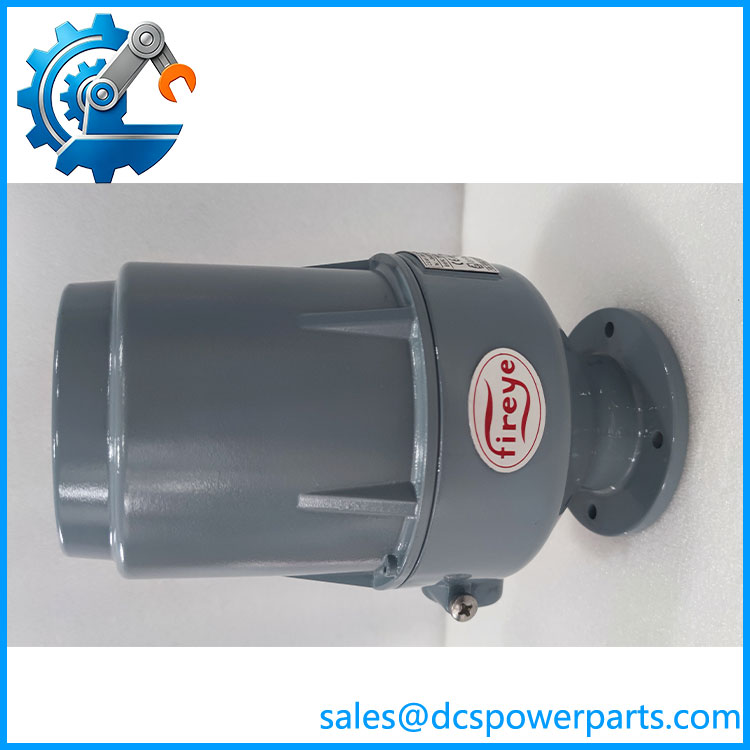
85UVF1-1CEX
Major Features and Advantages
Ultraviolet flame detection
The 85UVF1 uses UV sensing to detect combustion-related radiation. This provides a different detection method from infrared flame scanners. The correct sensor technology must be selected according to the fuel, burner design, flame characteristics, and potential background radiation.
Integrated flame relay
The scanner contains its own flame relay and microprocessor-based signal processing. The documented design automatically establishes flame ON/OFF thresholds during setup, reducing the need for a separate flame amplifier or external flame switch.
Automatic flame discrimination setup
During the setup procedure, the scanner stores the detected target-flame modulation characteristics and establishes suitable ON/OFF criteria. Correct setup is essential: the scanner must be aimed at the intended flame and tested under actual burner operating conditions.
CEX hazardous-area enclosure
The 85UVF1-1CEX uses a CEX enclosure intended for approved hazardous-area applications. The product documentation identifies IP66 protection and ATEX/IECEx approval. Verify the exact marking on the nameplate before installation; enclosure certification must match the site’s area classification.
Microprocessor-based supervision
The integrated electronics analyze the detected flame signal and control the internal relay. This provides a self-contained scanner architecture, but does not eliminate the need for periodic inspection, functional testing, and burner safety-system validation.
Safety-system application
Fireye documentation identifies the 85 Series Phoenix scanners as suitable for applications up to SIL 3 based on the cited FMEDA assessment. This is not a standalone guarantee that an entire burner management system achieves SIL 3. The complete safety loop, including logic solver, wiring, final elements, proof testing, and installation conditions, must meet the required safety assessment.
nexinstrument.com+1
Related Products
- 85UVF1-1CEX-K3 – Related UV scanner variant with the K3 option; confirm coating and environmental requirements.
- 85UVF1-1QD – UV flame scanner with quick-disconnect configuration and different enclosure approvals.
- 85UVF1-2QD – UV scanner variant with a different configuration code.
- 85UVF1-1QDK3 – UV scanner with quick-disconnect and K3 option.
- 85IRF1-1CEX – CEX infrared flame scanner; different sensing technology.
- 85IRF1-2QD – Infrared scanner with quick-disconnect configuration.
- 85UVF4-1QDWR – UV scanner variant for a different application and connection arrangement.
- E110 – Fireye flame safeguard control used in certain scanner system configurations.
These products belong to related Fireye flame-scanner and burner-control families. They are not automatic substitutes for the 85UVF1-1CEX.
Frequently Asked Questions
Q1: What is the Fireye 85UVF1-1CEX used for?
It is used to monitor ultraviolet radiation from burner flames in industrial combustion equipment. Its integrated electronics evaluate the flame signal and operate an internal flame relay.
Q2: What is the difference between 85UVF and 85IRF?
The 85UVF series uses ultraviolet flame detection, while the 85IRF series uses infrared detection. The correct technology depends on the burner, fuel, flame characteristics, and potential background radiation. They should not be substituted without an application review.
Q3: Does the 85UVF1-1CEX require a separate flame amplifier?
The integrated Phoenix scanner design includes internal signal processing and a flame relay, eliminating the need for a separate external flame amplifier or flame switch in the documented configuration.
Q4: Can I hot-swap the 85UVF1-1CEX?
No hot-swap assumption should be made for a burner flame safeguard device. Follow the burner management system’s approved shutdown and isolation procedure. Never remove or replace the scanner while relying on it to maintain an active combustion safety function.
Q5: Does the 85UVF1-1CEX support firmware v3.1?
A specific firmware v3.1 compatibility statement has not been verified. Confirm the scanner revision and the applicable Fireye setup and configuration documentation. Do not apply software or configuration intended for another scanner variant without manufacturer confirmation.
Q6: Is the 85UVF1-1CEX suitable for hazardous areas?
The CEX model is listed with ATEX/IECEx hazardous-area approvals and IP66 protection. The exact nameplate marking must be checked against the site’s hazardous-area classification before installation.
Q7: What should be tested before returning a replacement scanner to service?
Inspect the enclosure and mounting interface, verify the wiring and relay circuit, confirm scanner alignment, and carry out the prescribed flame-on and flame-off tests. Test the burner management system’s response to loss of flame under the approved safety procedure.
Procurement and Quality Inspection Notes
Before purchasing a Fireye 85UVF1-1CEX, verify:
- Exact model number and nameplate markings.
- UVF sensor type rather than IRF.
- CEX enclosure configuration.
- Applicable ATEX/IECEx certification and temperature class.
- IP66 enclosure condition and sealing surfaces.
- Mounting flange and burner sight-line compatibility.
- Internal flame relay operation.
- Electrical wiring and contact-rating requirements.
- Scanner setup and flame-discrimination test results.
- Traceable inspection and functional-test documentation.
Critical safety note: A flame scanner is part of a combustion safeguard system. A replacement should never be accepted solely on the basis of matching model numbers or a successful power-up. Verify flame detection, flame-failure response, relay behavior, and the complete burner safety sequence before returning equipment to operation.