Description
Key Technical Specifications
| Parameter | Specification |
|---|---|
| Manufacturer | Woodward |
| Model | 9907-029 |
| Product Series | SPM-A |
| Product Type | Automatic Synchronizer |
| Main Function | Generator frequency, phase, and voltage matching |
| Operating Frequency | 50/60 Hz |
| AC Supply Voltage | 115 or 230 VAC |
| Supply Voltage Tolerance | ±10% |
| Power Consumption | 5 W (verify against nameplate revision) |
| Phase Angle Limit | ±10° |
| Voltage Matching Accuracy | Approximately 1% |
| Voltage Inputs | Generator and bus voltage sensing |
| Frequency Inputs | Generator and bus frequency sensing |
| Speed Bias Output | Governor speed adjustment |
| Voltage Bias Output | Voltage regulator adjustment |
| Breaker Control | Synchronizing relay output |
| Adjustment Parameters | Phase offset, voltage offset, gain, stability |
| Connection Type | Screw-clamp terminals |
| Installation | Electrical control cabinet |
| Operating Frequency Standard | 50/60 Hz power systems |
The 9907-029 is an SPM-A synchronizer with voltage-matching capability. Confirm terminal assignments, electrical input configuration, and output characteristics against the exact hardware revision before wiring.
Product Introduction
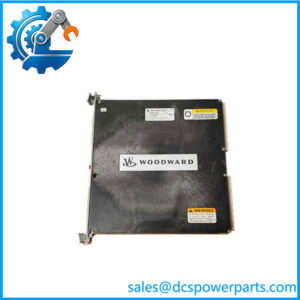
Woodward 9907-029 SPM-A Synchronizer
The Woodward 9907-029 is an SPM-A automatic synchronizer designed for generator-to-generator and generator-to-utility-bus paralleling. It monitors generator and bus voltage signals, compares frequency and phase angle, and adjusts engine speed through the governor interface. Its voltage-matching function provides a 1% matching tolerance before the breaker-closing conditions are satisfied.
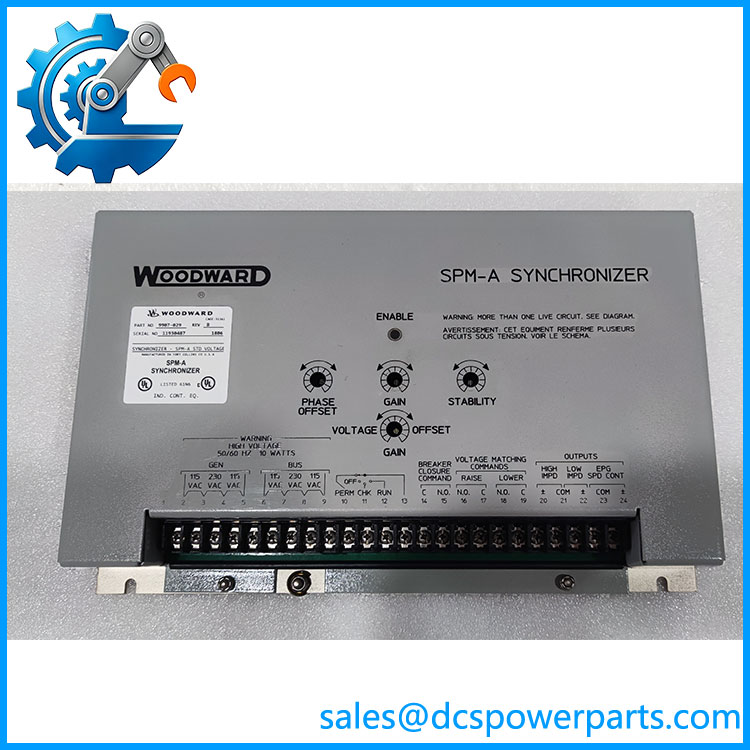
9907-029
For power plants and industrial generation facilities, the module helps coordinate generator connection without relying solely on manual synchronization. Its adjustable dynamics accommodate different prime-mover characteristics, including diesel engines and larger turbine installations.
Application Scenarios & Field Pitfalls (The Engineer’s Perspective)
Engineering Pain Point
A standby generator may reach rated speed and voltage but still fail to synchronize with an energized bus. Even a small frequency or phase difference can prevent breaker closure. In a power station operating multiple generator sets, this can delay load transfer and complicate recovery after an unexpected generator trip.
The Woodward 9907-029 addresses this problem through automatic frequency, phase, and voltage matching. It sends speed-correction signals to the governor and voltage raise/lower commands to the generator regulator. Breaker closure is permitted only when the required synchronization conditions are met.
Typical Applications
- Power Generation: Synchronization of diesel generator sets before connection to a common electrical bus.
- Oil and Gas: Generator paralleling in refinery utility systems and offshore power-generation installations.
- Marine Engineering: Synchronization of auxiliary diesel generators in shipboard electrical distribution systems.
- Industrial Manufacturing: Automatic synchronization of captive power generators with utility supplies.
- Gas and Steam Turbine Facilities: Frequency and phase matching during generator startup and grid-paralleling operations.
Technical Pitfalls to Avoid
1. Incorrect Voltage Input Configuration
The SPM-A uses generator and bus voltage sensing inputs. The documented input ratings are 115 or 230 VAC RMS, with a ±10% tolerance.
Do not assume that the existing voltage-transformer secondary wiring is correct simply because the replacement has the same part number. Verify the transformer ratios, phase connections, grounding arrangement, and terminal assignments against the installation drawings.
2. Governor Output Compatibility
The SPM-A supports three output configurations:
- High impedance: Woodward 2301 load-sharing controls.
- Low impedance: Woodward 2301A, 2500, and compatible EPG configurations through a generator load sensor.
- EPG output: EPG controls without load sharing.
Selecting the wrong output arrangement can cause incorrect speed-bias behavior or poor synchronization response. Check the original governor model and output configuration before commissioning.
3. Voltage Matching Calibration
The 9907-029 provides 1% voltage matching. Its voltage-offset adjustment is factory calibrated and should not be changed casually.
Woodward’s installation manual specifically warns that incorrect voltage-offset adjustment can cause the voltage regulator to drive in the wrong direction. This can move generator voltage farther away from the bus voltage and create serious operating problems.
4. Breaker Closing and Dwell-Time Settings
The synchronizer provides internally selectable matching dwell times of 1/8, 1/4, 1/2, and 1 second. The factory default is 1/2 second.
Check the existing dwell-time setting and breaker operating time. A replacement with different internal settings may change synchronization behavior.
5. Safe Commissioning Procedure
Use the CHECK operating mode during initial testing. This mode permits synchronization and voltage matching without issuing a breaker-closing command.
Verify frequency, phase angle, voltage matching, and ENABLE indication before permitting normal RUN operation. Never use an unverified synchronizer as the only protection against an incorrect breaker-closing event.
Engineering reference: Woodward SPM-A Installation and Operation Manual 82384, Revision U.
Related Products
The following models and control components are relevant to the Woodward SPM-A generator synchronization architecture.
1. Woodward 9907-028 – SPM-A synchronizer without voltage-matching capability. It supports 50/60 Hz operation and a ±10° phase window. Suitable when generator voltage matching is handled separately by the excitation control system.
2. Woodward 9905-002 – SPM-A synchronizer specification counterpart to the 9907-029. The Woodward technical manual groups these two part numbers under the same 50/60 Hz, ±10° phase-angle, 1% voltage-matching configuration. Verify physical revision and terminal details before considering interchangeability.
3. Woodward 9905-001 – SPM-A synchronizer without voltage matching. Provides frequency and phase synchronization for installations where voltage regulation is managed independently.
4. Woodward 9905-003 – SPM-A synchronizer with 5% voltage-matching capability and a ±10° phase window. Its voltage-matching tolerance differs substantially from the 9907-029.
5. Woodward 9905-005 – SPM-A synchronizer with 1% voltage matching and a narrower ±5° phase window. Relevant to installations requiring a tighter phase-angle acceptance window.
6. Woodward 2301 – Electronic load-sharing and speed-control system. The SPM-A high-impedance output configuration is intended for compatible 2301 installations.
7. Woodward 2301A – Electronic load-sharing and speed-control family supporting generator speed regulation and load sharing. The SPM-A can use its low-impedance output configuration when the specified interface arrangement is installed.
8. Woodward 2500 – Governor/load-sharing control used in compatible generator synchronization architectures. The SPM-A low-impedance output supports specified 2500 configurations.
9. Woodward EPG – Electrically Powered Governor control. The SPM-A provides a dedicated EPG output option for installations without load-sharing sensing.
10. Woodward Generator Load Sensor – Supporting component used in certain governor and load-sharing arrangements. It is relevant when integrating the SPM-A low-impedance output with compatible control configurations.
Compatibility warning: The 9907-028 is not an equivalent replacement because it lacks voltage matching. The 9905-002 is the closest documented specification counterpart to the 9907-029, but the complete hardware revision and wiring configuration must still be checked.
Procurement and quality-control note
The Woodward 9907-029 is a legacy SPM-A synchronizer, and replacement availability may be limited.
For surplus procurement, request:
- Complete nameplate photograph showing 9907-029 and revision.
- Confirmation of 115/230 VAC input configuration.
- Inspection of screw-clamp terminals and internal condition.
- Functional verification of frequency and phase matching.
- Verification of voltage raise/lower relay operation.
- Breaker-close relay contact testing.
- Confirmation of the selected governor output configuration.
Important: A basic power-up test does not prove synchronization accuracy. For critical generator applications, request a documented functional test covering both synchronization and voltage-matching functions.