Description
Product Introduction
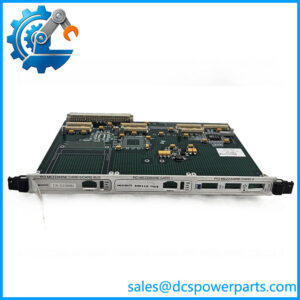
The BACHMANN MP226/EW is an industrial processor/controller module used within Bachmann automation systems, with particular relevance to wind-energy control equipment. The available industry catalogs consistently place the MP226/EW in the processor/controller category. One component catalog specifically identifies MP226/EW — 0001444-00 as a Bachmann Processor Module.
The module is intended to provide the central computing function of a modular control architecture, coordinating application logic and communicating with associated I/O, communication, and interface modules. This makes it substantially different from Bachmann’s DI, DO, analog, CAN, or bus-interface modules. A wind-energy repair-manufacturer reference also lists the MP226/EW specifically as a controller, supporting its use in turbine control equipment.
There is conflicting technical information in secondary sources regarding the exact processor architecture, memory size, operating system, interfaces, and electrical specifications. For example, one recent listing claims an Intel Core i7 processor and DDR3 memory, while another claims a 64-bit ARM processor. These descriptions cannot both be treated as authoritative for the same hardware.
For engineering documentation, I therefore recommend identifying the unit as Bachmann MP226/EW Processor/Controller Module and avoiding unsupported CPU, RAM, voltage, and communication specifications unless they are confirmed from the actual nameplate or Bachmann documentation.
Technical Specifications
| Parameter | Specification |
|---|---|
| Manufacturer | Bachmann electronic GmbH |
| Model | MP226/EW |
| Product Type | Processor / Controller Module |
| Part Number | 0001444-00 |
| System Family | Bachmann M1 automation platform |
| Primary Function | Control processing |
| Application | Industrial automation / wind turbine control |
| Controller Architecture | Configuration-dependent |
| Memory | Configuration-dependent |
| Ethernet | Configuration-dependent |
| Serial Interfaces | Configuration-dependent |
| Operating System | Configuration-dependent |
| Supply Voltage | Verify against installed hardware |
| Operating Temperature | Verify against system documentation |
| Mounting | Bachmann modular system |
| Hardware Revision | Must be verified |
The 0001444-00 association is supported by multiple industry component catalogs.
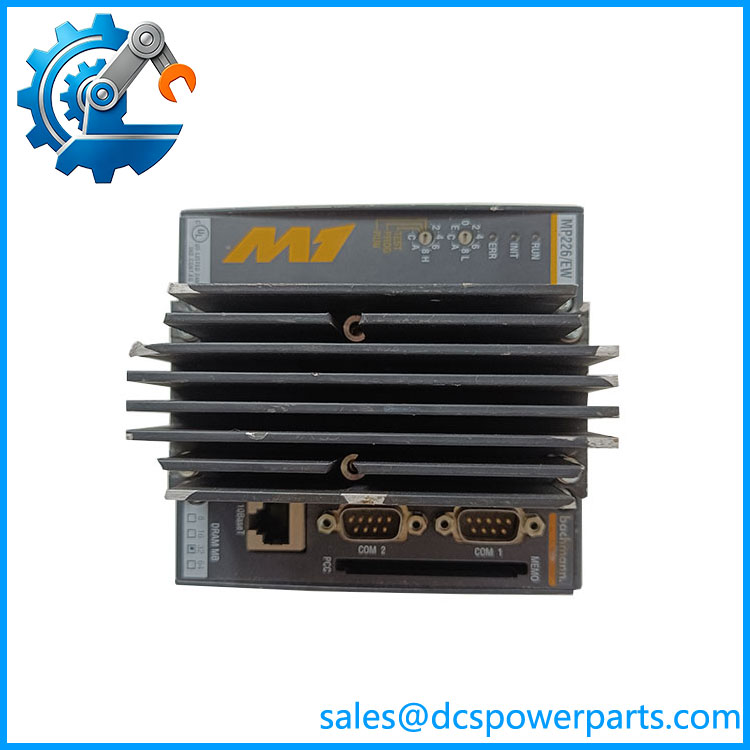
MP226EW
Main Features and Engineering Considerations
Central Control Processing
The primary purpose of the is control processing within a modular Bachmann automation system. It provides the computational layer required to execute the installed control application and coordinate connected modules.
Wind-Turbine Applications
The model appears repeatedly in wind-energy equipment catalogs. It is listed alongside Bachmann I/O, communication, power-supply, and bus modules used in wind-turbine control systems.
This makes the /EW particularly relevant to maintenance of older turbine-control cabinets where replacing the complete controller architecture would be considerably more disruptive than maintaining the existing Bachmann hardware.
Modular System Architecture
The /EW should be evaluated together with the associated Bachmann rack/backplane, I/O modules, communication modules, power supply, firmware, and application software. It should not be treated as an independent industrial PC.
Legacy Replacement
For an older installation, the key procurement question is not simply whether the replacement powers up. The controller must be compatible with the installed application image, firmware environment, I/O configuration, and system revision.
Typical Application Areas
The BACHMANN /EW may be encountered in:
- Wind turbine control systems
- Industrial automation equipment
- Modular machine-control systems
- Energy-generation control equipment
- Legacy Bachmann M1 installations
- Turbine retrofit and maintenance projects
- Industrial controller replacement programs
The model is specifically included in wind-energy component references as a Bachmann controller.
Engineer’s Guide: Field Pitfalls
⚠️ Do not assume the processor specification from reseller pages.
Online sources disagree on whether the /EW uses an Intel-based or ARM-based processor. Those claims should not be used as procurement specifications.
⚠️ Verify the complete part number.
Use:
BACHMANN /EW
Part No. 0001444-00
The 0001444-00 association is independently listed in industrial component catalogs.
⚠️ Firmware matters.
For a processor/controller replacement, firmware and application compatibility can be more important than physical compatibility. A controller with different firmware may boot correctly but fail to execute the installed turbine-control application.
⚠️ Check the complete M1 configuration.
Verify the installed I/O modules, communication modules, backplane, power supply, and application software before approving substitution.
⚠️ Test the controller at application level.
A basic power-on test is insufficient. A proper replacement test should include boot diagnostics, controller operation, communication with the rack, I/O exchange, watchdog behavior, and execution of the relevant control application.
Frequently Asked Questions
What is BACHMANN /EW?
It is a Bachmann industrial processor/controller module, commonly encountered in automation and wind-turbine control systems.
What is the part number for /EW?
Several industrial catalogs identify 0001444-00 as the part number associated with /EW.
Is /EW an I/O module?
No. The available component catalogs classify it as a Processor Module / Controller, distinguishing it from Bachmann DI, DO, analog, CAN, and interface modules.
Is /EW used in wind turbines?
Yes. It appears in wind-energy equipment component catalogs and repair references as a Bachmann controller.
What should be verified before purchasing?
- 0001444-00
- Hardware revision
- Firmware version
- Installed application
- Bachmann rack/backplane type
- Connected I/O modules
- Communication configuration
- Power-supply arrangement
- Controller-level functional test
For a used or refurbished , I would request a boot test plus communication and application-level test, not merely confirmation that the CPU powers on.