Description
Acquisition Logic AL81G | High-Speed Data Acquisition Board | 1 GS/s Data Capture
Key Technical Specifications
| Parameter | Specification |
|---|---|
| Product Model | AL81G |
| Manufacturer | Acquisition Logic |
| Product Type | High-speed data acquisition / ADC board |
| Channel Count | 1 analog channel |
| Maximum Sampling Rate | Up to 1 GS/s |
| Resolution | 8-bit |
| Input Bandwidth | Approximately 100 MHz |
| Onboard Memory | 64 MSamples |
| Board Type | PCI plug-in acquisition board |
| Primary Function | High-speed transient waveform capture |
| Application Class | Test, measurement, transient analysis |
The published AL81G specifications consistently center around 1 GS/s sampling, 8-bit resolution, 100 MHz bandwidth, and 64 MSamples of acquisition memory. One technical listing also gives a 1 MΩ / 15 pF input characteristic, although this should be confirmed from the actual hardware revision before using it for signal-interface design.
Specification Conflict Warning
Some current listings incorrectly describe AL81G as an industrial controller, communication module, multi-channel analog I/O device, or 220 V industrial module. Other pages publish unsupported values such as 12 VDC or 24 VDC supply, RS-485/CAN interfaces, 5 A output current, or IP65 protection. These claims conflict with the more consistent identification of the AL81G as a high-speed acquisition PCB and should not be used for engineering design.
Product Introduction
The Acquisition Logic AL81G is a high-speed analog data-acquisition board intended for capturing rapidly changing electrical signals. Its published architecture centers on a single high-speed ADC channel capable of sampling at up to 1 GS/s, allowing transient and waveform information that would be missed by conventional low-speed industrial analog-input modules to be recorded.
The board is better understood as test and measurement hardware rather than a PLC/DCS signal-conditioning module. Its combination of high sampling speed, approximately 100 MHz input bandwidth, and onboard acquisition memory makes it more appropriate for transient waveform analysis, electronic testing, high-speed sensor measurements, and laboratory or industrial diagnostic systems.
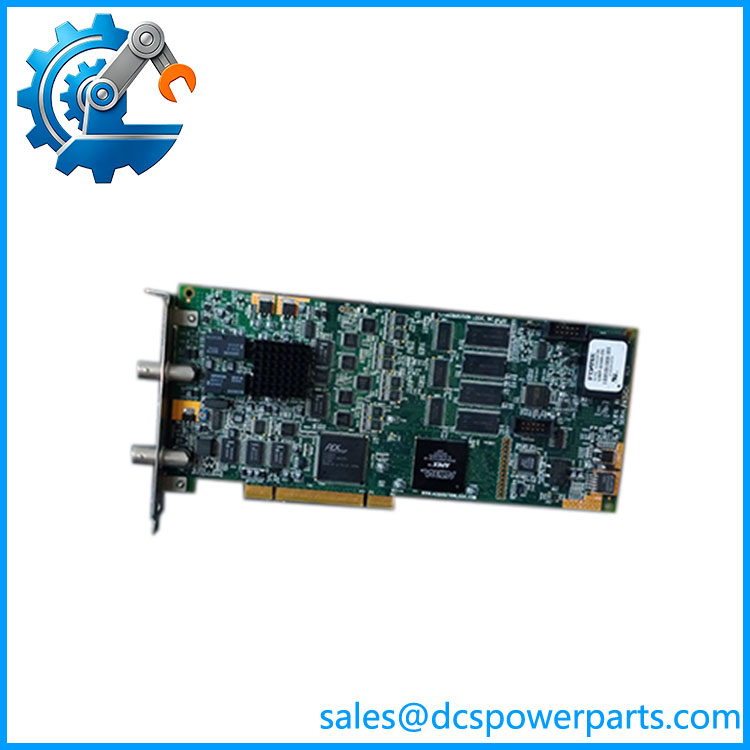
AL81G
Application Scenarios & Field Pitfalls — Engineer’s Perspective
Engineering Pain Point
The biggest issue with procurement is misclassification. A conventional PLC analog-input module is designed around process signals such as 4–20 mA or 0–10 V, while the is intended for substantially faster waveform acquisition. Selecting the wrong hardware based on a generic “data acquisition module” description can result in a completely different electrical interface.
Typical Applications
- Transient Signal Capture — recording fast electrical events that require high sampling rates.
- Waveform Analysis — capturing analog waveforms for engineering diagnostics and measurement.
- Electronic Test Systems — integrating high-speed ADC acquisition into a PCI-based test platform.
- Industrial Condition Testing — investigating fast-changing signals that cannot be adequately represented by standard PLC scan-based analog inputs.
- Research and Development — high-speed measurement where waveform fidelity is more important than conventional process-I/O density.
Technical Pitfalls to Avoid
- Do not treat as a standard PLC analog-input card.
Its published architecture is a single-channel high-speed digitizer, not a multi-channel 4–20 mA/0–10 V process-input module. - Verify the host computer/bus architecture.
Available documentation describes as a PCI plug-in board. A replacement therefore needs to match the host acquisition chassis or industrial computer, operating environment, driver stack, and application software. - Do not assume the advertised 1 GS/s figure equals usable measurement bandwidth.
Sampling rate and analog bandwidth are different specifications. The published information gives approximately 100 MHz input bandwidth, so the complete signal path—including probe, cable, front-end conditioning, and acquisition software—must be considered. - Match the hardware revision.
Repair documentation specifically shows an . When replacing a board in an existing acquisition system, compare revision markings and connector layout rather than relying only on the generic designation.
Related Products
- — documented PCB revision encountered in repair/replacement applications.
- AL8xG Series — high-speed Acquisition Logic board family associated with the .
- High-Speed PCI ADC Boards — same general hardware category; selection depends on sampling rate, bandwidth, resolution, and host-bus requirements.
- Transient Data Acquisition Systems — broader application class for capturing fast electrical events.
- Industrial PCI Measurement Hardware — host-computer-based acquisition architecture rather than conventional PLC I/O.
- Oscilloscope/Digitizer Platforms — alternative architecture when waveform visualization, triggering, and measurement functions are required.
Procurement Note
For an Acquisition Logic , specify the complete model and, where visible, the PCB revision. Verify the PCI host architecture, single-channel configuration, sampling requirement, input bandwidth, memory capacity, driver/software compatibility, and connector arrangement before purchasing.
Do not accept listings that describe as an ABB module, generic PLC controller, communication card, or high-current power module. The available evidence supports its identification as an Acquisition Logic high-speed data-acquisition/digitizer board.
Procurement identification: Acquisition Logic — single-channel high-speed data-acquisition/ADC board, up to 1 GS/s, 8-bit, approximately 100 MHz bandwidth, with approximately 64 MSamples onboard memory. Treat power-supply and auxiliary-interface claims from conflicting supplier pages as unverified until confirmed from the actual board documentation or nameplate.