Description
Yokogawa FLXA402
Key Technical Specifications
| Parameter | Specification |
|---|---|
| Product Model | FLXA402 |
| Manufacturer | Yokogawa Electric Corporation |
| Product Type | 4-wire liquid analyzer/converter |
| Measurement | pH/ORP, SC, ISC, DO, SENCOM |
| Sensor Inputs | Two sensor-module positions; up to 5 measurements with SENCOM SA + BA11 |
| Analog Output | 2 or 4 isolated 4–20 mA outputs, depending on suffix |
| HART | HART 7 on mA1 |
| Digital Communication | Modbus TCP/IP or Modbus RTU/RS-485, optional |
| AC Power Version | 100–240 VAC, acceptable 90–264 VAC |
| DC Power Version | 12–24 VDC, acceptable 10.8–26.4 VDC |
| Power Consumption | 35 VA AC / 15 W DC |
| Relay | Four SPDT dry contacts when relay option is fitted |
| Display | QVGA color LCD with touchscreen |
| Operating Temperature | -20 to +55 °C |
| Enclosure | IP66 / NEMA Type 4X |
| Dimensions | 165 × 165 × 168.5 mm, excluding cable glands |
| Weight | Maximum 3.0 kg |
| Mounting | Field, pipe/wall, or panel mounting depending on hardware option |
The FLXA402 specification is heavily suffix-dependent. For example, -P1, -C1, -C5, -D1, and -S5 identify different first-input sensor modules, while -A2/-A4, relay, Bluetooth, and communication codes determine the available I/O and communications.
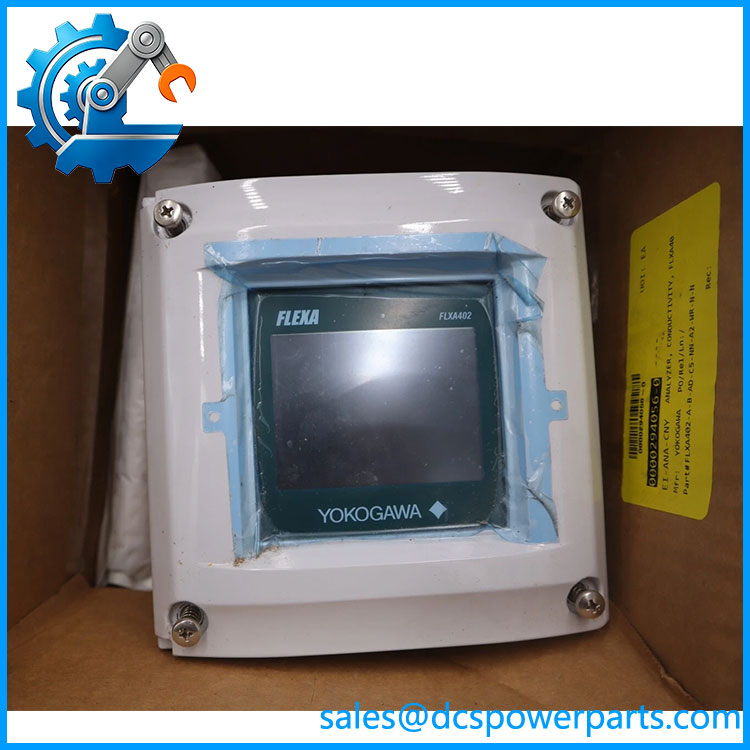
Yokogawa FLXA402
Product Introduction
The Yokogawa FLXA402 is a modular 4-wire liquid analyzer designed for industrial process measurement where different liquid-analysis technologies may be required. Depending on the installed modules, it can handle pH/ORP, contacting conductivity, inductive conductivity, dissolved oxygen, and SENCOM smart sensors. The architecture allows two sensor-module positions and, with SENCOM and the appropriate BA11 junction box, up to five sensor measurements.
For plant engineers, the important point is that FLXA402 is a configured instrument rather than a single fixed-function analyzer. Power supply, sensor type, analog outputs, relay package, Bluetooth, and Modbus communication are encoded through the complete model/suffix structure. A replacement should therefore be matched against the installed nameplate and wiring rather than ordered from the base model number alone.
Engineering Pain Point
The common field mistake is treating an FLXA402 replacement as a simple display or generic transmitter. Two units marked can have materially different sensor interfaces and I/O because the first and second sensor modules, mA output configuration, relay option, and communication interface are selectable. A unit configured for pH/ORP cannot simply be assumed to replace one configured for inductive conductivity or SENCOM service.
Typical Applications
- Water and wastewater treatment: pH, conductivity, dissolved oxygen, and related process measurements.
- Chemical processing: Conductivity and pH monitoring where process compensation and alarm handling are required.
- Boiler and utility systems: Conductivity/resistivity measurement and liquid-quality monitoring.
- General process instrumentation: Multiple liquid-analysis measurements integrated into PLC, DCS, or plant monitoring systems through 4–20 mA, HART, or optional Modbus.
Technical Pitfalls to Avoid
- Do not order from “” alone. Check the complete suffix code. Sensor modules and I/O options are configuration-specific.
- Verify the power version.
-Ais the AC version, while-Dis the DC version. The acceptable supply ranges are different. - Check communication hardware before assuming Modbus is available. Modbus TCP/IP and Modbus RTU/RS-485 are optional configurations rather than universal base features.
- Match the sensor technology. Analog pH, contacting conductivity, inductive conductivity, dissolved oxygen, and SENCOM connections require their corresponding input modules.
- Do not confuse measurement accuracy with total loop accuracy. Yokogawa’s published analyzer accuracy is based on simulated inputs; actual installed-system performance also depends on the sensor, cabling, calibration, process conditions, and installation.
Related Products
- Yokogawa SA11 — SENCOM smart adapter used to connect compatible digital sensors to the .
- Yokogawa BA11 — Active junction box that enables multiple SENCOM sensor measurements in the appropriate configuration.
- Yokogawa WU11 — Interconnection/extension cable for SENCOM products.
- Yokogawa PH4/OR4 — pH/ORP sensor family for compatible configurations.
- Yokogawa ISC40 series — Inductive conductivity sensors supported by the ISC input module.
- Yokogawa DO30G — Dissolved oxygen sensor supported by the DO input configuration.
- Yokogawa DO70G — Optical dissolved oxygen sensor associated with the digital-sensor configuration.
Procurement note: For a direct replacement, provide the complete nameplate code, including power supply, housing, first/second input modules, mA I/O, relay, Bluetooth, digital communication, country code, and option codes. That information determines whether the replacement is electrically and functionally equivalent.