Description
Product Introduction (Non-Templated)
Accurately quantifying low-velocity waste gas streams and sudden emergency relief surges across refinery flare stacks requires sophisticated ultrasonic technology capable of tracking rapid compositional shifts without pressure drop. Maintaining EPA regulatory compliance and environmental reporting accuracy demands specialized flow measurement hardware built to endure aggressive outdoor weather—which is precisely where this advanced transmitter steps in.
Instrumentation engineers managing environmental compliance upgrades or flare gas recovery retrofits rely on this specific ultrasonic processor to maintain precise mass flow calculations. Integrating a verified replacement unit eliminates erratic zero-drift issues while ensuring stable digital data feeds into the main control room system.
Key Technical Specifications
- Manufacturer: Panametrics (Baker Hughes)
- Product Series: XGF868i Flare Gas Mass Flow Transmitter
- Technology: Patented Correlation Transit-Time ultrasonic measurement
- Enclosure Rating: Explosion-proof / Flameproof housing for hazardous locations (Class I, Division 1 / Zone 1)
- Outputs: Dual 4-20 mA analog outputs with HART digital communication protocol
- Power Supply: 100 to 240 VAC / 95 to 240 VDC universal line power
- Operating Temperature Range (Electronics): -20 °C to +55 °C (-4 °F to +131 °F)
- Process Temperature Range: Up to +260 °C (+500 °F) standard probe dependent
- Enclosure Material: Epoxy-coated cast aluminum / Stainless steel options
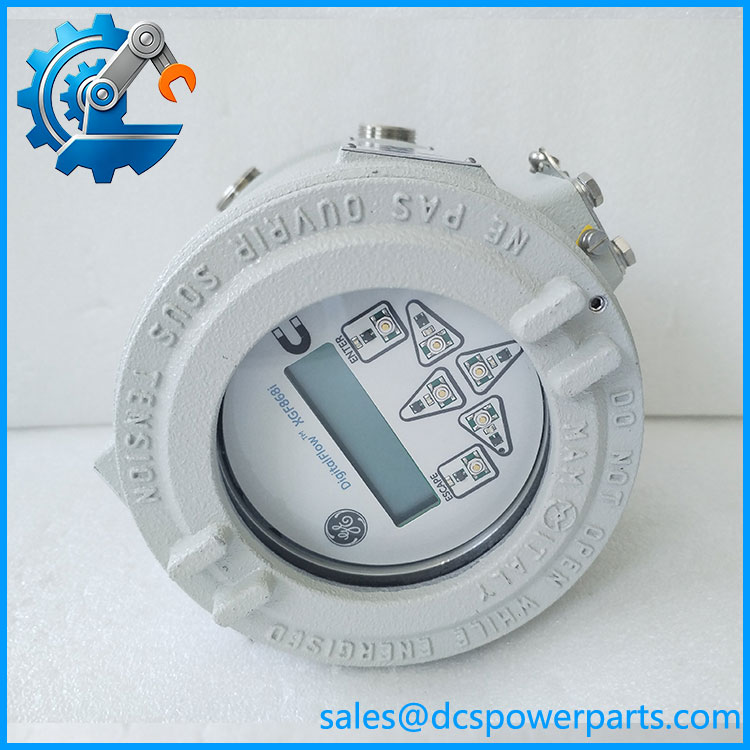
XGF868I-1-1-OI-H-3-4-0-CC
Application Scenarios & Pain Points
When an aging flare meter fails during a sudden plant depressurization event, operators lose critical mass flow visibility, risking severe environmental penalties and unmonitored hydrocarbon emissions.
- Petrochemical Flare Stacks: Deployed on main flare headers to monitor continuous waste gas destruction efficiency and satisfy strict environmental reporting mandates.
- Offshore Production Platforms: Installed on high-pressure relief lines exposed to harsh marine salt-air environments and severe vibration.
- Chemical Recovery Units: Used in hazardous processing zones requiring real-time molecular weight determination of mixed gas streams.
A large refinery complex on the US Gulf Coast experienced recurring signal attenuation issues on an older flare meter header during heavy moisture events. Upgrading to this factory-original Panametrics XGF868i transmitter restored robust ultrasonic signal strength instantly, ensuring continuous, reliable environmental compliance data.
Related Products
- Panametrics Flaremet transducers: High-frequency insertion ultrasonic transducers mounted directly onto the flare pipe spool.
- Panametrics Buffer Gas Assemblies: Auxiliary purge regulators required to keep optical and transducer faces clean in dirty flare streams.
- GE Multilin Alstom/DCS Analog Cards: I/O modules used in the central rack to ingest 4-20mA HART signals from the XGF868I.
- Panametrics Digital FlowPort Software: Diagnostic configuration suite used for parameter tuning and waveform analysis.
- BOC/Valmet Isolation Ball Valves: Hot-tap extraction hardware used to service transducers without shutting down the main flare line.
The Engineer’s Guide: Field Pitfalls to Avoid
- WARNING: Ignoring Path Acoustic Impedance Matching. Installing transducers without applying high-temperature acoustic couplant or aligning the beam paths precisely across the pipe diameter creates severe signal loss. How to avoid: Follow the factory spacing dimensions meticulously and verify sonic signal strength on the local display before commissioning.
- WARNING: Hot-Opening Explosion-Proof Enclosures. Opening the transmitter housing cover in an active hazardous area while the unit is energized risks initiating an electrical spark explosion. How to avoid: Always follow strict plant lockout/tagout (LOTO) and hot-work safety procedures or use a portable gas detector to clear the zone before opening the cover.
- WARNING: Mismanaging Purge Gas Pressure. Failing to maintain a continuous purge gas feed on the transducer buffers when sticky hydrocarbons are present causes fouling that deadens ultrasonic signals. How to avoid: Ensure purge pressure is regulated consistently above the maximum line pressure per the manufacturer’s manual.
Frequently Asked Questions (FAQ)
- Can I configure and troubleshoot this meter locally without connecting a laptop? Well, technically the unit features an internal magnetic keypad and local display interface allowing operators to check diagnostic health parameters, read velocity metrics, and view error codes directly in the field.
- What does the specific suffix string indicate regarding power supply and hazardous ratings? The complex model code governs specific input power ranges, housing materials, input/output options, and hazardous area certifications. Cross-reference your exact string against the Panametrics engineering data sheet to ensure compliance.
- How does the ultrasonic meter determine molecular weight in real time? The XGF868i utilizes patented Correlation Transit-Time techniques combined with temperature and pressure inputs to calculate actual gas sound speed, automatically deriving real-time molecular weight and mass flow.
- What type of documentation accompanies a verified surplus transmitter? Reputable industrial suppliers provide complete bench-test calibration check sheets, hazardous area tag verifications, and a standard 12-month operational warranty covering component health.
- What should I check first if the acoustic signal strength drops to zero suddenly? Verify that the transducer coaxial cables are securely connected, check that the pipe hasn’t experienced severe internal scaling or liquid slugging, and inspect the buffer purge lines for blockages.