Description
Product Overview
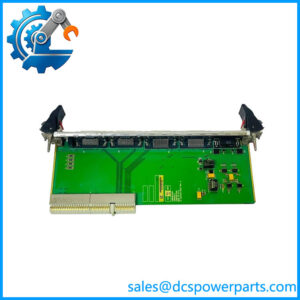
X10-14210201 is a rugged embedded CPU board designed and built by Abaco Systems, the Huntsville, Alabama embedded-computing house that inherited GE Intelligent Platforms’ board-level product lines and now sits inside AMETEK. It is not a control module in the PLC or DCS sense: it is a computer, the board that a larger embedded system uses as its processing element, with a processor complex under a substantial heat-sink assembly and a front-end built for copper networking rather than backplane I/O.
The two numbers the customer supplied are both real and both necessary. X10-14210201 is the model code that identifies the board configuration; 605-A53842-002 is the Abaco assembly code that identifies the built article, and the trailing -002 is a variant index rather than decoration. Abaco’s own shipment record for this assembly reads PCBA,CPU,X10,HSD — a CPU board assembly, X10 family, heat-sink build — and the same record carries the qualifier “not Lam designed”, which is the single most useful line in the whole file: it means the design authority is Abaco, while the tool builder is Lam Research. Sibling assemblies 605-A02119-001 and 605-A02119-010 appear in the same trade corridor between Lam Research in Malaysia, contract manufacturer Jabil, and Abaco, which is how a board designed in Alabama ends up on a semiconductor tool’s bill of materials under a tool-maker’s own part number.
That commercial arrangement explains both the scarcity and the confusion around this part. The board is not sold as a catalogue product with a public datasheet; it is bought by the machine builder, integrated into process equipment, and thereafter reached through the equipment maker’s spare-parts channel. Resellers publishing it as a PLC module, a 24 V DIN-rail device or a multi-channel analog output card are describing a different object entirely.
Mechanically, public listings disagree — some call the X10 a 3U VPX board, one calls it 6U VPX, another calls it an XMC mezzanine — so the slot standard, connector type and cooling method must be settled against the host chassis and Abaco’s master drawing rather than taken from a web page. What is consistent across sources is the front end: six Gigabit Ethernet ports, four USB ports, two serial channels and a DisplayPort output, with a reset button and status LEDs, which is a computer’s faceplate, not a fieldbus card’s.
One lifecycle fact deserves stating plainly. Abaco’s records contain an EOL marking against X10 printed-circuit assemblies, which is why this listing is flagged as an obsolete, limited-stock item rather than an active catalogue part. Buyers should plan around finite supply and treat every purchase as a like-for-like assembly match.
Technical Specifications
| Parameter | Value |
|---|---|
| Model code | X10-14210201 |
| Assembly / material code | 605-A53842-002 |
| Manufacturer | Abaco Systems (AMETEK), USA; GE Intelligent Platforms heritage |
| Product type | Embedded CPU board / rugged single-board computer |
| Shipment description | PCBA, CPU, X10, HSD (heat-sink build) |
| Ethernet | 6 × Gigabit Ethernet, G1–G6 |
| USB | 4 × USB, ports 1–4 |
| Serial | 2 × COM, designated COM5 and COM6 |
| Video | 1 × DisplayPort |
| Front panel | Reset (RST) button plus status LEDs |
| Logic companion | On-board Lattice FPGA |
| Thermal construction | Heat-sink assembly (HSD); cooling method set by host chassis |
| Primary integration | Semiconductor process equipment (tool-maker BOM), Abaco rugged embedded platforms |
| Lifecycle status | EOL marking present on X10 assemblies in shipment records; limited stock |
| Identity rule | Model code and assembly code must be quoted together; sibling assemblies not interchangeable |
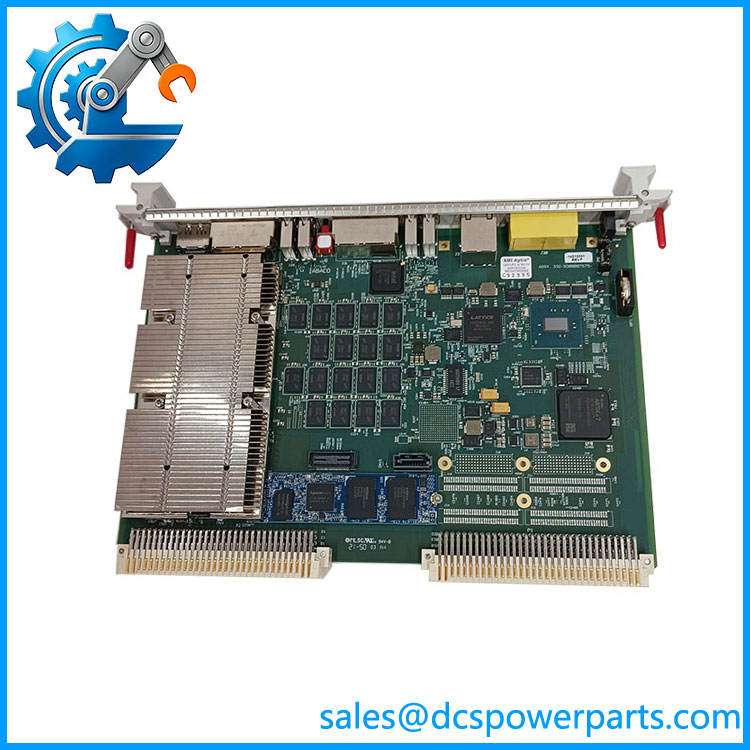
X10-14210201 605-A53842-002
Key Features and Advantages
Six Gigabit ports on one board: the X10-14210201 carries G1 through G6 as separate Gigabit Ethernet interfaces, which lets one compute element sit on camera, sensor, host and service networks at the same time without an external switch in the cabinet. In semiconductor tool architectures, where several subsystems exchange high-rate data with a single controller, that port count is the difference between a clean design and a hub of adapters.
A faceplate that tells you what it is: reset button, status LEDs, four USB, two COM and DisplayPort. The serial channels are numbered COM5 and COM6 in the panel legend, which implies the board’s design lineage already accounts for lower-numbered ports consumed elsewhere in the platform — a detail worth knowing before anyone assumes a dead port means a dead board.
Heat-sink build, honestly labelled: the HSD designator in the assembly description is Abaco’s own way of saying this build ships with its thermal hardware attached. On a board that dissipates real power in a sealed enclosure, the heat-sink is not an accessory; it is the mechanical interface to the chassis cold wall, and replacing a heat-sink build with a bare board of the same model code is a thermal decision, not a cosmetic one.
Two code levels, one article: because the model code names the design and the assembly code names the build, a quotation that carries only X10-14210201 can still land on the wrong variant, and a quotation carrying only 605-A53842-002 loses the family context. The siblings 605-A02119-001 and 605-A02119-010 sit in the same X10 build family; they are not drop-in substitutes, and the difference is documented at assembly level, not in a marketing table.
Firmware and configuration live on the board, not in the chassis: an embedded CPU board boots from its own storage and holds its own settings, so a replacement arrives as a blank computer that must be given the right image and the right parameter set. That is the operative risk of this part class, and it is also the reason a tested board with a known-good image is worth more than a cosmetically perfect one.
Longevity by design lineage: Abaco builds this class of hardware for programs measured in decades, with ECC-class memory practice, conformal expectation and industrial temperature screening typical of the rugged embedded market. That heritage is exactly why the board survives in twenty-year-old process tools — and why procurement is now a matter of finding a build, not ordering a new one.
Applications
Semiconductor front-end process equipment is the primary installed base. The X10-14210201 works as the compute element inside etch, deposition and clean platforms, where it runs the tool’s control application, aggregates sensor and camera data over its Gigabit ports and drives the operator display through DisplayPort. In that role it is one board in a tool whose uptime is measured against wafer starts, and the replacement decision is driven by a maintenance window rather than by a product roadmap.
Wafer handling and inspection subsystems: board-level compute for robot controllers, aligner and metrology stations, where the serial channels carry motion-controller links and the USB ports serve cameras and readers. When the host application is a mature one, the board is the part that must match, not the software that must be upgraded.
Rugged embedded platforms outside the fab: Abaco’s own line of VPX and mezzanine systems uses this class of CPU board as the processing node in conduction-cooled enclosures, covering ground-vehicle vetronics, mobile instrumentation and transport control cabinets where a fanless chassis and a wide temperature band are mandatory.
Test and simulation benches: because the front end is standard copper networking plus USB, serial and DisplayPort, the board is also found in bench rigs that emulate tool behaviour, and in lab systems where the same compute element must reproduce field conditions.
Legacy sustainment, which is the practical case for most buyers now: keeping an existing tool or embedded platform running when the original build is at end of life. The task is not to modernise the architecture, it is to place the correct assembly into a known-good slot and restore the image the machine expects.
Related Products
605-A02119-001 — sibling X10 assembly in the same build family; different build, not a drop-in substitute. 605-A02119-010 — further X10 assembly variant; quote by assembly code, not by model code alone. SBC3513 — Abaco’s current SOSA-aligned 3U VPX single board computer; the modern alternative when the platform is being re-architected rather than sustained. SBC3511 — earlier 3U OpenVPX SBC in the same Abaco family, with an announced upgrade path to SBC3513. SBC3901 — Abaco 3U VPX compute-intensive SBC for edge AI workloads; same vendor ecosystem, different generation. SBC347D — Abaco 3U VPX SBC known for high-temperature full-clock operation; a thermal-benchmark reference point. GVC1001 — Abaco graphics, vision and AI computer; the natural companion when the X10-class board is the host and video processing is offloaded. XVB602 — Abaco DSP module for compute offload alongside a general-purpose CPU board. FMC120 — Abaco FPGA mezzanine card for custom high-speed I/O in the same rugged ecosystem. VPX3UX311 — Abaco rear transition module used with VPX SBCs; relevant when the backplane-side I/O of the host system is being extended.
Installation and Maintenance
Before installation: settle the mechanics first, because the published descriptions of this board disagree. Confirm from the host chassis documentation and Abaco’s master drawing whether the slot is 3U or 6U VPX, whether the interface is VITA 46 or an XMC/PMC carrier, and what pitch and keying the slot uses; then confirm the cooling path, since the 605-A53842-002 build arrives with its heat-sink and must mate to the cold wall or air path the chassis provides. Capture the existing board’s model code, assembly code, serial number, firmware revision and parameter set before it comes out, and verify ESD protection and power-down state at the slot.
Maintenance practice: treat the board as a computer with a mechanical interface. On a suspected failure, check the front-panel LEDs and the reset behaviour before condemning the board, then verify each Gigabit port and the two serial channels individually, because a single dead port is as likely to be a cable or a switch as it is to be silicon. Keep the firmware image and configuration backed up off-tool, so that a replacement can be restored to the exact state the machine expects rather than a generic one. Inspect the heat-sink mounting and thermal compound on every re-seat, and never substitute a sibling assembly such as 605-A02119-001 into a slot documented for 605-A53842-002 without written confirmation from the tool builder, because the difference will be in build detail rather than in appearance.
Warranty and Quality
Every is supplied as an Abaco-designed X10 CPU board with both identifiers verified against the physical label, the heat-sink build confirmed, and the board inspected for connector, socket and component condition before dispatch. Because this assembly sits on a tool-maker’s bill of materials rather than in a public catalogue, orders are matched to the customer’s existing board by photograph and label, not by a product name alone, and sibling assemblies are never substituted silently. Boards are presented with their actual condition and firmware state, including any evidence of prior installation, and a 12-month repair, replacement or refund commitment applies. Support covers the questions this part actually raises: how to determine the slot standard and cooling path from the host chassis, how to distinguish the -002 assembly from its X10 siblings, how to capture and restore the boot image and parameters, how to test each network and serial channel after a swap, and how to plan around end-of-life supply so that a maintenance window is not lost waiting for a build that no longer exists.
免费
今天 09:05