
Description
Product Overview
XVME-674 is a VMEbus processor module from Xycom, the Michigan industrial-computing house whose XVME line put PC-compatible computers into VME chassis for two decades. It is not an I/O card, a communication board or a bus adapter: it is the CPU of the rack, a single-slot 6U board that carries an Intel 80486, its DRAM, an IDE hard-disk controller, a floppy controller, a VGA graphics controller, two serial ports and one parallel port, and presents all of that to the VMEbus as a bus master.
The point of the design was to let an application written for a PC run inside a VME rack. Instead of a proprietary real-time operating environment, the integrator got the PC/AT memory map, PC interrupt structure and PC peripheral conventions, wired to a VMEbus interface that could read and write the other boards in the chassis. That is why the board appears in so many 1990s test stands, machine controllers and laboratory systems: the software was ordinary DOS-era code, and the hardware behind it was a rugged backplane rack.
Two variants matter commercially. Processor speed is either 33 MHz 80486DX or 66 MHz 80486DX2 — the DX2 doubles the core clock internally while the external bus stays at 33 MHz, which changes instruction timing without changing bus timing. DRAM comes in 4, 16 or 32 MB, and Xycom’s own ordering shorthand carries that capacity in the suffix: XVME-674/4, XVME-674/16 and XVME-674/32. Assembly-level part numbers 70674-005 and 70674-098 identify built boards, and daughter-card assemblies 70674-014, 70674-201 and 70674-202 are associated with configurations, which is exactly the layer where a wrong replacement is most likely to arrive looking right.
Functionally the board sits in a narrow but important niche. It has a local VMEbus interrupter, so the CPU itself can assert a VMEbus interrupt on any of the seven levels — a capability shared with the 80486SX-based XVME-677 but not with the Cyrix-based XVME-678 or the 386SX-based XVME-688, which can service interrupts but not generate them. Its addressing extends to VMEbus extended space, again a 674/677 distinction, and its DOS software support came through the XVME-983 library, whose routines route VMEbus accesses through a 64 KB real-mode window at 0xE0000–0xEFFFF.
Lifecycle is the honest headline. Xycom’s own reference library still publishes datasheets and manuals for the later XVME-653, 654, 655, 656, 658 and 659 processor modules, but not for the 674 — the board had already been dropped from the current support set. Supply today is surplus and used stock, and the practical buying question is not which board is newer but whether the exact memory and speed variant matches what the machine’s software expects.
Technical Specifications
| Parameter | Value |
|---|---|
| Model | XVME-674; memory variants /4, /16, /32 |
| Manufacturer | Xycom (Xycom Automation), USA |
| Product type | Single-slot 6U VMEbus PC/AT processor module |
| Processor | Intel 80486DX at 33 MHz, or 80486DX2 at 66 MHz |
| DRAM | 4 MB, 16 MB or 32 MB, per assembly variant |
| Storage controllers | On-board IDE hard disk controller and floppy disk controller |
| Graphics | On-board VGA graphics controller |
| Serial / parallel | 2 × RS-232C serial ports, 1 × parallel port |
| VMEbus interface | Master and slave, IEEE 1014 VMEbus; extended (A32) address space supported |
| Interrupts | Handles all seven VMEbus interrupt levels; local VMEbus interrupter present (674/677 only) |
| Real Mode Window | 64 KB at 0xE0000–0xEFFFF, mappable to VME short I/O, standard, IACK, EPROM or extended space |
| Software support | XVME-983 MS-DOS Software Support Library, C routines and drivers |
| Assembly identifiers | Base assemblies 70674-005, 70674-098; daughter cards 70674-014, 70674-201, 70674-202 |
| Bus slot / format | 6U VMEbus, 233 × 160 mm class, single slot |
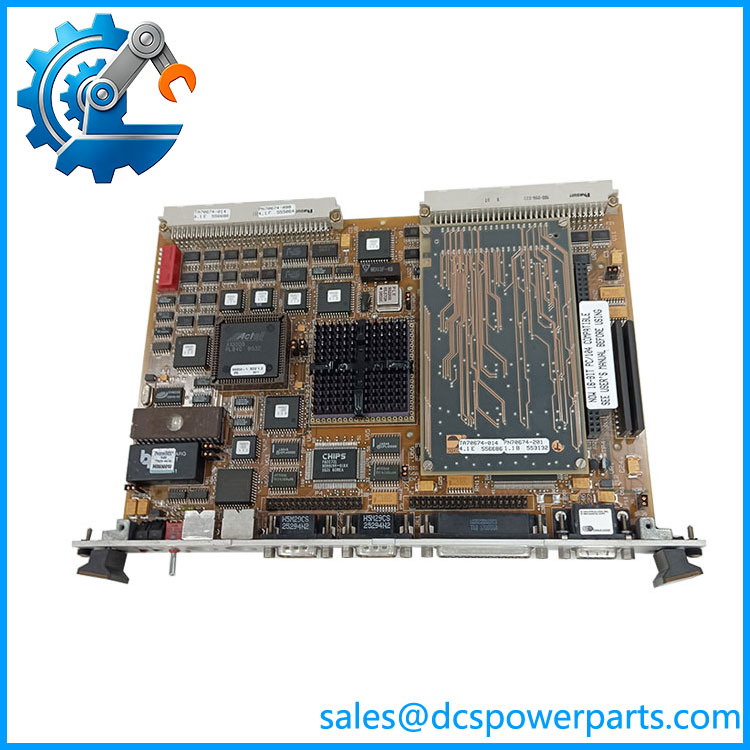
XVME-674
Key Features and Advantages
A complete PC inside the rack: the XVME-674 integrates processor, memory, IDE and floppy control, VGA and two serial ports on one 6U board. In a rack that already holds VME I/O, that means the system needs one processor slot and no external PC — no serial link between a desk-side computer and the chassis, no second enclosure, no separate power supply for the host.
The 64 KB Real Mode Window is the detail that makes legacy software portable: at 0xE0000–0xEFFFF, the board can map VMEbus short I/O, a block of standard address space, the IACK space, its own EPROM, or extended space, all while the CPU stays in real mode. Software written before protected-mode extenders existed could therefore touch the whole VME address space through a window it already knew how to address, which is why so much installed code still depends on that aperture today.
Interrupter on the local CPU: can generate a VMEbus interrupt on any of the seven levels itself, rather than only responding to one. In a rack where the processor must signal another master, a diagnostic card or a second CPU, that asymmetry between the 674/677 and the 678/688 is a hard functional difference, not a datasheet nuance.
Speed variants without bus-timing surprises: the 66 MHz option is a DX2, clock-doubled internally on a 33 MHz external bus. Boards and backplanes built for the 33 MHz part therefore keep working, while the core runs twice as fast — useful where the application is compute-bound but the VME timing must not shift.
IDE storage in an era of failing disks: because the drive interface is plain IDE with a floppy controller alongside, a modern IDE flash module can replace a spinning disk without any change to the operating software. That single substitution removes the most common cause of failure in these racks, and it is possible precisely because the board is a PC.
Repairable, documented hardware: the board’s behaviour is described in Xycom’s own software support manual — memory map, interrupt handling, address-space windows — and the assembly and daughter-card numbers are documented at build level. For a thirty-year-old controller, documented behaviour is worth more than headline performance, because it is what lets a technician prove a replacement board is equivalent before the machine is stopped.
Applications
Legacy test stands and environmental chambers: the is typically the rack’s computer, running a DOS-era test application that drives VME digital and analog I/O boards, logs results to an IDE disk and displays them on a VGA monitor. When the stand must keep running for a qualification programme, the board is the part that decides whether the whole rig stays in service.
Machine and process controllers built on VME: printed-circuit handling, web converting, press and packaging lines where the control software was written for a PC/AT environment and the I/O lives on VME modules in the same chassis. The board sequences the machine, reads the I/O cards through the backplane and serves the operator display.
Laboratory and analytical instruments: spectrometer, tester and measurement platforms of the same generation, where an embedded 486 with a VGA output and two serial ports was the standard instrument controller, often with a proprietary card set that has no modern replacement.
Training and simulation rigs: because the architecture is a PC, the board supports teaching benches and hardware-in-the-loop rigs where students or engineers need a real VME backplane and a real PC memory map, rather than an emulation.
Military and transport ground equipment: ruggedised racks in shelter, vehicle and ground-station applications that were specified around VMEbus and are still supported as legacy fleets, where replacement is a like-for-like board swap rather than a platform change.
Sustainment and reverse-engineering work: with a documented real-mode window and a standard PC peripheral set, the board is also the reference point when an existing controller must be characterised, copied or migrated, since its memory and interrupt behaviour can be measured directly.
Related Products
XVME-677 — 80486SX sibling in the same PC/AT processor family; also carries the local VMEbus interrupter. XVME-678 — Cyrix 486SLC/e variant with 1 or 4 MB DRAM; services interrupts but has no local interrupter and cannot access VMEbus in protected mode. XVME-688 — 80386SX variant with 80387SX coprocessor site; same family, earlier generation. XVME-653 — later single-slot VMEbus Intel Pentium processor module; the generation that succeeded the 486 boards. XVME-655 — VMEbus Pentium processor module, dual-slot; higher-performance successor for the same chassis. XVME-656 — double-slot Intel Pentium version, with its AMD-K6-2 counterpart in the 659. XVME-658 / XVME-659 — AMD-K6-2 processor modules, single and double slot; the last generation of this XVME CPU line. XVME-977 — hard drive and floppy drive module, the storage companion for CPU boards in the same rack. XVME-9670 — 6U VME64x I/O pack carrier board; the I/O side of a rack built around an XVME processor. XVME-400 / XVME-401 — four-channel RS-232C and RS-422A/RS-485 serial modules, supported by the same XVME-983 drivers.
Installation and Maintenance
Before installation: establish the exact variant. Confirm whether the machine expects a 33 MHz DX or a 66 MHz DX2, and whether its software was sized for 4, 16 or 32 MB — the suffix on , /16 or /32 is the memory capacity, and a lower-capacity board can fail to boot an application that maps memory above the installed range. Record the base assembly code (70674-005 or 70674-098) and the daughter-card numbers (70674-014, 70674-201, 70674-202) from the board being replaced, set the VMEbus address and interrupt level to match the existing configuration, and back up the IDE image and the CMOS/BIOS settings before power is removed.
Maintenance practice: keep the rack’s airflow path clear and inspect the 6U slot for bent pins and worn DIN connectors on every re-seat, because a partially engaged backplane connector produces faults that look like software. Replace the spinning IDE disk with a flash module of the same geometry before it fails rather than after, verify the two serial ports and the parallel port individually, and test the board’s interrupt behaviour rather than only its ability to boot. If the board is swapped, prove equivalence by running the application’s own VME access path — the real-mode window mapping in particular — before returning the machine to production. Where a cannot be sourced in the required memory and speed variant, treat conversion of the application to a later XVME processor as a separate engineering decision, not as a drop-in substitution.
Warranty and Quality
Each is supplied with its variant identified — processor speed, DRAM capacity, base assembly code and daughter-card configuration — rather than as a generic 486 VME board, because the differences between , /16 and /32 are the differences that decide whether an installed application boots. Boards are inspected for backplane connector condition, socket and daughter-card integrity, and evidence of heat or prior rework; where a VME chassis is available they are powered and checked for POST behaviour, VGA output, serial activity and VMEbus access before dispatch. A 12-month repair, replacement or refund commitment applies. Support covers what this board actually raises in service: identifying the correct variant from a label or a photograph, confirming whether the rack’s software depends on the local interrupter, restoring CMOS settings and the IDE image after a swap, proving the real-mode window access path, and planning a replacement path when the required build cannot be found.
