Description
Product Overview
P110-6052 is not a circuit board and not a drive module. In Converteam’s own AMC2 datasheet — Issue C, dated 2 July 2009 — the Re-order Codes table lists it in one line: “AMC2 Controller: 5 network ports — Ordering Code P110-6052 — Manufacturer Eltech Solutions”. The number is an OIS, a Converteam ordering reference that defines a kit of parts, and the datasheet says so plainly: the AMC “comes ready assembled and installed with basic firmware from its supplier”. What arrives is a complete, sealed controller box, built around an Arbor EmE7x-i701 embedded single-board computer, with the base firmware already in place.
The platform is AMC2, the second generation of Converteam’s Advanced Micro Controller and roughly twice the relative performance of AMC1 depending on application code. It was designed as a small, rugged, flange-mounted box for mounting on a vertical panel — not on a DIN rail, not in a 19-inch rack — with a 70 °C rating without a fan, type-tested, and shock-tested to 15 g against IEC 1131. The hardware is deliberately commercial-off-the-shelf Pentium-M class silicon, which is why a 600 MHz Celeron M sits behind five Ethernet ports instead of a bespoke industrial CPU.
The niche it fills is the one industrial PCs historically failed at. Converteam used AMC2 across its marine architecture — dynamic positioning and automation controllers, fieldstation PLCs, redundancy boxes — as well as PEC drive controllers and general-purpose PLC applications, running the Isagraf-based Marine Controller HPCi software platform. Five independent Ethernet ports are not a marketing number here: DP and automation networks are kept apart, host links are made redundant, and fieldbus traffic is routed, all inside one box that a classification surveyor can point at.
Two details decide whether a spare actually works, and neither appears in any reseller listing. First, there is a dedicated identity dongle port on the box: the controller’s identity — who it is on the network, in a redundant pair, in the DP architecture — is carried by that physical key, not by the part number. Second, the operating system and application live on an extractable CompactFlash card used as the unit’s solid-state drive. A replacement P110-6052 that arrives with basic firmware only is, functionally, a blank Pentium-class box; the dongle and the flash card carry the identity and the program, and both must travel from the old unit to the new one.
The rest is honest legacy engineering. It is a 2009-vintage Converteam product, and Converteam’s power conversion business passed to GE in 2011 and is now part of GE Vernova, so the practical supply question is not “is it current” but “who still holds the dongle, the flash image and the Isagraf project for this hull or this drive”. No OEM end-of-life notice for AMC2 has been located; reseller claims that the series is EOL should be treated as unverified until a GE Power Conversion document says so.
Technical Specifications
| Parameter | Value |
|---|---|
| Model / ordering code | P110-6052 (Converteam OIS defining a complete controller kit) |
| Product | AMC2 Controller, base configuration, 5 network ports |
| Design / supply | Converteam UK Ltd design; assembled and supplied by Eltech Solutions |
| Embedded board | Arbor EmE7x-i701 single-board computer (COTS Pentium-M class) |
| CPU / memory | 600 MHz Intel Celeron M; 256 MB DRAM; 256 MB CompactFlash (extractable, used as HDD) |
| Relative performance | Approximately 2× AMC1, depending on application code |
| Supply / consumption | 24 V DC ±20%; ≈0.9 A |
| Network | 5 × integrated Ethernet ports |
| Serial / USB | 4 × RS-232 (3 available to applications); 2 × USB with Yamaichi latching |
| Expansion | 4 × PMC / PC104+ slots — Serial16+, FIP, Profibus master/slave, fibre-optic Ethernet |
| Identity & storage | Identity dongle port defining controller ID; removable CompactFlash system image |
| Indication / monitoring | LEDs for Power, Healthy, Running; watchdog; temperature monitoring |
| Mechanical / environment | Flange-mounted panel box, 234 × 206 × 120 mm; fanless, rated to 70 °C; type-tested, 15 g shock per IEC 1131 |
| Software platform | Marine Controller (Isagraf) HPCi |
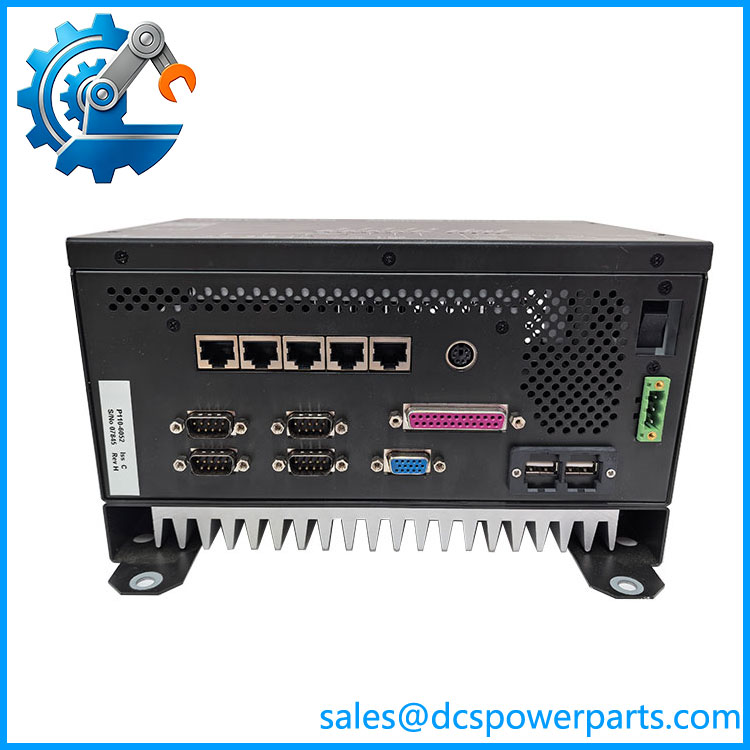
P110-6052
Key Features and Advantages
An ordering code, not a board number: P110-6052 is a Converteam OIS that names a complete, firmware-loaded controller kit. That removes the most common failure in sourcing this family — buying a “controller board” that turns out to be a bare PCB, or a box whose configuration does not match the one being replaced.
Identity carried in hardware, not paperwork: the dedicated dongle port means the controller’s network identity is a physical object that can be moved from a failed unit to a spare. In a redundant DP pair, that is the difference between a swap that the system accepts and a box that boots perfectly and is still refused by the network.
Standard CompactFlash as the system drive: the OS and application sit on an extractable CF card. Backing up a controller is therefore a card image plus a dongle, not a vendor-only procedure — a maintenance reality that matters enormously on a vessel or a plant where the original project files were lost a decade ago.
Five Ethernet ports in one box: control network, automation network, redundant host links and fieldbus routing can be separated physically rather than by VLANs, which is exactly what marine DP and drive-control architectures require, and it keeps broadcast domains small in a cabinet full of drives.
Fanless to 70 °C, type-tested, 15 g shock: no fan is a maintenance argument, not a datasheet flourish — there is no bearing to seize, no filter to clog, and no airflow path to design around inside a sealed panel on a ship. The 15 g shock rating against IEC 1131 covers the vibration a machinery-space panel actually sees.
Twice AMC1’s relative performance on COTS silicon: the keeps the code base of the earlier platform while roughly doubling headroom, so an upgrade of an existing AMC1-based panel is a controller replacement rather than a re-engineering of the whole station.
Twelve documented configurations from one platform: the same box is ordered as P111-6052 with one Serial16+ card, P112-6052 with two, P121/P122 with FIP, and P110-6152/6552 with Profibus master or slave. Fieldbus and serial needs are met by slot cards rather than by a different controller, which keeps spares common across a fleet.
A genuinely small footprint for a full controller: 234 × 206 × 120 mm flange-mounted on a vertical panel leaves cabinet depth for drives and terminals, and lets a redundant pair sit side by side without a dedicated rack.
Diagnostics you can read at the panel: three LEDs for Power, Healthy and Running, plus watchdog and temperature monitoring, tell a technician at the cabinet door whether the box is unpowered, booting, hung or thermally stressed — before anyone opens a laptop.
An honest position on lifecycle: this is a Converteam-era product now under GE Vernova, and the article says so rather than pretending otherwise. The board is replaceable; the dongle, the flash image and the Isagraf project are the parts that actually need a plan.
Applications
Marine dynamic positioning and vessel automation: P110-6052 was designed into the Converteam marine architecture as a DP controller, automation controller, fieldstation PLC and redundancy-box controller. On a DP vessel the box sits in the chain that holds station and heading, where five Ethernet ports keep the DP network, the automation network and the redundant host links apart, and where the identity dongle decides which controller a redundant pair believes.
PEC drive control: Converteam’s PEC drive controllers used as the embedded control layer, tying drive-level control into vessel or plant networks. Replacement units are typically ordered because a drive cabinet is sound but its controller is the one item with no second source.
Shipyard and offshore new-build support: the platform’s Isagraf/HPCi software base means an spare is also a commissioning tool — a box that can be loaded with a project and dropped into a fieldstation during an upgrade or a late-stage change.
Industrial PLC duties outside marine: the datasheet lists general-purpose PLC applications, and the reality is panels where a compact, fanless, shock-rated controller with five network ports and PMC expansion is a better fit than a card rack.
Redundancy boxes and hot-standby pairs: the architecture depends on two controllers that agree about identity; this is precisely where transplanting a dongle and a flash image matters more than the hardware revision.
Fleet spares and life extension: operators standardise on the base 5-port unit as a common spare and add serial or fieldbus function through slot cards, so one part number covers several station types across a class of vessels.
Legacy Converteam and Alstom-era conversions: systems built before the 2011 GE acquisition, and before that under Alstom Power Conversion, still run AMC-family controllers in propulsion, thruster and auxiliary machinery control.
Related Products
P111-6052 — same base plus one Serial16+ high-density serial card; the next step up for DP serial loads. P112-6052 — with two Serial16+ cards; the high-density serial variant for marine DP and redundant boxes. P121-6052 — FIP controller with one FIP card; WorldFIP network integration on the same box. P122-6052 — FIP controller with two FIP cards; upgrade and gateway applications, per the Converteam code table. P110-6152 — with one Profibus master port; same platform, fieldbus instead of plain Ethernet. P110-6552 — with one Profibus slave port; the slave-side counterpart for drive and I/O integration. P110-6053 — Pentium-M 1.40 GHz base unit (P1xx-6×53 family); the higher-performance special-order version of the same box. P106-6052 — with Windows XP, 5 network ports; the general embedded-PC variant of the platform. Arbor EmE7x-i701 — the embedded single-board computer inside the box; relevant only when board-level repair, not box replacement, is the chosen route.
Installation and Maintenance
Before installation: treat this as a controller transplant, not a hardware swap. Record the failed unit’s dongle position, photograph every LAN and serial connection, and take an image of the CompactFlash card before anything is removed — the card is the system drive, so an unreadable card is an unbootable controller. Confirm the replacement is the same ordering code with the same expansion cards fitted, because a and a P111-6052 differ by a Serial16+ card that the project may depend on. Verify the flange-mount panel is flat, grounded and clear, keep at least 50 mm of free space above and below for natural convection, and confirm the 24 V DC supply is within ±20% at the terminals, with protective earth bonded to the cabinet bar rather than to a convenient screw.
Fitting: isolate the supply, then mount the on its vertical panel, reconnect LAN ports strictly to the drawing, and reconnect serial leads with their terminations intact. Insert the identity dongle and the CompactFlash card from the original unit before power-up, not after — a controller that boots without its identity may join a network with the wrong address, which on a DP or drive network is worse than not booting at all. Power up and read the three LEDs: Power, Healthy, Running. A box that is powered and never reaches Healthy is usually a card or dongle problem, not a box problem.
Maintenance: the two consumables are the CompactFlash card and the dongle’s physical condition, so keep a verified card image off-unit and treat the dongle as a controlled item with a serial-number record. Annually, inspect the panel for dust build-up on the flange and heatsink surfaces, check that no LAN or serial connector has been strained by cable weight, and confirm the internal temperature trend rather than waiting for a thermal trip — the box is fanless, so its cooling is the cabinet’s cooling. Log the running firmware and project version at each outage; on a platform of this age, the configuration record is the spare part.
Warranty and Quality
Every is supplied as the Converteam controller kit it is defined to be — 5 network ports, 600 MHz Celeron M, 256 MB DRAM and 256 MB CompactFlash, flange-mounted box, base firmware installed — and the configuration is confirmed against the buyer’s ordering code, expansion cards and station role before dispatch, since a base unit and a Serial16+ variant are not interchangeable in service. Units are inspected for enclosure and flange condition, connector and slot integrity, dongle-port and card-slot function, label legibility and evidence of prior rework or substitution, and are powered to verify boot to Healthy, LED behaviour, LAN port response and serial channel activity. A 12-month repair, replacement or refund commitment applies. Support covers what this part actually needs: decoding the Converteam OIS code table so the right variant is ordered, explaining why the identity dongle and CompactFlash must be transplanted, how to image and verify the system card, the 3-of-4 serial port allocation, thermal clearance for a fanless box rated to 70 °C, and what the 2011 GE acquisition means for long-term support of an -based panel.