Description
Product Overview
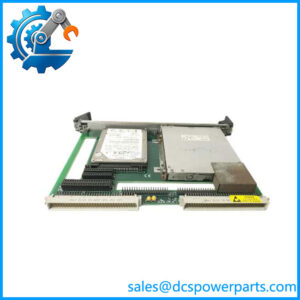
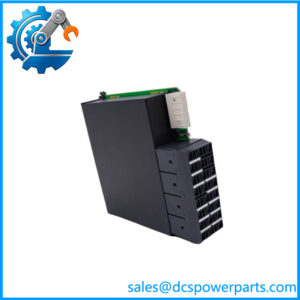
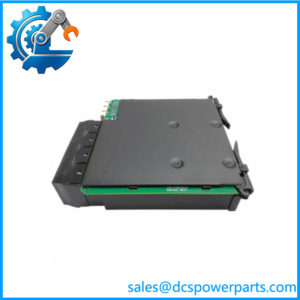
IS220PDIAH1A is a Mark VIe I/O pack of the discrete input type: a sealed pack that clips onto a Mark VIe terminal board, reads twenty-four contact inputs from the field, and publishes them to the controller over the IONet I/O network. It is one member of the packaged I/O family that GE built to get field wiring out of the controller cabinets — the pack holds the acquisition electronics and the local processor, the terminal board holds the field terminals, and the two are connected by a fixed interface so that a failed pack can be replaced without touching a single field wire.
The part that decides whether a given pack works is not the pack. It is the terminal board. The PDIA design hands the job of “making a contact readable” to the terminal assembly: the board supplies the wetting voltage that turns a dry contact into a measurable loop, and the same pack reads 0–32 Vdc contacts on an IS20ySTCIH1A or TBCIH2C board, grouped contacts with 31 Vdc wetting at 10 mA on channels 1–21 and 41 mA on channels 22–24 on an STCIH8A/TBCIH4C/TBCIS4C board, or 55 Vdc contact inputs on an IS400STCIH4A/STCIS4A/TBCIH3C board. So the same IS220PDIAH1A is a 24 Vdc contact pack in one cabinet and a station-battery contact pack in the next, and the reason is the board underneath it, not a variant of the module.
The generation suffix matters as well. H1A is the earlier build of the PDIA pack; the current Mark VIe certificates list IS220PDIAH1B, and the IS221PDIAH1B and IS42yPDIAH1C forms appear in the same certificate family. The channel count, the terminal-board list and the electrical classes do not change across those suffixes — the hardware generation does. A pack from a different generation will generally sit in the same slot and connect, which is exactly why the label has to be read before it is accepted as a spare.
Where this pack earns its place is in the trip and status layer of a turbine cabinet: valve limit switches, breaker and disconnector status, lube-oil and hydraulic pressure switches, fire and gas contacts, ESD pushbuttons. These are signals whose failure mode is a wrong boolean, not a drifting number — and a wrong boolean in a protection scheme trips a machine that did not need to trip, or fails to trip one that did. That is why the wetting arrangement, the input threshold and the channel grouping deserve more attention than the pack’s catalogue description.
Technical Specifications
| Parameter | Value |
|---|---|
| Model / assembly code | IS220PDIAH1A, assembly 336A4940CSP1; generation H1A |
| Manufacturer | GE (Mark VIe / Speedtronic), I/O pack built under Nexus Controls |
| Product type | Discrete input I/O pack (Packaged Discrete Input), Mark VIe |
| Input channels | 24 contact inputs, addressed as group 1–21 and group 22–24 |
| Pack supply | 24–28 Vdc, 0.24 A maximum |
| Contact input voltage | 0 to 32 Vdc on standard terminal boards; 55 Vdc on high-voltage terminal boards |
| Contact wetting (standard TA) | 32 Vdc, 110 mA dc — IS20ySTCIH1A, TBCIH2C |
| Contact wetting (grouped TA) | 31 Vdc, 10 mA dc on channels 1–21; 31 Vdc, 41 mA dc on channels 22–24 — IS20ySTCIH8A, TBCIH4C, TBCIS4C |
| Contact input (high-voltage TA) | 55 Vdc on channels 1–21 and 22–24 — IS400STCIH4A, IS400STCIS4A, IS400TBCIH3C |
| Terminal boards (approved) | IS20ySTCIH1A, IS20ySTCIH2A, IS20ySTCIH8A, TBCIH2C, TBCIH4C, TBCIS4C, IS400STCIH4A, IS400STCIS4A, IS400TBCIH3C |
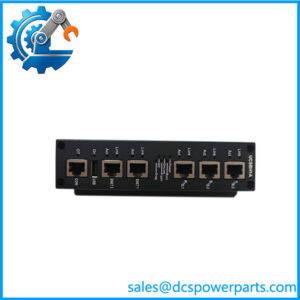
| Network | Dual IONet ports, redundant I/O network to the controller; no fieldbus protocol on the pack |
| Mounting | Pack seated on the terminal board, secured by captive screws; board carries the field terminals |
| Certification | IECEx UL 21.0067X (Ex “ec” increased safety / Ex “ic” intrinsic safety) with corresponding UL and ATEX listings; Mark VIe system certification covers the pack-and-board combination |
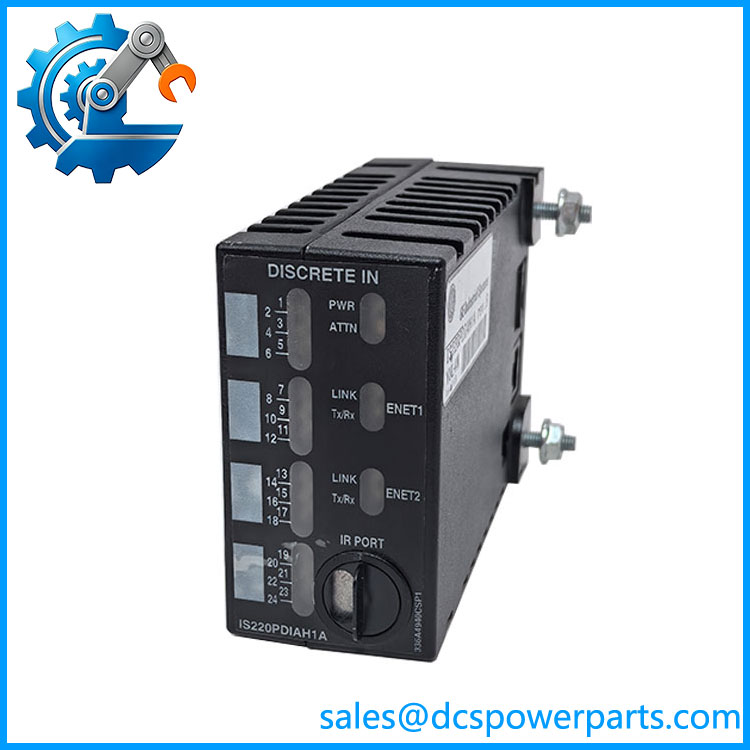
GE IS220PDIAH1A
Key Features and Advantages
Wetting decided at the terminals, not in the pack: the PDIA architecture puts the contact wetting supply on the terminal board, metres closer to the field contact than any cabinet-mounted supply would be. Long runs to a limit switch on a valve bonnet see a stiff wetting source and a defined current, so a contaminated contact reads as open rather than as a maybe — and the wetting current is a published number per board, not a guess.
Grouped wetting for the awkward channels: on the STCIH8A/TBCIH4C/TBCIS4C boards, channels 22–24 wet at 41 mA while 1–21 wet at 10 mA. That grouping exists for contacts that need more current to break through film — typically the ones on long cable runs or in dirty locations — and knowing which three channels are which is the difference between a reliable interlock and a channel that reports “open” once a month.
A 55 Vdc contact class for station batteries: with IS400STCIH4A, IS400STCIS4A or IS400TBCIH3C the same pack reads contacts sitting on a 48/55 Vdc DC system, which is what a switchyard or a DC auxiliary board actually provides. A 24 Vdc-only card in that cabinet would read every status wrong, and no amount of configuration fixes it.
Field wiring stays put during replacement: the pack unplugs from the terminal board while every field conductor, shield and ferrule remains terminated. On a machine that is running, that is the whole point of the packaged I/O concept — a pack swap is minutes, and a wiring re-termination is an outage with a risk of a wrong wire.
No hardware address to get wrong: the pack carries no address switches; its identity, channel mapping and scan behaviour come from the controller’s ToolboxST configuration over IONet. That removes the classic failure of a replacement pack set to the wrong node, and replaces it with a different discipline — the configuration must already exist and match.
Two IONet ports, one network discipline: the pack connects to the Mark VIe I/O network through dual ports, so a redundant IONet keeps reporting when one path or one switch port fails. The pack does not arbitrate between them at the application level; the controller’s I/O network design does.
Revision visibility on the label: IS220PDIAH1A with 336A4940CSP1 versus the later H1B build. The suffix is the only thing on the outside that tells a fitter which generation is in his hand, and the difference is real even when the connector is identical.
Honest diagnostic behaviour: a dead channel is not automatically a dead pack. Because the wetting source, the terminal and the field conductor all live on the board side, the first test is the terminal — wetting voltage present, contact resistance changing, channel LED responding — before a spare pack is booked out of the store.
Applications
Turbine trip and protection inputs: lube-oil pressure low, hydraulic supply pressure low, overspeed switch, fire detection contacts, emergency stop pushbuttons. The IS220PDIAH1A reads these as hard contacts that must not be filtered into ambiguity; the grouped-wetting board is the usual choice where a contact sits at the end of a long run in a hot enclosure.
Valve and actuator position feedback: limit switches on fuel gas control valves, IGV actuators, bleed valve and stop/control valve assemblies, where the pack’s 24 channels map neatly onto a valve train and where a stuck “open” indication is a real hazard rather than an inconvenience.
Breaker, disconnector and auxiliary status in a plant DC system: with the 55 Vdc terminal boards the same pack reads switchyard and auxiliary-board contacts directly, avoiding interposing relays that add a failure point and a commissioning step each.
Balance-of-plant and auxiliary skids: pump and fan run status, filter differential pressure switches, level switches, damper end switches — the bulk of a cabinet’s boolean content, which is exactly what a 24-channel pack is for.
Packaged I/O retrofit and legacy Mark VI/VIe estates: frames where the terminal boards are already installed and only the pack is being renewed, which is the ordinary maintenance case for this part and the one where generation matching matters most.
Hazardous and classified areas: the pack-and-board combination carries IECEx “ec”/”ic” certification with corresponding UL and ATEX listings, so it can sit in the Zone 2 / Division 2 cabinets that surround gas skids and fuel-gas conditioning, provided the approved board pairing is used.
Related Products
IS220PDIAH1B — the later generation of the same discrete input pack; listed in the current Mark VIe IECEx certificate and the correct current-build reference when a frame is being renewed. IS221PDIAH1B — the companion PDIA form in the same certificate family, used with the IS221-series terminal boards; not interchangeable with an IS220 slot. IS42yPDIAH1C — the RoHS/redesigned PDIA variant (x = 2 or 4, y = 0 or 1) with its own board list. IS220PDIIH1B — Isolated Discrete Input pack; different input class (ISx0ySDIIH1A boards), so it is not a drop-in alternative to the PDIA. ISx2yPDIOH1B — Discrete I/O pack, contact inputs plus 32 Vdc/3.15 A contact outputs; use it where the cabinet needs both directions rather than a pure input pack. IS20ySTCIH1A — simplex contact-input terminal board, 32 Vdc wetting at 110 mA; the standard pairing for the IS220PDIAH1A. IS20ySTCIH8A — contact-input terminal board with grouped wetting (10 mA on 1–21, 41 mA on 22–24). IS400TBCIH3C — high-voltage contact-input terminal board, 55 Vdc class, for DC-system status inputs. IS220PSVOH1A — servo control pack in the same Mark VIe family; shares the pack mechanics and IONet interface but drives valve position loops instead of reading contacts.
Installation and Maintenance
Before installation: identify the terminal board already in the cabinet and its contact class, then choose a pack that matches the slot’s generation — only replaces an H1A position, and an IS220PDIAH1B belongs where the frame expects the later build. Confirm the pack supply is 24–28 Vdc and that the IONet drop for this slot is configured in ToolboxST before the pack is fitted; a pack with no matching configuration will come up but will not serve the loop. Confirm the terminal board’s wetting supply is present and its field conductors are sound, and isolate the corresponding input group if the machine is being worked on.
Replacement: the pack can be withdrawn from its terminal board without disturbing field wiring, which is the point of the design; on a non-redundant slot the inputs are lost while the pack is out, so plan the swap against the machine state rather than against convenience. Seat the replacement fully, tighten the captive screws, restore supply, and watch the pack’s status indication settle before confirming the drop online. Do the same swap on the terminal board only when the board itself is at fault, and re-check every field termination afterwards.
Maintenance: the recurring work on this part is on the board side, not the pack. Verify wetting voltage at the terminals at each outage, check contact resistance through the field loop with the contact operated, inspect ferrules and shields for corrosion in sulphur-laden cabinets, and confirm that channels 22–24 on a grouped board are the ones carrying the high-current contacts they were assigned. A channel that fails only when the plant is warm is a terminal or a field contact; a pack that loses several channels at once, or drops off IONet, is the pack. Keep one tested spare of the correct generation per frame, and record the assembly code so the next order is not filled with a look-alike.
Warranty and Quality
Every is supplied as the Mark VIe discrete input pack it actually is — 24 contact inputs, 24–28 Vdc pack supply, terminal-board-defined wetting, dual IONet ports — and never as the “16 in/16 out”, “8 analog input” or “analog expansion” module that careless listings describe. Each unit is identified by label before dispatch, so the buyer sees the part number, the 336A4940CSP1 assembly code and the generation that will arrive, and the terminal-board pairing is confirmed against the buyer’s cabinet before the order ships. Packs are inspected for connector and captive-screw integrity, seal and housing condition, and evidence of prior rework; where a Mark VIe bench is available they are powered and checked for status indication, IONet communication on both ports, channel-by-channel response with a contact simulator, and stable reading under wetting load. A 12-month repair, replacement or refund commitment applies. Support covers what this part actually raises: which terminal board sets which contact class, why channels 22–24 wet differently, how H1A and H1B differ in practice, how to prove a dead channel is the field loop rather than the pack, and what to check in ToolboxST before a replacement is fitted.