Description
Product Overview
FBM202 is a thermocouple and millivolt input module for the Foxboro 200 Series I/O subsystem — the Fieldbus Module family that sits on a baseplate and talks to a control processor over a redundant 2 Mbps module Fieldbus. Foxboro’s product specification is unambiguous about what it is: eight thermocouple input channels plus one isolated RTD reference junction compensation channel for terminal temperature sensing, each input galvanically isolated from the other channels and from ground, each with thermocouple burnout detection that drives the reading upscale.
The ordering code matters before anything else. P0926EQ is the module part number in the earlier I/A Series documentation; the Foxboro Evo specification lists the module as RH926EQ, explicitly “supersedes P0926EQ”. That is a supersession of the ordering generation, not a change of function: the slot, the baseplate, the termination assemblies and the application program are the same. But it is the first thing a buyer should understand about a P0926EQ offer, because a replacement sourced against the old code and a module shipped under the new code are the same article in different catalogue clothing — and a quotation that treats them as different products is selling paperwork, not hardware.
The engineering idea that makes this module worth understanding is where the cold junction lives. A thermocouple measures the difference between two junctions, so the terminal temperature has to be known to convert millivolts into degrees. In the 200 Series, that reference junction is not inside the module: it is an isolated 4-wire 100 Ω platinum RTD (IEC 751 Class B) built into the termination assembly. The DIN-rail TA carries one such RTD for its eight channels; the baseplate-mounted TA carries one RTD for each of the two FBM202s it serves. This changes the maintenance logic completely. Replacing the module swaps the electronics; replacing the termination assembly swaps the thermometer every temperature loop depends on. A plant that keeps spare modules but not spare TAs has spares for half the measurement chain.
The signal path is deliberately narrow and quiet. Each channel has its own sigma-delta converter, which can produce a new reading every 25 ms, and the module averages those readings over a configurable integration period to reject process noise and power-line frequencies. That integration period is an engineering decision, not a factory default to leave alone: too short and the loop chases noise, too long and it lags a genuine temperature excursion. Foxboro also exposes a Rate of Change Limit in the analog input application program, which is the module-level answer to a sensor that fails in a way that produces plausible but impossible movement.
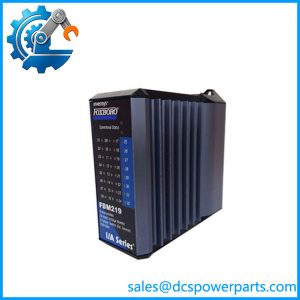
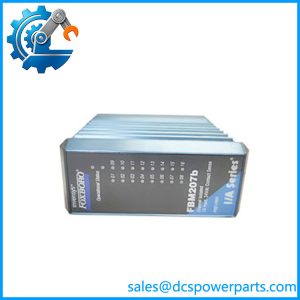
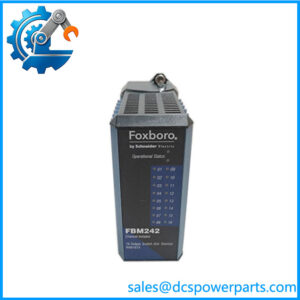
Physically it is a 45 mm wide, 284 g extruded-aluminium module, 102 mm high (114 mm with lugs) and 104 mm deep, rated for Class G3 harsh environments per ISA S71.04 and for −20 to +70 °C operation. It mounts on a DIN-rail or rack-mounted baseplate holding four or eight FBMs, or on a 100 Series conversion mounting structure — which is the point of the module: connected to the right termination assemblies it delivers the functionality of the 100 Series FBM02, so an old subsystem can be renewed without rewiring the field.
Technical Specifications
| Parameter | Value |
|---|---|
| Model / ordering code | FBM202 — module part number P0926EQ, superseded by RH926EQ |
| Manufacturer | Foxboro (Schneider Electric), I/A Series / Foxboro Evo / EcoStruxure Foxboro DCS |
| Product type | Fieldbus Module (FBM), 200 Series analog input, thermocouple/mV |
| Input channels | 8 thermocouple/mV channels, each galvanically isolated from other channels and ground |
| Reference junction | 1 isolated RTD channel for terminal temperature sensing; RTD is integral to the termination assembly |
| RTD type (TA) | 4-wire 100 Ω platinum, IEC 751 Class B |
| Cold-junction architecture | One RTD per DIN-rail TA (8 channels); one RTD per FBM202 in a baseplate-mounted TA (16 channels / 2 modules) |
| Conversion | Sigma-delta per channel; new analog input reading every 25 ms; configurable integration period |
| Diagnostics | Thermocouple burnout detection, upscale; Rate of Change Limit configurable in the analog input application program |
| Fieldbus | Redundant 2 Mbps module Fieldbus; accepts communication from path A or B |
| Mounting / baseplate | Baseplate-mounted, 4 or 8 FBM slots; DIN rail (horizontal or vertical) or 19-inch rack kit; also 100 Series conversion mounting structure |
| Dimensions / weight | 102 mm H (114 mm with lugs) × 45 mm W × 104 mm D; approx. 284 g |
| Environmental | −20 to +70 °C operating, −40 to +70 °C storage; 5–95 % RH non-condensing; −300 to 3000 m; Class G3 harsh per ISA S71.04; vibration 0.75 m/s² (5–500 Hz) |
| Certification | UL/UL-C Class I Div 2 Groups A–D T4 (enclosure-based); ATEX/CENELEC (DEMKO) EEx nA IIC T4, Zone 2; EMC EN 61326-1:2013 Class A; RoHS |
| Termination assemblies | P0916AC / P0916XH (DIN rail, compression); P0916AD / P0917JL (DIN rail, ring lug); P0928CN (baseplate-mounted, compression) |
| Termination cable | 37-pin D-sub at baseplate end, 25-pin D-sub at TA end; up to 30 m; PUR or LSZH |
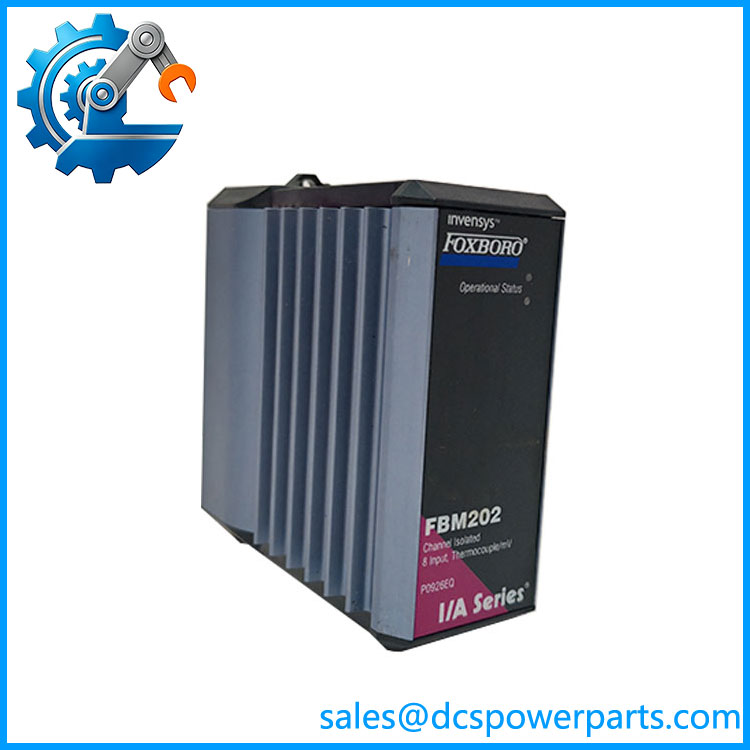
FBM202-P0926EQ
Key Features and Advantages
Eight isolated thermocouple channels in 45 mm: the FBM202 puts eight temperature loops into a single-width module with channel-to-channel isolation, so a grounded thermocouple on a furnace shell and a floating one on a pipe do not fight each other through a shared reference.
Cold junction in the termination assembly, declared openly: Foxboro’s design puts the reference RTD in the TA rather than the module. That is an advantage and a maintenance obligation at the same time — it keeps the reference at the terminals where the thermocouple wires actually land, eliminating the error of measuring cabinet air instead of terminal temperature, but it means the TA is a calibrated part of every temperature loop.
Sigma-delta per channel with a tunable integration period: 25 ms readings plus configurable averaging is the difference between a signal that survives a cement kiln’s electrical noise and one that reports it. The integration period is the first thing to set deliberately at commissioning.
Burnout detection that fails safe: an open thermocouple drives the reading upscale instead of quietly reporting ambient, so a broken sensor trips the high alarm rather than hiding inside a plausible number.
Rate of Change Limits at the module level: a sensor that fails with a drifting output — the failure mode burnout detection cannot see — produces an implausible rate of change, and the analog input application program can flag it without a custom control block.
Single-module replacement without disturbing field wiring: the module can be removed and replaced without removing field termination cabling, power or communications cabling. On a running unit, that is the difference between a swap and a re-termination.
Two Fieldbus paths, no switchover logic in the module: the FBM accepts communication from either path of the redundant 2 Mbps Fieldbus and keeps working over whichever path is active — the availability lives in the baseplate and the system, not in the card.
A direct replacement for 100 Series FBM02: with the appropriate termination assemblies, the FBM202 delivers the functionality of the older FBM02, and a Termination Assembly Adapter lets existing field wiring be reused. That is how a 1990s I/A Series installation gets renewed without a field-wiring project.
Certified for the places temperature measurement actually happens: Class I Div 2 and Zone 2 EEx nA IIC T4 ratings, Class G3 contamination tolerance and a −20 to +70 °C range cover the cabinet beside a reformer or a reheating furnace, not a clean laboratory.
Applications
Furnace and kiln temperature in cement and lime: burning-zone and kiln-shell thermocouples, where the FBM202’s channel isolation keeps shell and process readings independent and its integration period is set long enough to survive the electrical environment of a kiln drive.
Reforming and petrochemical furnaces: tube-skin and outlet-header thermocouples in hydrogen and methanol plants, where a single open thermocouple must alarm rather than silently reduce the reported tube metal temperature — the reason burnout upscale matters more than absolute accuracy on these loops.
Boilers and CFB units: bed, cyclone and furnace-exit gas temperature points, plus metal temperature monitoring where a group of thermocouples shares one cabinet and one reference junction.
Steel reheating and heat-treatment furnaces: zone control and slab temperature monitoring on walking-beam and batch furnaces, in the same electrical neighbourhood as SCR power supplies and heavy drives.
Glass furnaces and forehearths: multi-zone thermocouple arrays where eight channels per module matches a zone group, and where the TA’s reference RTD sits close to the terminal block rather than in a distant cabinet.
Millivolt process signals: zirconia oxygen probe outputs, pH and other millivolt-level sensors that are not thermocouples but need the same low-level, isolated acquisition path.
Legacy I/A Series renewal: the largest practical use today — a 100 Series subsystem with FBM02 modules being replaced by on 200 Series baseplates, using conversion mounting structures or a termination assembly adapter to keep the existing field wiring.
Related Products
RH926EQ — the current module part number that supersedes P0926EQ; same , different catalogue generation, and the code to quote for a new-specification order. FBM02 — the 100 Series module whose functionality reproduces when fitted with the appropriate termination assemblies. FBM201 — 200 Series analog input module for 0–20 mA current loops; the current-input counterpart in the same baseplate and Fieldbus. FBM203 — 200 Series RTD input module; the right choice for a resistive temperature sensor, where a thermocouple module is not. FBM204 — 0–20 mA analog I/O module (4 in / 4 out) in the same 200 Series family. FBM205 — 0–20 mA analog output module, the output counterpart for the same subsystem. FBM207 / FBM211 — 16-channel discrete input modules used alongside temperature I/O in the same cabinets. P0916AC / P0916AD — DIN-rail termination assemblies for , compression and ring-lug respectively; each carries the reference RTD for eight channels. P0928CN — baseplate-mounted termination assembly serving two modules and sixteen channels, with one reference RTD per module.
Installation and Maintenance
Before installation: decide the termination assembly first, because it carries the cold junction. Confirm whether the cabinet needs a DIN-rail TA (compression P0916AC/P0916XH or ring-lug P0916AD/P0917JL) or a baseplate-mounted P0928CN, and confirm the baseplate slot pair — baseplate TAs serve modules in slots 1&2, 3&4, 5&6 or 7&8, so a module in the wrong slot has no reference junction at all. Verify the thermocouple type and range configured in the I/A Series database against the actual sensor, check that the termination cable is Type 2 with a 37-pin D-sub at the baseplate end and a 25-pin at the TA end, and confirm the 30 m limit is not exceeded in a cabinet where the TA is mounted remotely. Isolate the field circuits before wiring; a thermocouple loop has no voltage worth fearing but plenty of ways to be damaged.
Fitting: mount the module on its baseplate and connect the termination cable, then land the thermocouples as two-wire pairs, observing polarity and keeping the run away from drive and SCR wiring. Do not remove field termination cabling to swap a module — Foxboro’s design allows replacement with the cabling in place — but do verify the TA’s reference RTD wiring is intact and its terminals are clean, because a corroded RTD terminal corrupts all eight channels by the same offset. Power up, confirm the module’s red/green status LEDs settle, and check each channel against a known temperature before returning the loop to service.
Maintenance: the recurring work is not on the module. Inspect TA terminals for corrosion and thermocouple degradation at each outage, verify the reference RTD reading against cabinet temperature, and re-check the integration period and Rate of Change Limit if a loop starts chasing noise or masking a slow sensor failure. Treat a persistent burnout alarm as a field-wiring finding, not a module fault. Keep a spare and, more importantly, a spare termination assembly of the installed type; record the ordering code on the module label (P0926EQ or RH926EQ) and the TA part number in the loop file so the next replacement is ordered against the right generation.
Warranty and Quality
Each is supplied as the 200 Series thermocouple/mV input module it is — eight isolated thermocouple channels plus the isolated RTD reference-junction channel — with the ordering code, revision and slot-pair requirement verified against the buyer’s baseplate layout and termination assembly type before dispatch, because a module that arrives without a compatible TA has no cold junction and will read every loop wrongly. Units are inspected for the extruded-aluminium housing and faceplate condition, connector and pin integrity, label and code legibility, and evidence of prior rework or substitution; where a 200 Series baseplate and a -compatible TA are available, modules are powered and checked for status indication, Fieldbus communication over both paths, per-channel acquisition with a millivolt source, burnout detection behaviour and reference-junction reading. A 12-month repair, replacement or refund commitment applies. Support covers the practical questions this part raises: how relates to the superseding RH926EQ, which termination assembly fits which cabinet, why the cold junction lives in the TA and how to test it, how to choose the integration period, what upscale burnout does to a control loop, and how a 100 Series FBM02 installation is migrated to without touching field wiring.