Description
Product Overview
8200-1302 is a part number, and the part number is the whole point. Woodward builds the 505D digital governor in three power and compliance variants that share one manual (26839, in two volumes): 8200-1300 for standard locations on 18–32 V DC, 8200-1301 for standard locations on 88–132 V AC or 90–150 V DC, and 8200-1302 for marine and hazardous-rated locations on 18–32 V DC. The control program, the I/O count, the front panel and the tuning are the same across all three. What changes in the 1302 is the low-voltage DC input stage and the compliance package that lets the unit be installed where a ship’s classification society or an Ex assessor is going to look at it.
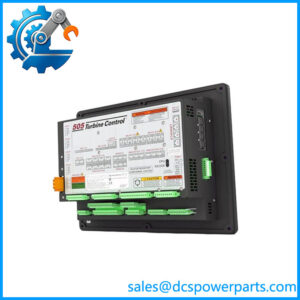
The device itself is a field-configurable steam turbine governor with an operator control panel built into the same chassis: a graphical display and keypad on the front, terminal blocks for field wiring behind. It drives one or two throttle valves — single actuator, or split range where a second valve takes over above a demand threshold — and it controls one turbine parameter at a time while limiting operation on others. Speed or load is the usual controlled variable, but the same platform can be configured to hold inlet pressure or flow, exhaust pressure, first-stage pressure, generator power, plant import/export, compressor discharge pressure, process temperature or unit frequency.
Five PID controllers shape the inlet steam demand: the speed/load loop, auxiliary, auxiliary 2, cascade, plus an optional isolated loop that drives an independent analogue output for ancillary duty such as seal gas or lube oil pressure. Around them sit the functions that make a governor usable on a real turbine: three critical-speed avoidance bands, hot and cold auto-start sequences, first-out trip and alarm indication with real-time-clock timestamps, ten external trip inputs, ten external alarm inputs, zero-speed detection, peak-speed capture for overspeed investigation, acceleration protection during start-up, remote droop and frequency deadband.
Two redundant speed inputs accept magnetic pickups, proximity probes or eddy-current probes, with open-wire detection on the MPU signals — the failure mode that silently removes a governor’s only view of shaft speed. Twenty contact inputs and eight Form-C relay outputs complete the discrete side, the first relay dedicated to trip and the second defaulting to alarm summary.
Configuration is done from the front panel with password-protected levels. Entering configuration mode forces the hardware into IO LOCK: relays de-energise and analogue outputs drop to zero current, so a live turbine cannot be moved while someone is editing the program. This is the feature that makes the 505D safe to work on in a plant where the governor cannot simply be switched off.
The 505D family has since been joined by the 505XT for extraction and admission turbines and by the Peak200 for Zone 2 panel applications, but the 505 remains the reference governor on a very large installed base of single and split-range machines — mechanical-drive turbines, back-pressure generators and marine auxiliary sets. A 1302 is ordered when the existing unit is a 1302, or when the new location demands its approvals; it is not an upgrade over the 1300.
Technical Specifications
| Parameter | Value |
|---|---|
| Model / part number | 8200-1302 (505D, LVDC, Marine, HAZLOC) |
| Manufacturer | Woodward, USA |
| Product type | Steam turbine digital governor with integrated operator panel |
| Application | Single or dual (split-range) actuator steam turbines |
| Input power | 18–32 V DC, low-voltage variant |
| Speed inputs | 2 redundant, configurable for MPU, proximity probe or eddy-current probe |
| Analogue inputs | 8 programmable 4–20 mA inputs |
| Contact inputs | 20, first four defaulted to shutdown, reset, raise and lower set point |
| Actuator outputs | 2, configurable 4–20 mA or 20–160 mA with linearisation |
| Analogue outputs | 6 × 4–20 mA, function-configurable |
| Relay outputs | 8 Form-C, relay 1 dedicated trip, relay 2 default alarm summary |
| Communications | 1 serial port RS-232/RS-485 (ASCII or RTU Modbus), 2 Ethernet ports (Modbus TCP) |
| Hazardous area rating | Class I Div 2 Groups A–D / Class I Zone 2 Group IIC; Zone 2 Group II per EN 60079-15 type ‘n’ |
| Marine approval | Lloyd’s Register type approval, environmental categories ENV1–ENV3 |
| Mounting | Front panel mount, integrated display and keypad |
| Documentation | Woodward manual 26839, Volumes 1 and 2 |
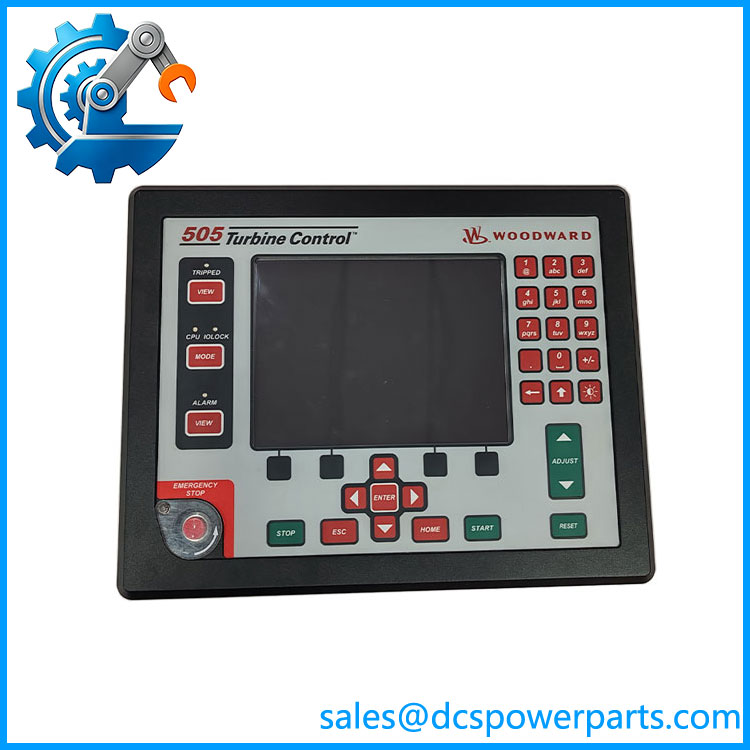
8200-1302
Key Features and Advantages
One part number, one compliance envelope: the 8200-1302 carries the marine and hazardous-location approvals that the 8200-1300 does not, on the same 18–32 V DC input. On a ship or a Zone 2 skid, that approval is not paperwork — it is the difference between a governor that can be installed and one that a surveyor or Ex assessor will reject. Ordering the standard variant to save cost buys a unit that has to be replaced at commissioning.
Low-voltage DC input matched to ship and skid supplies: 18–32 V DC spans the nominal 24 V battery and DC system window used on vessels and in remote packages, including the dip during engine start. No inverter, no separate AC feed, no additional conversion stage inside the cabinet.
Governor and operator panel in one chassis: the display and keypad are part of the unit, so local start-up, valve stroking, tuning and alarm acknowledgement do not need an external HMI or a laptop on a lead. On a machinery space flat or a skid deck, that is one less enclosure to mount and one less cable to run.
IO LOCK as a safety behaviour, not a setting: configuration mode de-energises every relay and forces all analogue outputs to zero current. The turbine cannot be moved by a partially edited program, and the state is visible rather than implied.
Five PIDs and a full protection set: speed/load, auxiliary, auxiliary 2 and cascade loops cover pressure, flow and power limiting, while the isolated fifth loop gives ancillary control without consuming a valve. Three critical-speed bands, hot/cold auto-start, acceleration limiting and zero-speed detection are functions a turbine needs and a generic PLC does not provide out of the box.
Speed measurement that declares its own failure: two redundant inputs on MPU, proximity or eddy-current probes, with open-wire detection on the MPU channels. A governor that loses its speed signal without saying so is the most dangerous version of a governor; the 505 reports it.
First-out trip diagnosis with timestamps: alarm and trip events are logged first-out with real-time-clock stamps, so the cause of a shutdown is identifiable after the fact instead of reconstructed from operator memory. Ten external trip inputs and ten alarm inputs give the protection scheme room to bring in its own devices.
Two protocols, no gateway: Modbus RTU on the serial port and Modbus TCP on two Ethernet ports, for DCS or HMI integration. The same data is available both ways, which matters when one path is the plant network and the other is a local maintenance link.
Field-proven architecture across three variants: the 1300, 1301 and 1302 share a manual, a configuration structure and a service toolset — Control Assistant, Servlink-to-OPC Server, Appmanager and RemoteView. A site that already runs 505s can support a 1302 with the tools it already has.
Applications
Marine steam turbine applications: auxiliary turbine-generator sets and steam-driven cargo or service machinery on vessels, where the governor must hold frequency and speed under rolling load and must satisfy the classification society’s environmental categories. The 8200-1302 is the variant that belongs in that machinery space, on the ship’s 24 V DC supply.
Offshore and hazardous-rated packages: Zone 2 modules and skids carrying steam turbine drives, where the enclosure and the control’s own certification determine whether the package can be installed at all. Purchasing the 8200-1302 rather than a standard 505 avoids the retrofit that a Zone 2 assessment otherwise forces.
Refinery and petrochemical mechanical drives: steam turbines driving compressors, pumps and fans, governed on speed with suction or discharge pressure held by an auxiliary or cascade loop, and with generator power or plant import limited when the machine is also feeding a bus.
Captive and industrial power generation: back-pressure and condensing turbine-generators in plants with their own steam balance, where the governor holds frequency in island mode and load when paralleled, with isochronous load sharing coordinated through a DSLC-2.
Pulp, paper, sugar and district heating: process steam turbines where exhaust pressure or extraction pressure is the real controlled variable and speed is the constraint. The cascade and auxiliary loops let one governor hold the process while protecting the machine.
Replacement of existing 505 installations: sites with a failed 8200-1302 in a marine or hazardous location, where the replacement must carry the same part number because a 8200-1300 will not satisfy the original approval basis, even though the terminals and the program look identical.
Related Products
8200-1300 — 505D, LVDC, standard compliance; identical control, same 18–32 V DC input, without the marine and hazardous-location approvals. 8200-1301 — 505D, AC/DC, standard compliance; 88–132 V AC or 90–150 V DC input for plants without a 24 V DC control supply. 8200-1311 — 505XT, AC/DC, extraction/admission; the next-generation governor for turbines that need extraction or admission control, which the 505D cannot perform. 8200-1505 — Peak200, LVDC, Zone 2 ATEX; panel-mounted colour-display governor with integrated overspeed protection, the current option for Zone 2 applications. DSLC-2 — generator synchroniser and load control; provides isochronous load sharing between units governed by 505 controllers. VariStroke II — electro-hydraulic actuator; the valve actuator family typically stroked and calibrated from the 505 configuration and service screens. MFR300 — multi-function relay for protection and breaker control; complements the governor’s own trip and alarm outputs. SPC (Servo Position Controller) — interface for servo-driven valve positioning where the throttle valve is not driven by a conventional actuator. Real Power Sensor — power measurement device with a 2.5 Hz low-pass filter on its output; the sensor Woodward references for generator power and import/export control loops. EGCP-3 LS — engine-generator control package and load sharing; used with the 505 as synchroniser and load control through the speed bias input.
Installation and Maintenance
Before installation: confirm the delivered unit is 8200-1302 and not a 1300 or 1301, because the terminals will accept the wiring either way and the difference only shows up at survey or at the first hazardous-area inspection. Verify the DC supply is within 18–32 V DC and sized for the panel’s load, and confirm the location’s classification matches the unit’s rating — Class I Div 2 A–D, Zone 2 IIC, or Zone 2 Group II per EN 60079-15 ‘n’. Field wiring must be stranded copper rated at least 75 °C where the ambient can exceed 50 °C. Mount the control on the front panel where the display is readable and the keypad reachable, earth the chassis per the manual, and record the existing configuration and tuning before removing any working unit.
Commissioning follows the manual’s order rather than convenience: define the turbine type and actuator arrangement, calibrate and stroke the actuators through the calibration screens, prove the two speed inputs and their open-wire detection, then test the start permissives and the trip path with the external trip inputs. Enter configuration mode deliberately, knowing that the control will hold IO LOCK with relays de-energised and analogue outputs at zero — and that leaving it in that state is itself a fault condition on a running machine.
Maintenance practice: read the first-out trip and alarm log with its timestamp after every shutdown, and treat repeated trips from the same input as a wiring or device problem rather than a control problem. Check actuator calibration drift at each major outage, verify critical-speed bands against the current rotor data, and keep the configuration file archived so a replacement can be loaded rather than re-engineered. Spares should be held as 8200-1302 specifically; a standard 505 kept “just in case” will fit the cubicle and will not satisfy the approval basis it was bought to preserve.
Warranty and Quality
Each 8200-1302 is supplied as the Woodward 505D governor in its marine and hazardous-location build, with the part number verified against the label and the delivered configuration recorded, and with the variant distinction made explicit at order stage — because a governor that is correct in every respect except its approval basis is not a usable spare on a vessel or in a Zone 2 area. Units are inspected for display and keypad condition, terminal-block and connector integrity, enclosure and marking, and evidence of prior installation; where a test bench is available, they are powered within the 18–32 V DC window and checked for boot behaviour, display function, speed-input response and communications on both the serial and Ethernet ports. A 12-month repair, replacement or refund commitment applies. Technical support covers what this product actually turns on: whether the application needs the 1302 or the 1300, whether the turbine requires a 505XT instead, how to calibrate split-range actuators, how to read first-out trip data, how to archive and reload a configuration, and how to prepare a replacement for survey without discovering the compliance question at commissioning.
免费
今天 09:25