Description
Product Overview
RH101FQ is the part number of the Foxboro FDC280 Field Device Controller — not a baseplate, not an adapter, not a driver licence. The module itself is a distributed, optionally fault-tolerant, field-mounted controller that both executes a control strategy and talks directly to field devices, so that PLCs, drives, analysers and skid packages can be brought into the Foxboro DCS over Ethernet and serial links without a separate fieldbus module in between. Foxboro’s own specification draws the architectural conclusion explicitly: the FDC280 removes the need for additional Fieldbus Modules for the device types it supports, and cuts footprint and wiring by roughly half against the older CP-plus-FDSI arrangement.
The internals are what make that possible. The module runs a dual-core CPU with two separated computational environments: Core 1 is the Control Core, running the control software and the Control Network communications software; Core 2 is the I/O Core, running the device integration software — the Modbus TCP client, Modbus RTU serial, EtherNet/IP scanner, PROFINET IO controller, OPC UA client and Triconex system access drivers. The two cores exchange data over an internal bus, which is why a driver download or a device-side comms fault does not simply stop the control program.
What the module is not is equally important. Unlike the FCP280 control processor, the FDC280 has no PIO bus at all: it is built for Ethernet and serial device integration, not for driving 200 Series fieldbus I/O modules. A site that needs distributed I/O on PIO keeps its FCP280; a site that needs to absorb third-party devices uses the FDC280. Confusing the two because both are “Foxboro 280 controllers” is the most expensive mistake in this product family.
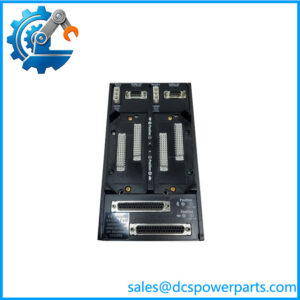
The physical package is a field-mounted, die-cast aluminium module that needs no venting, mounted on a keyed two-position DIN-rail baseplate — RH101KF — carrying the network adapters and the field connectors. A fault-tolerant pair is two modules in adjacent slots of that baseplate, joined by the fault-tolerant connector built into it, so the pair can exchange data at high speed and stay cooled. The baseplate supplies the two field-Ethernet RJ-45s, two RJ-45 Time Strobe connectors that take the strobe cables directly without adapters, and two 37-pin D-sub connectors that carry four serial ports each.
Connectivity to the control network is 100 Mbps Ethernet, fibre or copper, through adapters mounted on the baseplate: RH924WA for fibre at Rev E or later, RH924UQ for copper at Rev D or later. Field-device Ethernet is separate, 10/100 Mbps or 1 Gbps over Cat 5e or Cat 6, into customer-supplied switches.
The module carries an LCD whose second line reports its own part number, image version, hardware revision including manufacture date, and control-network link status — a genuinely useful feature when a spare has to be proven identical to the module it replaces. The FDC280 is certified ISASecure EDSA Level 1, is CE marked, and is rated for Class G3 harsh environments. It requires a host workstation running Foxboro Control Core Services v9.3 or later.
Technical Specifications
| Parameter | Value |
|---|---|
| Model / part number | FDC280, RH101FQ |
| Baseplate | RH101KF, two-position, keyed, DIN-rail mounted |
| Network adapters | RH924WA fibre (Rev E or later); RH924UQ copper (Rev D or later) |
| Product type | Field-mounted, optionally fault-tolerant controller with device integration |
| Processor | Dual-core: Core 1 control, Core 2 device integration drivers |
| Field device Ethernet | 2 × RJ-45, 10/100 Mbps or 1 Gbps, Cat 5e / Cat 6 |
| Serial ports | 2 × 37-pin D-sub, four ports each, 8 serial ports total via termination assemblies |
| Time strobe | 2 × Cat 5 RJ-45 on the baseplate, direct connection without adapters |
| Capacity | Up to 256 field devices and up to 8000 points, driver and sizing dependent |
| Control network | 100 Mbps Ethernet, fibre or copper, via baseplate adapter |
| Supply | 24 V DC from the 200 Series baseplate |
| Environment | Class G3 harsh environment, die-cast aluminium, no venting required, CE |
| Dimensions / weight | 105 mm (116 mm with lugs) × 51.8 mm × 147 mm; 0.8 kg single module |
| Security certification | ISASecure EDSA Level 1 |
| Host software | Foxboro Control Core Services v9.3 or later |
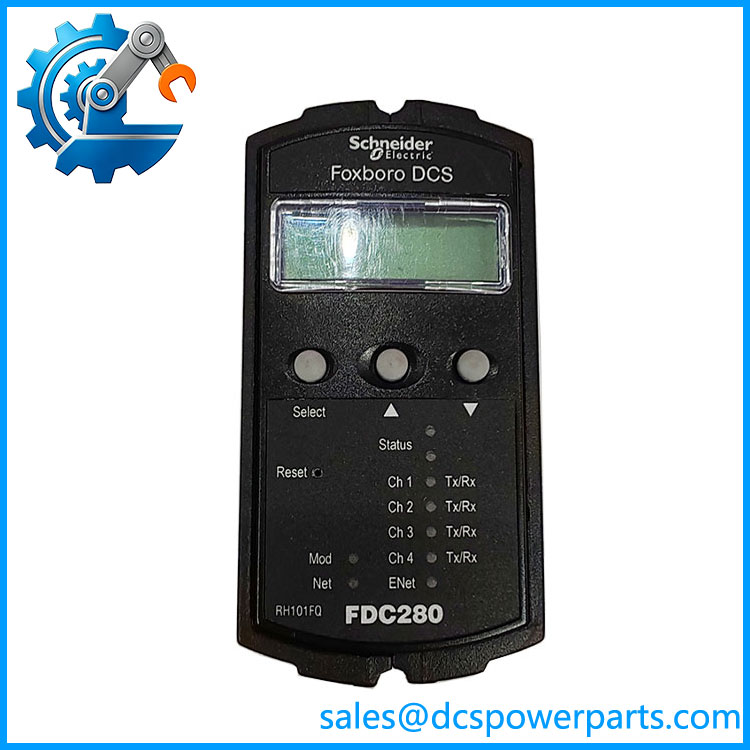
FDC280 RH101FQ
Key Features and Advantages
Two cores, two jobs, one module: keeps control execution on Core 1 and device protocol handling on Core 2, joined by an internal bus. In practice that means a Modbus device that stops answering, or a driver download on the integration side, does not take the regulatory control program with it — the separation is architectural, not a matter of task priority.
Controller and gateway in one slot: the module performs regulatory, logic, timing and sequential control internally, and it also collects data from Ethernet and serial devices, converts it, and holds it in its database for display, historisation and control blocks. Replacing a CP plus FDSI pair with one RH101FQ halves the cabinet footprint and the wiring, which is the reason Foxboro states 50 percent less space and cabling against the older arrangement.
No PIO bus, deliberately: the is built for device integration, so it carries no programmed I/O bus. That is an advantage where the job is absorbing skid PLCs and analysers — the module’s whole I/O budget goes to Ethernet and serial — and a hard limitation where the job is 200 Series fieldbus I/O. Sites that try to use it as a general-purpose controller discover this the hard way.
Eight serial ports on two D-sub connectors: each 37-pin connector carries four serial channels, giving eight ports per module through the appropriate termination assembly. For a compressor station or a wellpad with a cluster of Modbus RTU devices, that is a lot of serial integration in one field-mounted box, on Type 5 cables up to 5 m to the termination assemblies.
Field-mounted packaging that needs no cabinet: die-cast aluminium, no venting, Class G3, CE, mounted remotely on a DIN-rail baseplate in a field enclosure. The controller can therefore sit near the equipment it integrates rather than in a central rack, with the control network over fibre up to 2 km from the switch.
Fault tolerance built into the baseplate: two modules in adjacent keyed slots, joined by the baseplate’s fault-tolerant connector, with the pair able to reach field devices over separate networks. The keying exists so a controller module cannot be seated in a slot it was not designed for — worth knowing before anyone forces a module into the wrong bay.
Self-identifying hardware: the LCD’s second line reports part number, image version, hardware revision and manufacture date. On a spare-part transaction, that readout is the difference between shipping the right image and shipping a module that boots into an incompatible system.
Cyber-security posture stated, not implied: ISASecure EDSA Level 1 certification, driver downloads that can be applied as a minor image update without disturbing the rest of the system, and encrypted device communications that are logged and decrypted by the Diagnostic application rather than captured off the wire.
Applications
Oil and gas gathering and compression: wellpads, compressor stations and metering skids where the field devices are Modbus RTU meters, VFDs and package PLCs. The sits in a field enclosure, polls them over its eight serial ports or field Ethernet, and presents the data to the DCS as ordinary control blocks, so the operator sees one plant instead of a collection of standalone panels.
Chemical and petrochemical units: third-party analysers, weigh systems and packaged equipment that speak Modbus TCP or EtherNet/IP. Integrating them through the RH101FQ rather than through a stack of protocol converters keeps the conversion inside the controller, where the tag database, alarms and historisation already live.
Power generation balance of plant: CEMS analysers, water-treatment packages, fuel-gas skids and auxiliary PLCs, where the plant controller is a Foxboro system and the subsystems are vendor equipment. The module’s role is to make those subsystems first-class citizens of the DCS without a separate integration gateway.
Water and wastewater: pump stations and treatment packages with PLCs and intelligent instruments distributed across a site, connected over field Ethernet into customer switches, with the controller executing local control and passing the rest up the control network.
Pulp, paper, metals and mining: drive systems, scanner and gauge packages, and lubrication or hydraulic skids that expose Modbus or Ethernet interfaces, integrated at the unit level where a field-mounted controller is easier to install than a central rack.
Brownfield integration and cabinet consolidation: sites replacing a CP-plus-FDSI arrangement, or retiring several protocol converters, with one field-mounted controller that executes control and integrates devices in the same box — the case in which the footprint and wiring reduction is the business case.
Related Products
RH101KF — the two-position keyed baseplate the RH101FQ module is installed on; carries the field Ethernet, Time Strobe and 37-pin serial connectors. RH924WA — fibre control-network adapter for the baseplate, Rev E or later; multimode 62.5/125 µm, up to 2 km from switch to controller. RH924UQ — copper control-network adapter, Rev D or later; 1000BASE-T Cat 5, up to 100 m. FCP280 — the Foxboro field control processor; same 280 generation, but with a PIO bus for 200 Series I/O and no device-integration role, so not interchangeable with the . FBM233 (P0926GX) — the FDSI Ethernet fieldbus module previously used for device integration; the component the is designed to displace. P0926PA — serial termination assembly, ring-lug version, for the ‘s serial ports. RH926GH — serial termination assembly, compression-screw version, the alternative to P0926PA. RH100HV — Type 5 termination cable, 1.0 m; the series runs to RH100HZ at 5.0 m for baseplate-to-TA runs. RH970XD — RS-232 cable, 6 m, for VT100 or DCE devices; RH100MM is the 6 m Y-cable used with a fault-tolerant pair. FPS400-24 — 200 Series 24 V DC power supply that feeds the baseplate and the controller module.
Installation and Maintenance
Before installation: confirm the module is RH101FQ and the baseplate is RH101KF, because a controller cannot be commissioned on an unrelated 200 Series baseplate. Check that the slot is the keyed controller slot, and that a fault-tolerant pair occupies two adjacent slots with the baseplate’s fault-tolerant connector available. Verify the network adapter revision — RH924WA at Rev E or later, RH924UQ at Rev D or later — and that the host workstation runs Control Core Services v9.3 or later. Record the module’s LCD readout, image version and hardware revision before removal, note the 24 V DC feed and the field-network switch ports, and capture the control strategy and driver configuration so the replacement can be restored rather than merely booted.
Maintenance practice: after power-up, read the LCD second line to confirm part number, image version and network status, and check the Ethernet indications for both control-network and field-side links. Commission by proving device visibility in System Manager, then by checking the DCI blocks that carry each device’s data, then by testing the control functions and alarms the module executes. Where a fault-tolerant pair is installed, verify the partner module’s state and that the pair fails over as designed rather than assuming redundancy because two modules are present.
Driver and image management is the recurring task: a minor image update can be downloaded without disturbing the rest of the system, while a major update requires the module to be rebooted, so the two must not be confused during a live window. When device communications misbehave, remember that traffic is encrypted — packet capture on the network will not tell you what the controller is saying. Use the Diagnostic application, which logs the messages in decrypted form, and check adapters, termination assemblies, switch configuration and device settings before condemning the controller.
Warranty and Quality
Every is supplied as the Foxboro field device controller module itself, with the part number verified against the label and the LCD readout, the image version and hardware revision recorded, and the baseplate, adapter and termination-assembly requirements confirmed with the buyer before dispatch — because a correct module on the wrong baseplate, or with an adapter below the required revision, is not a working spare. Units are inspected for housing and connector condition, keyed-slot features, LCD and LED integrity, and evidence of prior removal; where a Foxboro test environment is available, they are powered and checked for boot behaviour, LCD identification, control-network link status and device-integration driver presence. A 12-month repair, replacement or refund commitment applies. Support covers the decisions this product actually forces: whether the site needs an or an FCP280, which drivers and image version the strategy depends on, how to pair modules for fault tolerance on the RH101KF baseplate, how to read the LCD to prove a spare is identical, and how to diagnose encrypted device communications through the Diagnostic application instead of a packet capture.