Description
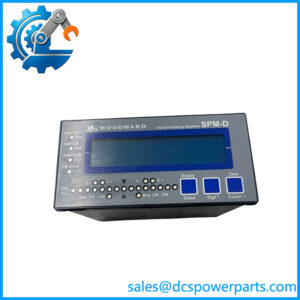
Woodward SPM-D11 8440-1666/E | Generator Synchronizer | Load Sharing Controller
Key Technical Specifications
| Parameter | Specification |
|---|---|
| Manufacturer | Woodward |
| Model | SPM-D11 8440-1666/E |
| Part Number | 8440-1666/E |
| Product Family | SPM-D Series |
| Package | LSXR |
| Product Type | Synchronizer / Load-Share Controller |
| Generator Voltage Measurement | 400 VAC configuration |
| Generator Current Measurement | 5 A CT secondary |
| Busbar Voltage Measurement | 400 VAC configuration |
| Synchronizing Circuits | 2-phase measurement |
| Breaker Control | 1 circuit breaker |
| Operating Modes | Synchronization, synch-check, isolated operation, mains parallel, dead-bus |
| Voltage/Speed Control | Analog bias outputs in LSXR package |
| Active Power Setpoint | 0/4–20 mA |
| Load/VAR Sharing | Supported |
| Alarm Relays | 3 |
| Signaling Relays | 3 |
| Display | Two-line LCD |
| Synchronoscope | LED |
| Configuration | Front panel / PC |
| Certifications | CE, UL/cUL |
Woodward’s documentation describes the product as a microprocessor-based synchronizing unit with integrated generator power control and load-sharing functions. The LSXR package includes analog controllers for speed and voltage bias, while the 8440-1666 configuration is specified for 400 VAC measurement and 5 A current-transformer inputs.
Product Introduction
The Woodward 8440-1666/E is an /LSXR generator synchronizer and load-sharing controller designed for AC generator applications. It performs automatic matching of generator frequency, phase, and voltage before breaker closing, then provides functions for active-power, power-factor, and load-sharing control after the generator is connected. Woodward also integrates generator protection functions such as over/undervoltage, over/underfrequency, overload, reverse power, and reduced-power protection.
The Woodward 8440-1666/E uses the 400 VAC / 5 A measurement configuration associated with the 8440-1666 ordering designation. The LSXR package is significant because it provides analog bias outputs for speed and voltage control rather than relying only on three-step raise/lower control. For a replacement project, the measurement transformer ratios, control-output arrangement, package designation, and generator operating scheme should all be matched before installation.
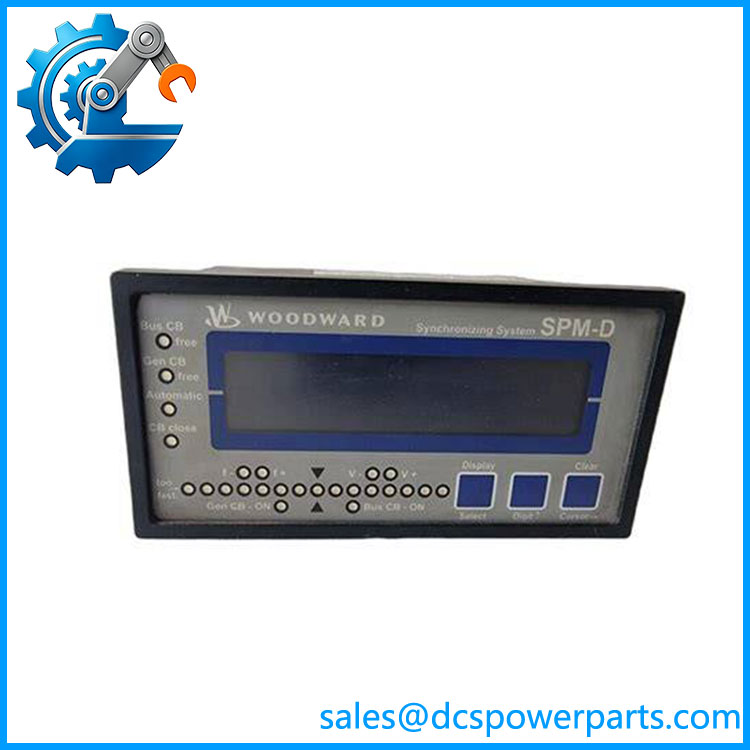
8440-1666-E
Application Scenarios & Field Pitfalls — The Engineer’s Perspective
Engineering Pain Point
A generator that refuses to close onto the bus is not necessarily suffering from a failed synchronizer. Incorrect PT/VT scaling, CT wiring, phase sequence, breaker feedback, speed-control bias polarity, AVR interface, or synchronization settings can produce the same field symptom. The must therefore be evaluated as part of the complete generator control loop.
Typical Applications
1. Generator synchronization
The compares generator and bus electrical conditions and controls the generator speed and voltage toward the required synchronization window before breaker closure. Woodward documents both phase-match and slip-frequency synchronization methods.
2. Generator parallel operation
After synchronization, the controller can manage active-power and power-factor functions and participate in load/VAR sharing between generator sets.
3. Islanded generator operation
Woodward identifies isolated operation and load/VAR sharing among the available functions, making the controller suitable for generator plants operating independently from the utility grid.
4. Industrial power-generation systems
The unit can be used with generators driven by compatible Woodward or third-party speed controls and automatic voltage regulators.
Technical Pitfalls
Confirm 400 VAC measurement configuration.
The 8440-1666 designation is associated with the configuration using 400 VAC measurement inputs and 5 A CT inputs. Do not substitute a 100 VAC or 1 A version simply because the front panel appears identical.
Verify LSXR functionality.
The LSXR package includes analog controllers for voltage and speed bias. This is materially different from an LSR configuration that relies on three-step control.
CT and PT wiring must be checked carefully.
A synchronizer can produce apparently incorrect frequency, phase, voltage, or power readings when transformer ratios, phase connections, or CT polarity are wrong. Verify the actual generator and bus measurement circuits before replacing the controller.
Breaker feedback is part of the control scheme.
The synchronizer controls one circuit breaker, so auxiliary contacts and breaker-status logic should be checked when diagnosing unsuccessful synchronization.
Check speed-control and AVR interfaces.
The does not independently control the prime mover or excitation system. Its bias outputs interact with the installed speed governor and AVR. Signal polarity, scaling, and response should be documented before commissioning.
Do not assume every has identical I/O.
Woodward offered multiple packages, supply-voltage configurations, measurement configurations, and control options. The model family alone is not sufficient for a like-for-like replacement.
Retain the existing configuration where possible.
Before removing a functioning controller, record all synchronization, protection, load-sharing, CT/PT scaling, and bias-control parameters. A replacement unit may require configuration even when the hardware designation matches.
Related Products
- Woodward 8440-1706 — /LSXR configuration with 100 VAC measurement and 5 A CT input.
- Woodward 8440-1705 — /LSXR configuration with 100 VAC measurement and 1 A CT input.
- Woodward 8440-1686 — 400 VAC / 5 A configuration with different package arrangement.
- Woodward 8440-1703 — 100 VAC / 5 A measurement configuration.
- Woodward 8440-1702 — 100 VAC / 1 A measurement configuration.
- Woodward 8440-1715 — 24 VDC configuration with 400 VAC / 5 A measurement inputs.
- Woodward 8440-1714 — 24 VDC configuration with 400 VAC / 1 A measurement inputs.
- Woodward LSR — package using three-step speed and voltage control rather than the full LSXR analog-control arrangement.
Procurement Note
For a Woodward 8440-1666/E, the critical identification points are , 8440-1666, LSXR package, 400 VAC measurement configuration, and 5 A CT input. Woodward’s own documentation shows that variants differ substantially by measurement voltage/current and package configuration.
For used or surplus inventory, inspect the LCD, synchronoscope LEDs, terminal blocks, enclosure, and PCB condition. Before commissioning, compare the replacement’s configuration against the original controller and verify PT/CT scaling, phase sequence, breaker feedback, speed bias, voltage bias, protection thresholds, and load-sharing settings.
The 8440-1666/E should therefore be sourced as a configuration-specific generator synchronizer, not simply as a generic controller.