Description
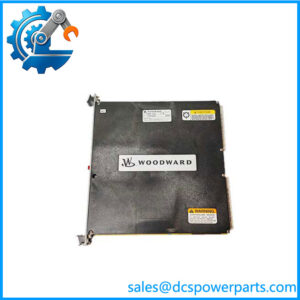
WOODWARD 9905-867
Product Introduction
The Woodward 9905-867 is a Peak 150 digital control designed for governing single-valve or single-valve-rack steam turbines. Unlike a general-purpose PLC or DCS controller, the Peak 150 is purpose-built for turbine speed regulation, including speed sensing, remote speed setting, actuator control, alarm handling, trip functions, and turbine-specific control dynamics. Woodward’s Manual 85565 explicitly identifies 9905-867 as the AC/DC with Modbus, NEMA 4X version of the Peak 150 family.
The Woodward 9905-867 accepts either AC or DC control power, making it suitable for turbine installations where the available plant control power differs between sites. The AC input range is 88–132 VAC at 47–63 Hz, while the DC range is 90–150 VDC. The enclosure is NEMA 4X, and the controller provides a Modbus communication interface through serial hardware. The Peak 150 manual also identifies analog inputs and outputs, discrete inputs and outputs, magnetic-pickup speed inputs, and a service port for the handheld programmer.
The Woodward 9905-867 should be evaluated as a complete turbine governor rather than as a replaceable I/O card. Its speed-control behavior depends on the turbine configuration, actuator characteristics, magnetic-pickup signals, programmed constants, and trip logic. The controller can interface with a plant PLC or DCS through Modbus, but the plant control system should not be assumed to replace the Peak 150’s turbine-governing functions. For an existing installation, preserving the programmed constants and verifying the actuator and speed-sensing circuits are critical parts of replacement work.
Technical Specifications
| Parameter | Specification |
|---|---|
| Product Model | 9905-867 |
| Manufacturer | Woodward |
| Series | Peak 150 |
| Product Type | Digital steam turbine control |
| Application | Single-valve or single-valve-rack steam turbines |
| Processor | 16-bit, 12 MHz microprocessor |
| AC Input | 88–132 VAC |
| AC Frequency | 47–63 Hz |
| DC Input | 90–150 VDC |
| Communication Protocol | Modbus |
| Communication Interfaces | RS-232 / RS-422 / RS-485 |
| Speed Inputs | 2 magnetic pickup inputs |
| Remote Speed Input | 4–20 mA or 1–5 VDC |
| Discrete Inputs | 8 contact inputs |
| Actuator Output | Programmable 0–200 mA or 0–20/4–20 mA, configuration-dependent |
| Analog Outputs | 2 |
| Relay Outputs | 4 hermetically sealed relays |
| Enclosure | NEMA 4X |
| Operating Temperature | -25°C to +60°C |
| Storage Temperature | -40°C to +85°C |
| Approx. Dimensions | 483 × 305 × 102 mm |
| Configuration Tool | Woodward handheld programmer |
| Manual | 85565 |
The detailed I/O values above are taken from the Peak 150 documentation and supporting technical records; the exact actuator output configuration and jumper settings must be checked against the installed controller.
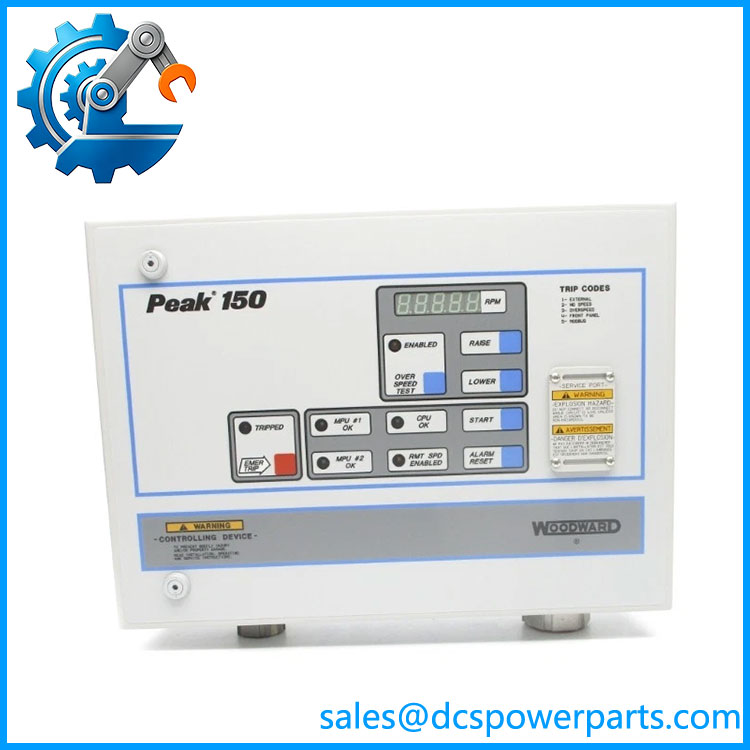
9905-867
Main Features and Engineering Considerations
Turbine-Specific Digital Governing
The Peak 150 is designed around the control requirements of steam turbines rather than general process automation. It receives turbine-speed feedback from magnetic pickups, compares actual speed against the programmed reference, and controls the steam admission actuator accordingly.
This makes it particularly useful on smaller industrial turbines driving pumps, compressors, fans, blowers, generators, and similar mechanical loads.
Exact 9905-867 Power Configuration
The part number is important. Woodward’s manual separates the Peak 150 versions into 24 VDC, AC/DC, Modbus, and enclosure variants. 9905-867 specifically combines AC/DC power, Modbus communications, and NEMA 4X construction.
Do not substitute 9905-866 simply because it also has Modbus and NEMA 4X. The 9905-866 version uses 24 VDC power, whereas 9905-867 accepts the higher AC/DC input range.
Magnetic Pickup Inputs
The controller uses magnetic pickup inputs for turbine-speed measurement. Speed-sensor wiring deserves careful attention because signal amplitude, frequency range, polarity, shielding, cable routing, and pickup-to-gear clearance can affect the quality of the speed signal.
A replacement controller should not be commissioned until the MPU signals have been checked under the appropriate turbine operating conditions.
Actuator Interface
The Peak 150 provides a dedicated actuator output. Depending on configuration, the output can be programmed for 0–200 mA or 0–20/4–20 mA operation. The actual output configuration must match the installed actuator and the controller’s programmed settings.
This is one area where simply transferring wiring from an old controller to a replacement without checking configuration can create a serious commissioning problem.
Modbus Integration
The 9905-867 includes Modbus communication capability. This allows turbine operating information and selected control/status data to be exchanged with a PLC, DCS, or supervisory system. The Modbus interface should be considered supplementary to the turbine governor’s local control functions.
Communication loss should not be assumed to mean loss of local turbine governing capability; the actual behavior depends on the programmed application and control architecture.
NEMA 4X Enclosure
The NEMA 4X enclosure is intended for demanding industrial environments and provides protection against environmental exposure beyond what a conventional open control chassis would provide. The documented operating range is -25°C to +60°C.
Even with the enclosure rating, installation should avoid locations where ambient temperature exceeds the specified operating limit or where vibration and turbine-induced mechanical stresses exceed the equipment’s installation requirements.
Legacy-System Consideration
The Peak 150 is an established turbine-control platform. A current Woodward cross-reference lists the Peak 150 family as superseded while still supported, with an upgrade path toward Peak200.
For an existing plant, this does not automatically mean the 9905-867 should be replaced with a newer controller. A like-for-like spare may be preferable where the turbine application is stable and the existing actuator, speed pickups, wiring, and programmed constants have already been validated.
Application Scenarios
- Industrial steam turbines
- Mechanical-drive turbines
- Turbine-driven pumps
- Compressor drives
- Fan and blower drives
- Small turbine-generator systems
- Single-valve steam turbines
- Single-valve-rack turbine systems
- Turbine control retrofits
- Legacy Peak 150 maintenance systems
Engineer’s Guide: Field Pitfalls
1. Do not confuse the 9905-867 with a PLC.
It is a dedicated turbine control. The PLC/DCS normally supervises or exchanges data with it rather than replacing its governing algorithms.
2. Verify the power supply before energizing.
9905-867 is the AC/DC version. The documented inputs are 88–132 VAC or 90–150 VDC.
3. Check the MPU signals.
A weak or noisy magnetic-pickup signal can appear to be a controller fault.
4. Verify actuator output configuration.
The actuator output range and jumper/configuration settings must correspond to the actual turbine actuator.
5. Preserve programmed constants.
The Peak 150 uses programmed constants that define turbine-control behavior. Record the existing configuration before replacing the controller.
6. Check Modbus parameters.
Record station address, baud rate, parity, interface type, register mapping, and PLC/DCS communication settings before replacement.
7. Do not open the enclosure in a hazardous atmosphere.
Woodward’s manual specifically warns that wiring connections inside the Peak 150 enclosure can create ignition hazards.
8. Check the exact part-number suffix.
9905-867 is AC/DC + Modbus + NEMA 4X. Other Peak 150 part numbers have different power and communications configurations.
Frequently Asked Questions
What is Woodward 9905-867?
It is a Peak 150 digital steam turbine control configured for AC/DC power, Modbus communication, and a NEMA 4X enclosure.
What turbine does 9905-867 control?
It is intended for single-valve or single-valve-rack steam turbines.
What power supply does 9905-867 use?
It accepts 88–132 VAC at 47–63 Hz or 90–150 VDC.
Does 9905-867 support Modbus?
Yes. The exact 9905-867 configuration is the AC/DC with Modbus, NEMA 4X version.
What serial interfaces are available?
The Peak 150 documentation supports Modbus communications using RS-232, RS-422, or RS-485, depending on the interface wiring/configuration.
Is 9905-867 still a current Woodward product?
The Peak 150 family is a legacy platform. A current cross-reference identifies the family as superseded while still supported, with a Peak200 upgrade path.
Can I replace 9905-867 with another Peak 150 model?
Not automatically. The power-supply type, Modbus availability, enclosure rating, wiring, and configuration must match. For example, 9905-866 is a 24 VDC/Modbus/NEMA 4X configuration, while 9905-867 is the AC/DC/Modbus/NEMA 4X version.
Procurement Note
Specify the component as:
Woodward Peak 150 — 9905-867 — AC/DC with Modbus, NEMA 4X
For a replacement on an operating turbine, verify the turbine valve configuration, actuator type and current range, MPU arrangement, programmed constants, trip/alarm wiring, Modbus settings, and exact power supply before installation.
The most important distinction is that 9905-867 is a complete turbine governor/control unit, not a generic Woodward I/O module. A visually similar Peak 150 unit with a different part number can have a different power supply or communications configuration, so the complete 9905-867 designation should be retained in the procurement specification.