Description
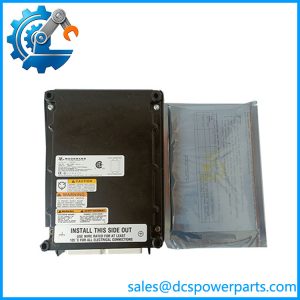
Woodward 9905-864
Product Introduction
Steam turbine control systems leave little room for ambiguity around power input, speed sensing, and actuator configuration. The Woodward 9905-864 is a Peak 150 digital controller intended for single-valve and single-valve-rack steam turbines. It combines turbine speed control, magnetic-pickup sensing, remote speed reference, discrete control inputs, relay outputs, and analog signal interfaces inside a NEMA 4X enclosure.
The important procurement detail is the 864 suffix. Woodward’s manual identifies 9905-864 as the cCSAus AC/DC, NEMA 4X version, while nearby Peak 150 numbers use different power, enclosure, or communications configurations. The controller accepts either 88–132 VAC or 90–150 VDC input, so it should not be treated as a conventional 24 VDC turbine controller.
Key Technical Specifications
| Parameter | Specification |
|---|---|
| Product Model | 9905-864 |
| Manufacturer / Brand | Woodward |
| Series | Peak 150 Digital Control |
| Product Type | Digital steam turbine controller |
| Application | Single-valve / single-valve-rack steam turbines |
| Power Input | 88–132 VAC, 47–63 Hz |
| DC Input | 90–150 VDC |
| Enclosure | NEMA 4X |
| Certification Configuration | cCSAus AC/DC version |
| Magnetic Pickup Inputs | 2 |
| Remote Speed Reference Input | 4–20 mA or 1–5 VDC |
| Actual Speed Output | Scalable 4–20 mA or 0–1 mA |
| Configurable Readout Output | Scalable 4–20 mA or 0–1 mA |
| Discrete Inputs | 8 |
| Discrete Functions | Start, raise, lower, trip, reset, idle, remote-speed enable, overspeed test |
| Actuator Output | 1 |
| Relay Outputs | 4 |
| Communications | Optional Modbus |
| Programming Interface | Hand-held programmer service port |
| Manual Number | 85565 |
| Dimensions | Approximately 19 × 12.2 × 4.1 in. (483 × 310 × 105 mm) |
Woodward’s manual confirms the Peak 150 I/O architecture, including power, analog, discrete, magnetic-pickup, optional Modbus, and programmer connections. The 9905-864 is specifically listed as the AC/DC NEMA 4X model.
Application Scenarios & Field Pain Points
1. Single-valve steam turbine control
The 9905-864 was designed for single-valve and single-valve-rack steam turbines. It is therefore suited to turbine-driven mechanical equipment where speed regulation is the primary control requirement.
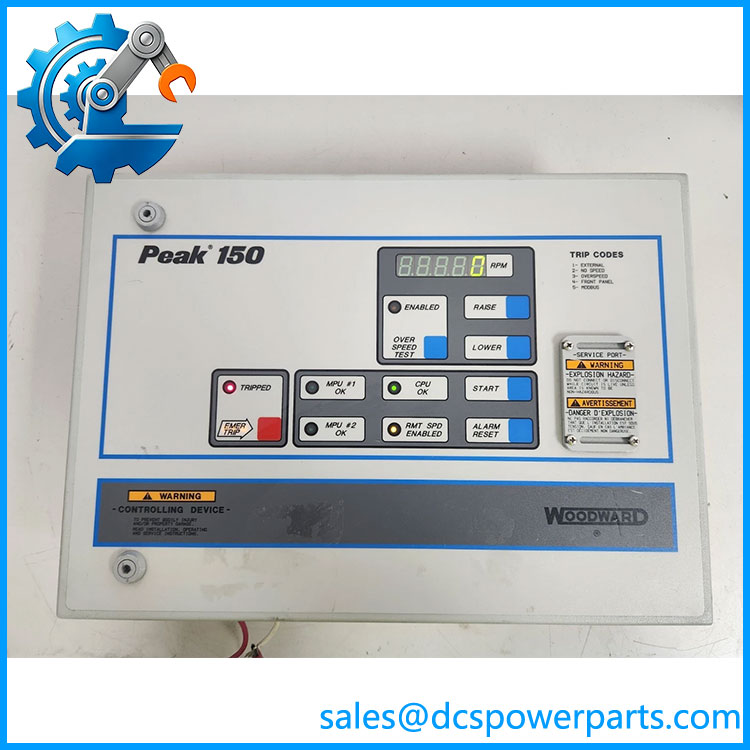
9905-864
2. Mechanical-drive turbine packages
Typical installations can involve steam turbines driving pumps, compressors, fans, or other rotating machinery. The controller provides speed-reference, turbine-speed feedback, shutdown, reset, and actuator-control interfaces within the same control enclosure.
3. Harsh industrial environments
The 9905-864 uses a NEMA 4X enclosure, making enclosure protection part of the original product configuration rather than something added externally. That distinction matters when replacing a Peak 150 unit in an existing turbine skid.
4. Legacy turbine control replacement
The Peak 150 architecture is now a legacy platform, so replacement projects often involve an existing wiring harness and established turbine dynamics. The practical issue is not simply finding a controller with the same nominal voltage; the magnetic pickup configuration, actuator interface, speed reference, discrete logic, and programmed dynamics all need to match.
Related Products
- Woodward 9905-863 — Peak 150, 24 VDC, NEMA 4X configuration; different power architecture.
- Woodward 9905-857 — Peak 150, 24 VDC, NEMA 4 configuration.
- Woodward 9905-858 — Peak 150 AC/DC, NEMA 4 configuration.
- Woodward 9905-860 — 24 VDC Peak 150 with optional Modbus, NEMA 4 configuration.
- Woodward 9905-861 — AC/DC Peak 150 with optional Modbus, NEMA 4 configuration.
- Woodward 9905-866 — 24 VDC, NEMA 4X version with optional Modbus.
- Woodward 9905-867 — AC/DC, NEMA 4X version with optional Modbus.
- Woodward Peak 150 — common controller family for the above configurations.
The 9905-863/864 and 9905-866/867 distinctions are particularly important: the last digit changes the power/communications configuration. Woodward’s manual explicitly separates the AC/DC NEMA 4X 9905-864 from the AC/DC NEMA 4X version with Modbus, 9905-867.
Engineer’s Guide — Field Pitfalls to Avoid
1. Do not substitute a 24 VDC model
The 9905-864 accepts 90–150 VDC or 88–132 VAC. The nearby 9905-863 and 9905-866 models are 24 VDC configurations. A similar-looking Peak 150 enclosure does not mean the power supply is interchangeable.
2. Do not assume Modbus is included
Woodward lists Modbus as an optional communication function. The 9905-864 is not automatically equivalent to the 9905-867 simply because both use AC/DC input and NEMA 4X construction.
3. Check both magnetic pickups
The controller uses two magnetic pickup inputs. Before commissioning a replacement, verify pickup wiring, signal quality, polarity, air gap, and the actual turbine tooth/frequency relationship. A controller can power up normally while still receiving an unusable speed signal.
4. Preserve the original turbine dynamics
The Peak 150 uses configurable speed-control dynamics. Replacing hardware without documenting the existing configuration can turn a straightforward hardware change into a turbine commissioning problem. Record programmed settings before removing the original controller whenever possible.
5. Verify the actuator interface
The controller includes an actuator output, but the actuator and turbine-valve arrangement must be matched to the original application. Do not infer actuator current requirements or output characteristics merely from the 9905-864 part number.
6. Treat the enclosure as part of the specification
NEMA 4X is not just a cosmetic enclosure classification. The cabinet, wiring entries, sealing, grounding, and installation environment all affect whether the installed system maintains the intended enclosure protection.
FAQ
What is Woodward 9905-864?
The 9905-864 is a Woodward Peak 150 digital steam turbine controller for single-valve and single-valve-rack steam turbines. It is the AC/DC, NEMA 4X configuration documented in Woodward manual 85565.
What voltage does the 9905-864 use?
The documented input range is 88–132 VAC at 47–63 Hz or 90–150 VDC. This is one of the most important differences between the 9905-864 and 24 VDC Peak 150 variants.
Does the 9905-864 have Modbus?
The Peak 150 platform supports optional Modbus communication, but the 9905-864 should not be assumed to have the optional Modbus configuration unless the actual unit’s documentation or hardware confirms it. Woodward separately identifies 9905-867 as the AC/DC NEMA 4X version with Modbus.
How many speed sensors can it accept?
The published product information identifies two magnetic pickup inputs. The controller monitors these signals as part of its turbine-speed control and protection functions.
What remote speed reference signals are supported?
The documented analog input accepts a 4–20 mA or 1–5 VDC remote speed-setting signal.
Is 9905-864 still a current Woodward product?
The current Woodward-hosted manual still documents the model, but equipment databases identify 9905-864 as discontinued by the manufacturer. For a replacement project, confirm current Woodward support or an approved migration path rather than assuming the old controller remains a current-production item.
What should be checked before purchasing a replacement?
Match the complete 9905-864 designation, power configuration, NEMA enclosure version, Modbus option, hardware revision, programmed turbine parameters, magnetic-pickup wiring, actuator interface, and existing cabinet wiring. For an operating turbine, actual hardware condition and configuration should be verified before installation.