Description
Woodward 8444-1091 MFR300-71M Multifunction Relay / Measuring Transducer
Product Introduction
Generator and mains-control systems often need more than a simple voltage or current transducer. The Woodward 8444-1091 MFR300-71M combines electrical measurement with configurable monitoring and relay functions in a compact DIN-rail device. Woodward identifies 8444-1091 specifically as the MFR300-71M, configured for a 690 VAC-rated PT secondary and 1 A CT secondary.
The MFR300 measures true-RMS voltage and current and calculates real, reactive, and apparent power, power factor, frequency, and energy values. Measured and calculated data can be transmitted to a supervisory control system through CANopen or Modbus, while the relay functions can be configured for monitoring and control tasks. In generator or mains applications, Woodward documents use of the relay outputs for breaker-opening functions.
Key Technical Specifications
| Parameter | Specification |
|---|---|
| Product Model | MFR300-71M |
| Woodward Part Number | 8444-1091 |
| Product Type | Multifunction relay / measuring transducer |
| Measurement System | Single-phase, three-phase, or combination configurations |
| Voltage Inputs | 3 true-RMS voltage inputs |
| Current Inputs | 3 true-RMS current inputs |
| Rated PT Secondary | 690 VAC |
| Rated CT Secondary | 1 A |
| Rated Phase-to-Ground Voltage | 600 VAC |
| Maximum Continuous Phase-to-Phase Voltage | 862 VAC |
| Rated Surge Voltage | 6.0 kV |
| Measuring Frequency | 45–65 Hz |
| Linear Voltage Range | 1.25 × rated voltage |
| Linear Current Range | 3 × rated current |
| Rated Short-Time Current | 10 A AC for 1 s |
| Power Supply | 12/24 VDC |
| Supply Range | 8–32 VDC |
| Power Consumption | Maximum 5 W |
| Relay Outputs | 4 configurable isolated Form C relays + 1 ready-for-operation relay |
| Communication | CANopen / Modbus |
| Configuration Interfaces | CAN bus / RS-485 / service port |
| Operating Temperature | -20°C to +70°C |
| Storage Temperature | -40°C to +85°C |
| Relative Humidity | 95%, non-condensing |
| Mounting | DIN rail |
| Dimensions | 146 × 128 × 50 mm |
| Weight | Approximately 300 g |
| Protection Rating | IP20 |
| Terminal Capacity | Up to 2.5 mm² / 14 AWG |
The manufacturer specifies the 690 VAC configuration as code [7] and the 1 A current configuration as [1]. The exact 8444-1091 part-number mapping is therefore significant; 8444-1092 is the related MFR300-75M with a 5 A CT secondary and should not be treated as the same electrical configuration.
Major Features / Advantages
1. True-RMS Electrical Measurement
The -71M is designed to measure electrical power systems rather than simply reproduce a scaled analog signal. Its three voltage and three current inputs use true-RMS measurement, allowing the device to process signals in the presence of harmonics, transients, and other waveform disturbances. Woodward specifies Class 0.5 accuracy for voltage, frequency, and current.
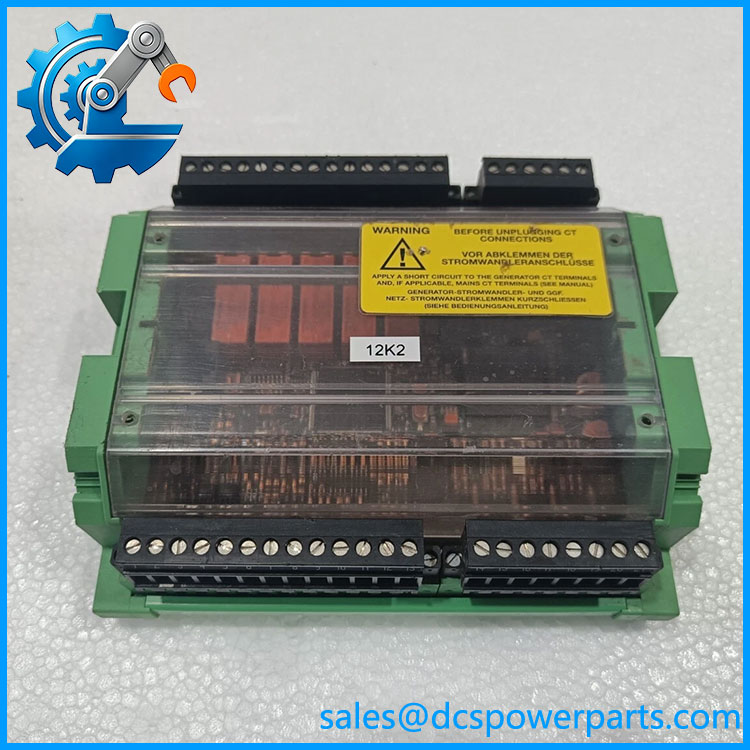
8444-1091
2. High-Voltage 690 VAC Configuration
The MFR300-71M / 8444-1091 is specifically the 690 VAC / 1 A CT version. Its documented rated phase-to-ground voltage is 600 VAC, maximum continuous phase-to-phase voltage is 862 VAC, and rated surge voltage is 6.0 kV. These values are important when replacing an in a generator switchboard or higher-voltage power-distribution application.
3. Integrated Power Calculations
Beyond direct voltage and current measurements, the calculates average/minimum/maximum voltage and current, total and phase real power, reactive power, apparent power, power factor, and positive/negative energy values. This makes the device useful as a measurement point between generator or mains equipment and a supervisory PLC or control system.
4. Configurable Relay Functions
Four isolated Form C change-over relays are available for configurable monitoring and control functions, along with a dedicated ready-for-operation relay. Individual alarm functions can use programmable setpoints and time delays from 0.02 to 300.00 seconds. Relay logic can also be switched according to the application.
5. CANopen and Modbus Integration
The provides CANopen and Modbus communication for supervisory systems. Woodward also identifies CAN bus, RS-485, and a service port for configuration. This allows measured electrical parameters to be brought into a PLC or higher-level control system without requiring separate transducers for every calculated value.
6. Protection and Monitoring Functions
The device supports configurable monitoring functions covering overvoltage, undervoltage, overfrequency, underfrequency, voltage asymmetry, overload, load direction, load unbalance, phase shift, overcurrent, rate of change of frequency, ground fault, and other application-specific conditions. The actual protection logic should be checked against the application configuration rather than assuming every function is enabled in every installation.
Application Scenarios & Pain Points
Generator Monitoring
In generator applications, the can receive voltage and current measurements, calculate electrical power parameters, communicate those values to a PLC, and use configured relay functions for control actions. Woodward’s application diagram specifically shows generator monitoring with breaker-opening capability.
Mains Monitoring and Decoupling
The device can be used in mains-related applications for voltage, frequency, current, active/reactive power, and related monitoring. Its configurable undervoltage functions are also documented for fault ride-through applications.
PLC Electrical Measurement Interface
Where a PLC needs generator or mains electrical data, the can act as the measurement layer between the power system and supervisory controller. CANopen/Modbus communication provides access to measured and calculated values without requiring a dedicated analog input for each quantity.
Legacy Power-Generation Equipment
The family appears in Woodward’s industrial turbine and power-generation product documentation. The current Woodward industrial catalog continues to list , P/N 8444-1091, alongside related configurations.
Related Products
- 8444-1089 / -11M — 100 VAC PT secondary, 1 A CT secondary.
- 8444-1090 / -15M — 100 VAC PT secondary, 5 A CT secondary.
- 8444-1092 / -75M — 690 VAC PT secondary, 5 A CT secondary.
- 8444-1093 / -75M/SU03 — 690 VAC / 5 A configuration with SU03 variant.
- 8444-1094 / -75M/K28 — 690 VAC / 5 A K28 variant.
- — another 690 VAC / 1 A configuration.
- ted part number.
- 844 / /K42 — K42 variant.
Woodward’s industrial catalog explicitly lists these variants and identifies Product Specification 37406 as the applicable documentation.
Engineer’s Guide — Field Pitfalls to Avoid
1. Do not confuse 8444-1091 with 8444-1092.
Both are devices with 690 VAC voltage configuration, but 8444-1091 uses a 1 A CT secondary while 8444-1092 uses a 5 A CT secondary. That difference is fundamental to the measurement circuit.
2. Verify the PT secondary arrangement.
The 8444-1091 configuration is identified as , 690 VAC PT secondary. Do not select the unit based solely on the primary generator or bus voltage. Confirm the actual PT secondary connected to the transducer.
3. Check the CT secondary before wiring.
This part is designed around a 1 A CT secondary. Connecting a 5 A CT arrangement without the appropriate variant is not a harmless configuration difference.
4. Do not treat the relay outputs as high-power switching devices.
Woodward specifies isolated Form C contacts with a general-purpose load rating of 2.00 A AC at 250 VAC and DC ratings that vary with voltage. Higher-current breakers or contactors require an appropriate intermediate interface.
5. Confirm communication configuration.
CANopen and Modbus are supported, but the physical/configuration interface depends on the installation. RS-485 and the service interface are also used for configuration. Confirm baud rate, node addressing, protocol settings, and register mapping against the existing application before commissioning.
6. Do not confuse with a standalone turbine controller.
The is primarily a measuring transducer with integrated monitoring and relay functions. It supplies electrical measurement and protection-related functions to a supervisory control architecture; it is not a replacement for a Woodward turbine governor or complete generator controller.
7. Verify the exact part number on the nameplate.
Woodward has several variants with very similar physical construction. For procurement, record the full part number, model, PT/CT configuration, hardware revision where applicable, and installed communication configuration.
FAQ
What is Woodward 8444-1091?
8444-1091 is theard , a multifunction relay and measuring transducer designed for monitoring single- and three-phase electrical power systems. Woodward’s documentation explicitly maps this part numbthe configuration.
What is the voltage and CT configuration of 8444-1091?
The exact configuration is 690 VAC PT secondary and 1 A CT secondary. The related -75M / 8444-1092 uses the same 690 VAC voltage class but a 5 A CT secondary.
Does 8444-1091 support Modbus?
Yes. The supports CANopen and Modbus communication. Woodward also identifies CAN bus, RS-485, and a service port as configuration interfaces.
What accuracythe provide?
Woodward specifies Class 0.5 accuracy for voltage, frequency, and current, and Class 1 accuracy for real power, reactive power, and energy.
What power supply does 8444-1091 require?
The uses a 12/24 VDC supply with an 8–32 VDC allowable range and maximum intrinsic consumption of 5 W.
Can the relay outputs directly operate a generator circuit breaker?
The relay outputs can participate in breaker-control applications; Woodward specifically documents generator and mains applications where the control can be used to open a breaker. However, the relay contacts have defined electrical load ratings, so the actual breaker coil circuit must be checked against those ratings. An intermediate relay may be required.
What should be checked before purchasing a replacement 8444-1091?
Verify the 841 / identification, 690 VAC PT configuration, 1 A CT secondary, relay arrangement, communication protocol, configuration parameters, and physical condition. Do not substitute another variant simply because its housing and general function appear identical.