Description
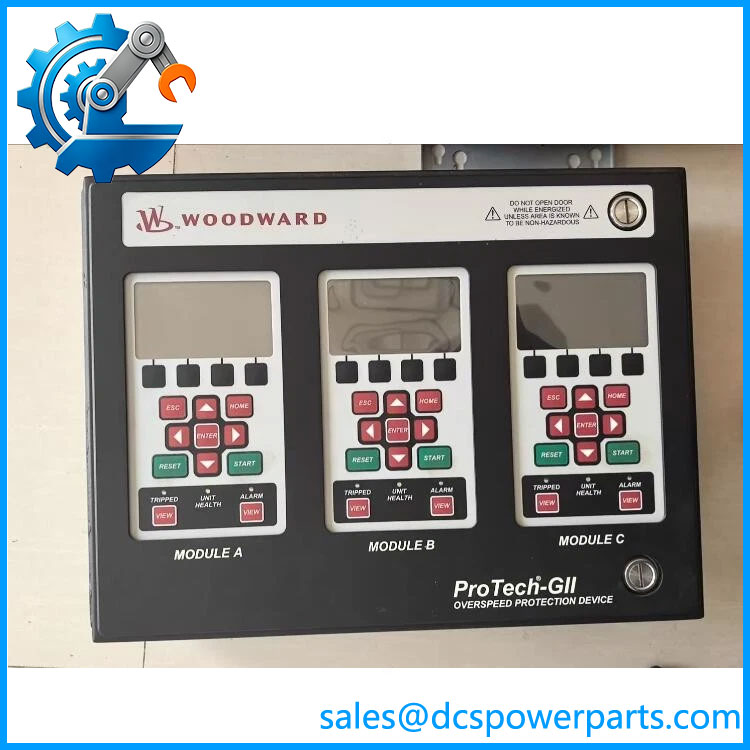
Woodward 8237-2597 ProTech-GII Overspeed Protection System
Product Overview
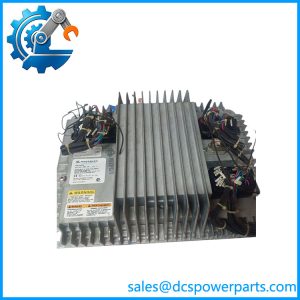
The Woodward 8237-2597 is a ProTech-GII overspeed protection system configured for bulkhead mounting with high-voltage/high-voltage power inputs, voted trip relays, and voted speed inputs. Woodward’s current product documentation specifically identifies part number 8237-2597 as “ProTech-GII – Bulkhead Mount, HV/HV, Voted Relays.” This is a turbine safety device rather than a conventional turbine speed controller. Its primary job is to independently monitor rotational speed and initiate a trip when configured overspeed or over-acceleration conditions are detected.
The 8237-2597 uses a three-channel architecture with voting logic so that a single channel or measurement fault does not automatically produce the same consequence as a genuine overspeed condition. The documented configuration uses voted relay outputs and voted inputs, with two independent high-voltage power inputs. Each module can accept either 90–264 VAC at 47–63 Hz or 100–150 VDC, with a stated 30 W maximum per supply input. Speed sensing can be configured for passive magnetic pickup or active proximity-type probes.
For turbine maintenance, the distinction between the ProTech-GII overspeed protection system and the main turbine controller is important. The ProTech-GII is intended to provide a dedicated safety layer for rotating machinery. It can provide speed indication, alarm information, trip relay outputs, and communications to supervisory systems, but the overspeed trip function should be evaluated according to the approved turbine protection scheme rather than treated as another ordinary PLC control loop.
Product Introduction
Overspeed protection is one of the few turbine functions where response time, independence, voting architecture, and failure behavior matter more than ordinary control-loop convenience. The Woodward 8237-2597 ProTech-GII is designed around that requirement.
Woodward lists this exact part number under its bulkhead-mount, HV/HV, voted-relay ProTech-GII configurations. The device monitors turbine speed and acceleration and can issue a shutdown command when configured protection limits are exceeded.
The unit is applicable to steam, gas, and hydraulic turbine protection schemes and can be integrated with turbine trip systems, emergency shutdown circuits, and plant supervisory systems.
Key Technical Specifications
| Parameter | Specification |
|---|---|
| Product Model | 8237-2597 |
| Manufacturer | Woodward |
| Product Family | ProTech-GII |
| Product Type | Turbine overspeed protection system |
| Mounting | Bulkhead mount |
| Power Configuration | HV/HV |
| Relay Configuration | Voted relays |
| Input Configuration | Voted speed inputs |
| Architecture | Three-channel redundant protection |
| Voting | 2-out-of-3 voting |
| Supply Input 1 | 90–264 VAC, 47–63 Hz or 100–150 VDC |
| Supply Input 2 | 90–264 VAC, 47–63 Hz or 100–150 VDC |
| Power Consumption | 30 W maximum per module/input |
| Speed Input | 1 selectable active or passive probe input per module |
| Passive MPU Frequency | 100 Hz–32 kHz |
| Passive MPU Amplitude | 1–35 Vrms |
| Passive MPU Input Impedance | 1.5 kΩ |
| Active Probe | 24 V proximity / eddy-current type |
| Active Probe Frequency | 0.5 Hz–25 kHz |
| Active Probe Supply | 24 V ±10%, 1 W |
| Speed Accuracy | ±0.04% of current speed over -20 to +60°C |
| Acceleration Range | 0–25,000 RPM/s |
| Acceleration Accuracy | ±1% of current speed |
| Maximum Speed-Signal Cable Length | 1,500 ft / 457 m under specified cable conditions |
| MPU Isolation | 500 VAC from input to chassis and other circuits |
| Communication | Modbus-capable system communication |
| Analog Speed Output | 4–20 mA |
| Safety Application | Turbine overspeed / over-acceleration protection |
| Documentation | Woodward Product Specification 03370; Manual 35086 |
The configuration and electrical figures above are based primarily on Woodward’s product documentation and technical procurement specifications.
Major Features / Practical Advantages
1. Three-channel protection architecture
The ProTech-GII uses three independent protection channels with voting logic. This architecture is intended to reduce the likelihood that a single failed measurement channel will cause either an unwanted trip or loss of protection.
For a turbine safety system, this is materially different from simply putting three speed sensors into a PLC and writing majority logic in software. The ProTech-GII is purpose-built for the overspeed protection function.
8237-1246
2. 2-out-of-3 voting
The voted configuration associated with 8237-2597 uses a 2oo3 voting philosophy. Two channels agreeing on the protection condition can initiate the relevant trip action while a single discrepant channel can be treated as a fault condition rather than automatically representing a genuine overspeed.
The actual trip wiring and final shutdown architecture still need to be checked against the turbine’s approved protection drawing.
3. Voted relay outputs
Woodward identifies 8237-2597 specifically as a voted-relay configuration. This distinguishes it from ProTech-GII variants using independent/non-voted relays.
This distinction is procurement-critical. An independent-relay version should not be assumed to provide identical external trip behavior merely because the enclosure and ProTech-GII name are the same.
4. Dual high-voltage power inputs
The 8237-2597 configuration uses two high-voltage power inputs. Each input supports 90–264 VAC or 100–150 VDC, with a 30 W maximum rating per module/input.
This allows the protection system to be supplied from redundant power sources in installations designed for that arrangement.
The actual plant wiring should be checked carefully before energization because the presence of two acceptable electrical ranges does not mean every cabinet is wired for both simultaneously.
5. Passive or active speed sensing
Each channel can be configured for a passive magnetic pickup or an active proximity-type speed probe. The passive MPU input is specified for 100 Hz to 32 kHz with 1–35 Vrms amplitude. The active-probe arrangement supports a 24 V probe and frequencies from 0.5 Hz to 25 kHz.
This makes the ProTech-GII adaptable to different turbine speed-sensing arrangements, but probe type and configuration must match the actual turbine instrumentation.
6. High speed-measurement accuracy
Woodward’s published specification gives speed-sensing accuracy of approximately ±0.04% of current speed over -20 to +60°C for the applicable configuration. Acceleration detection is specified over a range up to 25,000 RPM/s, with ±1% accuracy relative to current speed.
These figures are relevant when reviewing the device as a protection instrument rather than as a normal speed display.
7. Overspeed and over-acceleration detection
The system can monitor both rotational speed and acceleration. This is useful where a rapidly accelerating rotor could approach a dangerous condition before the conventional overspeed threshold has been reached.
The acceleration protection function should be reviewed against the specific turbine protection philosophy. It should not be enabled or retuned simply because a different threshold appears suitable on another turbine.
8. Fast protection response
The ProTech-GII is intended to provide a rapid turbine shutdown path. Published technical descriptions for the family identify millisecond-scale trip response, with the actual complete trip time depending on sensing, configured logic, relay operation, and the downstream shutdown equipment.
When evaluating an installed system, measure the complete protection chain rather than quoting the controller response alone. A fast electronic decision is of limited value if the final trip valve or actuator has a significantly longer response time.
9. Modbus and analog integration
The ProTech-GII family provides 4–20 mA speed indication and Modbus communications for supervisory integration. These functions are useful for transmitting operating information and diagnostic status to a DCS or plant monitoring system without making the DCS responsible for the primary overspeed decision.
That separation is important in safety applications: supervisory communication should not be confused with the independent hardwired trip function.
10. Bulkhead-mounted configuration
The exact 8237-2597 variant is a bulkhead-mount configuration. Woodward distinguishes this from panel-mount ProTech-GII variants in its current ordering table.
Therefore, cabinet mounting and enclosure arrangement should be verified before replacing a panel-mounted or differently configured ProTech-GII.
Related Products
- Woodward 8237-2598 — ProTech-GII panel mount, HV/LV, independent relays.
- Woodward 8237-2599 — ProTech-GII panel mount, HV/HV, independent relays.
- Woodward 8237-2600 — ProTech-GII panel mount, HV/LV, voted relays.
- Woodward 8237-2601 — ProTech-GII panel mount, HV/HV, voted relays.
- Woodward 8237-2596 — Related ProTech-GII configuration in the same product family.
- Woodward 5437-2125 — ProTech-GII spare module associated with voted-relay/voted-input configurations including 8237-2597 and 8237-2601.
The important point is that these are not automatically interchangeable. Mounting style, supply arrangement, relay architecture, and input voting configuration vary across the 8237 part numbers. Woodward’s current product table explicitly separates those configurations.
FAQ
What is Woodward 8237-2597?
It is a ProTech-GII turbine overspeed protection system, configured for bulkhead mounting, high-voltage/high-voltage power supplies, voted relay outputs, and voted speed inputs.
Is 8237-2597 a turbine speed controller?
No. It is primarily an overspeed and over-acceleration protection device. It should not be confused with Woodward turbine control products that regulate speed, load, steam valves, or fuel valves.
What does 2oo3 mean?
It means two-out-of-three voting. Three protection channels independently evaluate the relevant condition, and the voting architecture uses agreement between two channels for the corresponding voted protection action.
What power supply does 8237-2597 use?
The documented configuration supports 90–264 VAC at 47–63 Hz or 100–150 VDC for each high-voltage supply input. The specification gives a maximum of 30 W per module/input.
Can it use a magnetic pickup?
Yes. The speed input can be configured for a passive magnetic pickup. Woodward specifies a passive MPU frequency range of 100 Hz–32 kHz and input amplitude of 1–35 Vrms.
Can it use an active proximity probe?
Yes. The active-probe configuration supports a 24 V probe, with a specified operating frequency range of 0.5–25 kHz and approximately 24 V ±10% probe supply.
Is 8237-2597 SIL-rated?
The ProTech-GII family is designed for safety-related overspeed protection applications and is associated with SIL-certified configurations. However, the applicable SIL claim depends on the complete certified configuration and installation. Do not infer a site-level SIL capability from the part number alone.
Can 8237-2597 replace 8237-2598?
Not as a generic drop-in assumption. Woodward identifies 8237-2597 as bulkhead mount, HV/HV, voted relays, while 8237-2598 is panel mount, HV/LV, independent relays. Those are materially different configurations.
What should be checked before replacing an installed 8237-2597?
Verify:
- Complete Woodward part number.
- ProTech-GII hardware revision.
- Bulkhead mounting arrangement.
- HV/HV power configuration.
- Voted versus independent relay configuration.
- Voted input configuration.
- MPU versus active-probe configuration.
- Speed-sensor type and wiring.
- Overspeed and acceleration settings.
- Trip-relay wiring and downstream shutdown logic.
- Modbus/4–20 mA integration.
- Existing firmware/configuration and turbine-specific settings.
For a turbine protection device, these configuration details are more important than simply confirming that the front panel powers up.
Procurement Note
The Woodward 8237-2597 should be purchased as a specific ProTech-GII safety configuration, not merely as a generic Woodward overspeed controller.
Woodward’s own current product documentation identifies the exact configuration as:
ProTech-GII — Bulkhead Mount, HV/HV, Voted Relays — 8237-2597.
That makes the following distinctions especially important:
- Bulkhead mount versus panel mount
- HV/HV versus HV/LV power
- Voted relays versus independent relays
- Voted inputs versus non-voted arrangements
- Correct speed-probe type
- Correct turbine-specific trip settings
Do not substitute another 8237-series number simply because it is also labeled ProTech-GII.
For used or surplus equipment, inspect the three protection channels, display/interface condition, terminal blocks, probe inputs, relay outputs, power-input sections, and configuration information. A visual inspection cannot establish that all three protection channels perform correctly.
For a production turbine, acceptance testing should cover the complete overspeed protection chain: speed-signal simulation, channel comparison, voting behavior, alarm states, trip relay operation, redundant power behavior, and final shutdown-device response. The test should follow the turbine OEM and Woodward-approved protection procedure.
Bottom line: Woodward 8237-2597 is a ProTech-GII bulkhead-mounted, HV/HV, voted-relay overspeed protection configuration. Its value in a turbine safety system comes from the complete redundant protection architecture, so replacement should preserve the exact electrical, voting, sensing, mounting, and configuration characteristics rather than relying on family-level compatibility.