Description
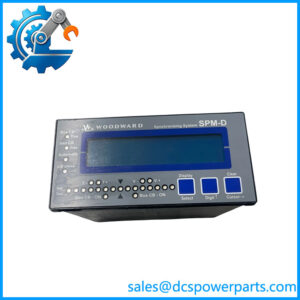
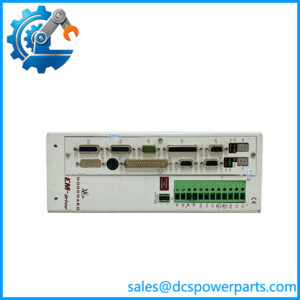
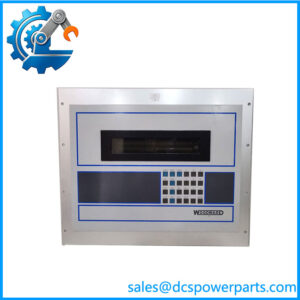
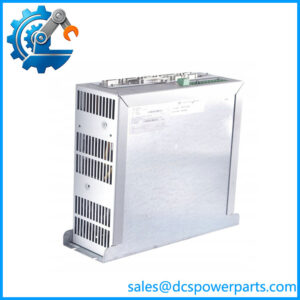
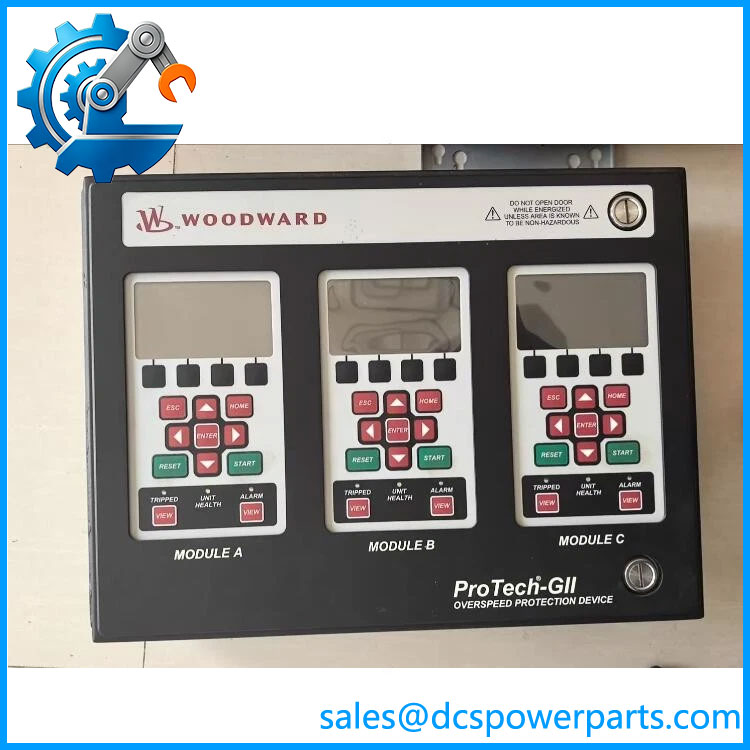
Woodward 8237-1597 | ProTech-GII Overspeed Protection Device
Key Technical Specifications
| Parameter | Specification |
|---|---|
| Product Model | 8237-1597 |
| Manufacturer | Woodward |
| Product Family | ProTech-GII |
| Product Type | Overspeed protection device |
| Mounting | Bulkhead |
| Voltage Configuration | HV/HV |
| Internal Architecture | Three independent modules |
| Voting Architecture | Two-out-of-three |
| Relay Configuration | Voted relays |
| Speed Inputs | One speed signal per module |
| Speed Sensor Compatibility | MPU or compatible active probe configurations, depending on application |
| Speed Range | 0.5 to 32,000 rpm, configuration dependent |
| Typical Response Time | Approximately 8–26 ms, depending on model/configuration |
| Analog Speed Outputs | One per module |
| Alarm Relay Outputs | One per module |
| Enclosure | IP56 |
| Approx. Dimensions | 13 × 19.1 × 6 in |
| High-Voltage Supply | 100–150 VDC, approximately 30 W/module |
| Operating Temperature | -4°F to +140°F |
| Storage Temperature | -4°F to +158°F |
Woodward identifies 8237-1597 specifically as the ProTech-GII Bulkhead Mount, HV/HV, Voted Relays, Voted Inputs configuration. The ProTech-GII platform uses three independent modules and can accept one speed signal per module; the exact response time and speed range depend on the selected model and configuration.
Product Introduction
The Woodward 8237-1597 is a ProTech-GII independent overspeed protection device intended to provide dedicated speed monitoring and turbine shutdown protection separate from the primary turbine control system. Its three-module architecture uses two-out-of-three voting so that a single module or channel fault does not automatically create the same result as a confirmed overspeed condition. Woodward lists applications covering steam, gas, and hydro turbines, reciprocating engines, compressors, and other rotating machinery.
The 8237-1597 configuration combines a bulkhead-mounted enclosure, HV/HV power arrangement, and voted relay outputs. Each internal module has its own speed input, alarm relay, and analog speed output. This makes the unit a dedicated protection layer rather than a conventional turbine governor or general-purpose PLC controller.
8237-1246
Application Scenarios & Field Pitfalls — The Engineer’s Perspective
Engineering Pain Point
Overspeed protection has a different engineering objective from normal speed control. The protection system must be capable of detecting an unsafe speed condition and initiating the defined shutdown action independently of the normal governing loop. With the 8237-1597, the critical engineering task is therefore not simply replacing the enclosure; the replacement must preserve the sensor arrangement, voting logic, trip relay architecture, power configuration, and configured trip parameters.
Typical Applications
- Steam turbine protection: Independent overspeed detection and trip initiation for steam turbine installations.
- Gas and hydro turbines: Dedicated rotational-speed protection where the normal control system should not be the sole overspeed protection layer.
- Reciprocating engines: Monitoring of engine speed with independent protective shutdown functionality.
- Industrial rotating equipment: Application to compressors and other process machinery where excessive rotational speed presents a mechanical protection risk.
Technical Pitfalls to Avoid
- Do not classify 8237-1597 as a turbine governor.
The ProTech-GII is an overspeed protection system. It performs a different safety function from a Woodward governor responsible for normal speed/load control. - Verify the HV/HV configuration.
Woodward’s model table distinguishes HV/LV and HV/HV variants as well as individual-relay and voted-relay configurations. A visually similar ProTech-GII with a different voltage or relay arrangement is not automatically interchangeable. - Check all three speed channels.
The ProTech-GII architecture uses independent modules, with one speed input per module. Sensor type, wiring, polarity, signal level, and physical pickup installation should be checked against the original turbine protection drawings. - Preserve the voting architecture.
The 8237-1597 uses voted relays and a two-out-of-three architecture. Do not modify relay wiring or bypass one protection channel without an engineering review of the complete trip circuit. - Record the existing configuration before replacement.
Woodward states that configuration files from older ProTech-GII models can be loaded into newer models using the ProTech-GII Service Tool, while configuration files from newer models cannot be loaded into older models. - Check the revision before selecting a conversion route.
Woodward’s conversion documentation states that Rev D or later 8237-1597 units can be converted using Field Software Conversion Kit 8929-039. Units older than Rev D require factory conversion. - Do not confuse the original and preferred part numbers.
Woodward has designated 8237-1597 as a non-preferred model and identifies 8237-2597 as the preferred corresponding HV/HV bulkhead-mounted voted-relay model. The original 8237-1597 remains relevant to existing installations and spare requirements.
Related Products
- Woodward 8237-2597 — Preferred successor to 8237-1597 for new installations; same basic HV/HV bulkhead/voted-relay configuration.
- Woodward 8237-1595 — ProTech-GII bulkhead HV/HV configuration using individual relays rather than the 8237-1597 voted-relay arrangement.
- Woodward 8237-1596 — Bulkhead HV/LV configuration with voted relays; different power configuration from 8237-1597.
- Woodward 8237-1601 — Panel-mounted HV/HV ProTech-GII with voted relays; mounting configuration differs from the bulkhead 8237-1597.
- Woodward 8929-039 — Field Software Conversion Kit for eligible ProTech-GII units, including Rev D or later 8237-1597 units.
- Woodward 9927-1810 — ProTech-GII Service Tool used for configuration and service functions across old and new ProTech-GII models.
Procurement and Replacement Note
For an existing 8237-1597, record the complete nameplate information, hardware revision, configured trip settings, speed sensor type, power supply arrangement, relay wiring, and ProTech-GII configuration file before replacement.
For new projects, Woodward’s documented preferred part number is 8237-2597, while 8237-1597 remains relevant to existing systems and spare requirements. The two should not be treated as interchangeable solely because their basic HV/HV bulkhead/voted-relay description is similar; verify the installed revision and conversion requirements.
The most important procurement fields are therefore 8237-1597 + hardware revision + ProTech-GII configuration + speed-sensor arrangement + trip-circuit wiring. A part-number-only comparison is insufficient for a turbine overspeed protection replacement.