Description
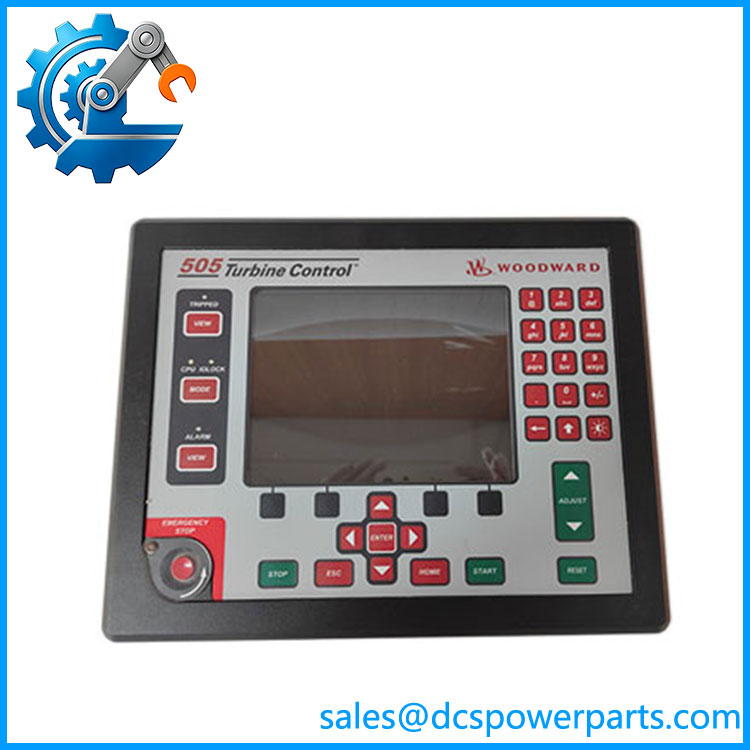
WOODWARD 8200-1300 505 Digital Governor
Key Technical Specifications
| Parameter | Specification |
|---|---|
| Product Model | 8200-1300 |
| Manufacturer | Woodward |
| Series | 505 Digital Governor / 505D |
| Product Type | Digital steam-turbine governor |
| Application | Steam turbine control |
| Actuator Configuration | Single or split-range |
| Input Power | 18–36 VDC |
| Power Variant | LVDC |
| Location Classification | Ordinary location |
| Operator Interface | Integrated graphical front panel |
| Display | Graphical operator display |
| Keypad | Integrated operator keypad |
| Operating Temperature | -30 to +70°C with display, according to available product documentation |
| Control Configuration | Programmable / configurable |
| Plant Integration | DCS integration or standalone operation |
| Related Power Variant | 8200-1301 — AC/DC |
| Related ATEX Variant | 8200-2302 — LVDC, ATEX |
The 18–36 VDC supply range and ordinary-location designation come directly from Woodward’s 505 manual. Secondary documentation identifies the integrated graphical panel and 34-key operator interface, but exact I/O population should be verified against the specific hardware revision rather than copied from generic 505D listings.
Product Introduction
The WOODWARD 8200-1300 is a 505 Digital Governor used for control of steam turbines with single or split-range actuators. It combines turbine-control processing with an integrated operator interface, allowing the unit to be configured for turbine operating requirements rather than functioning as a conventional PLC CPU. Woodward’s documentation specifically describes the 505 as a digital control for steam turbines and distinguishes the 8200-1300 as the LVDC ordinary-location version.
The controller can be applied as a standalone turbine control or as part of a larger plant control architecture. For replacement work, the power variant is particularly important: 8200-1300 is the 18–36 VDC version, while the similar-looking 8200-1301 uses AC/DC input. Substituting between these models without checking the cabinet power architecture can create an immediate installation problem.
8200-1300
Engineering Pain Point
The difficult part of replacing a 505 governor is rarely the physical mounting alone. The controller contains application-specific turbine configuration, actuator settings, speed-sensing configuration, control parameters, and operating logic. A replacement with the correct 8200-1300 part number still needs the correct application configuration and commissioning checks. Woodward also documents different operating-system/footprint and GAP requirements depending on the control revision, so hardware identification alone is not enough when migrating an older unit.
Typical Applications
- Steam-turbine speed and load control
- Generator-driven steam turbines
- Mechanical-drive steam turbines
- Single-actuator turbine systems
- Split-range actuator turbine systems
- Turbine installations integrated with a plant DCS
Technical Pitfalls to Avoid
- Verify the input power first. Woodward specifies 18–36 VDC for 8200-1300. Do not apply the AC/DC specification of the 8200-1301 to this model.
- Do not confuse 8200-1300 with 8200-2302. Both are LVDC versions, but 8200-2302 carries the ATEX compliance designation.
- Check the complete turbine configuration. Actuator type, valve arrangement, speed sensors, extraction/admission functions, generator application, and configured control modes must match the replacement configuration.
- Preserve the existing application configuration. Do not assume that a factory-default controller can simply be installed and placed in service.
- Check the control revision and software footprint. Woodward documents different OS/Footprint and GAP requirements according to revision.
- Verify speed-sensing wiring before startup. Incorrect sensor type, polarity, scaling, or channel assignment can prevent correct turbine control even when the controller itself is healthy.
- Separate governor control from independent overspeed protection. The 505’s turbine-control functions should not automatically be treated as a substitute for an independent overspeed trip system unless the complete engineered protection architecture specifically provides for it.
- Do not rely on generic reseller I/O tables. Public secondary listings disagree on several specifications. For an actual replacement, use the Woodward manual, nameplate, hardware revision, and installed application documentation.
Related Products
- WOODWARD 8200-1301 — 505 Digital Governor version using AC/DC input rather than the 18–36 VDC input of the 8200-1300.
- WOODWARD 8200-2302 — ATEX-compliant LVDC version of the 505 Digital Governor; compliance configuration differs from 8200-1300.
- WOODWARD 505 Digital Governor — Product family covering the digital turbine-control platform used for steam turbines.
- WOODWARD 505D — 505D generation associated with the 8200-1300 ordering code and integrated graphical operator interface.
- WOODWARD 8200-1302 — Secondary listings sometimes identify this number in older 505D material, but the current Woodward manual should be used to establish the applicable ordering-code revision before treating it as a replacement.
Procurement Note
For procurement, specify the complete WOODWARD 8200-1300 part number and verify:
- 18–36 VDC cabinet supply
- Hardware revision
- OS/Footprint revision
- GAP/software requirement
- Existing turbine application configuration
- Actuator type and wiring
- Speed-sensing arrangement
- Generator or mechanical-drive application
- Independent overspeed-trip architecture
- Existing 505 configuration backup
The most important distinction is 8200-1300 versus 8200-1301: they belong to the same 505 governor family but have different power-input architectures. Woodward’s documentation explicitly identifies 8200-1300 as LVDC 18–36 VDC and 8200-1301 as AC/DC 88–264 VAC or 90–150 VDC.
For a legacy replacement, the nameplate, hardware revision, existing application file, and turbine wiring drawings should be treated as part of the replacement specification—not optional paperwork.