Description
Woodward 1680-622
Product Introduction
Accurate shaft-speed feedback starts with the sensor, not the governor. Woodward 1680-622 is a passive magnetic speed pickup designed to detect the teeth of a rotating gear and generate an AC speed signal for an electronic engine or turbine control system. Woodward’s own manual identifies it as the standard long magnetic pickup, with a 0.625-18 thread and 2.500-inch dimension.
The Woodward 1680-622 is commonly associated with prime-mover speed measurement in engine, turbine, and generator applications. Current Woodward documentation also references 1680-622 as an applicable magnetic pickup when replacing certain older MPU part numbers. This is a sensor, not a Woodward 2301A controller or DCS input module, so replacement should focus on mechanical fit, pickup gap, gear characteristics, generated signal, connector arrangement, and the requirements of the receiving governor.
Key Technical Specifications
| Parameter | Specification |
|---|---|
| Product Model | 1680-622 |
| Manufacturer | Woodward |
| Product Type | Magnetic speed pickup / motional pickup transducer |
| Woodward Description | Standard Long Magnetic Pickup |
| MPU Family | MPU-60 VPP |
| Sensing Principle | Passive magnetic pickup |
| Thread | 0.625-18 |
| Threaded Length | 2.500 in |
| Overall Dimension | Approximately 3.500 in according to Woodward drawing |
| Pole Piece Diameter | 0.188 in |
| Locknut | Supplied configuration uses a threaded locknut arrangement |
| Typical Speed Application | Prime-mover gear speed measurement |
| Typical Equipment | Engines, turbines, generator sets |
| Connector | 1630-755-compatible configuration reported for this MPU |
| Electrical Output | AC voltage generated by the rotating gear; output varies with speed and installation |
| External Power | Passive sensor; no separate excitation supply is normally required |
| NSN | 6695-01-519-1042 |
| Installation | Threaded mounting into the speed-sensing location |
| Condition | Verify actual inventory condition and test status |
Woodward’s technical drawing gives the 1680-622 a 0.625-18 thread, 2.500-inch dimension, approximately 3.500-inch overall dimension, and 0.188-inch pole-piece diameter.
A component reference identifies the 1680-622 as an MPU-60 VPP, 0.625-18 thread, 2.5-inch length, with approximately 250 Ω DC resistance. Because that resistance value is from a secondary component listing rather than the current Woodward drawing, it should be treated as a useful identification check rather than a design-limit specification.
Application Scenarios & Pain Points
Engine Speed Measurement
The 1680-622 can provide the speed feedback required by an electronic governor. The pickup senses the passing teeth of a suitable rotating gear and produces an AC signal proportional to rotational speed. Woodward documentation for GECO control equipment specifically lists 1680-622 as an acceptable MPU speed sensor.
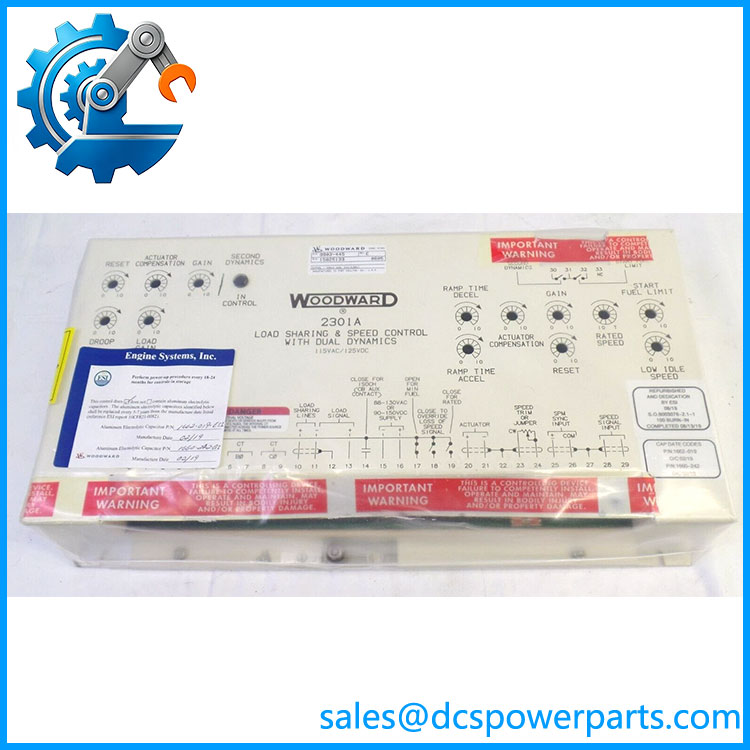
9903-445
Diesel Generator Sets
In generator applications, the magnetic pickup is part of the speed-feedback loop between the prime mover and governor. A weak or unstable MPU signal can cause speed-control problems that may initially look like a governor fault.
Turbine Speed Sensing
The same sensing principle is used on turbine machinery where a toothed wheel provides the mechanical target. Mechanical installation is critical: incorrect gap, damaged teeth, excessive runout, or poor cable termination can all affect the generated speed signal.
Legacy Woodward Control Systems
The 1680-622 remains relevant when maintaining older Woodward governor and control installations. Woodward’s current product-change documentation specifically lists 1680-622 as a potential replacement for certain obsolete magnetic pickups, subject to engineering review.
Major Features / Engineering Advantages
Passive Magnetic Sensing
The 1680-622 does not require a separate electronic excitation supply. Its signal is generated as the magnetic field changes when the gear teeth pass the pickup pole piece. That makes it a straightforward input device for compatible Woodward speed controls.
Standard Long Mechanical Format
Woodward identifies 1680-622 as the standard long magnetic pickup. Its 0.625-18 mounting thread and 2.500-inch dimension make mechanical identification relatively straightforward when compared with other MPU variants.
MPU-60 VPP Configuration
Component references identify the 1680-622 as an MPU-60 VPP device. The designation helps distinguish it from other Woodward magnetic pickups such as the shorter 1680-613 and extra-long 1680-631.
Broad Woodward Control Compatibility
Woodward documentation for the GECO control family specifically lists 202-816, 1680-622, and 1680-631 as compatible speed-sensor choices. This does not mean the three sensors are mechanically interchangeable in every installation; mounting length and available adjustment must still be checked.
Established Spare-Part Identification
U.S. federal parts records associate Woodward 1680-622 with NSN 6695-01-519-1042 and classify the item as a motional pickup/transducer, with the manufacturer’s special feature identified as a magnetic pickup.
Related Products
- Woodward 1680-613 — Standard magnetic pickup with a shorter 2.0-inch configuration.
- Woodward 1680-631 — Extra-long magnetic pickup; approximately 4.5-inch threaded dimension.
- Woodward 1680-649 — Metric-thread MPU using M16 × 1.5 mounting.
- Woodward 1680-609 — Explosion-proof magnetic pickup with hazardous-location certification.
- Woodward 1680-637 — Metric-thread MPU for specific installation requirements.
- Woodward 1680-727 — MPU-190 VPP magnetic pickup with different electrical characteristics.
- Woodward 1680-2024 — MPU-62 VPP pickup with a different sensing architecture and application specification.
- Woodward 1630-755 — Connector associated with several standard Woodward magnetic pickups, including the 1680-622 configuration.
These are not automatic substitutes. Woodward uses different thread sizes, pickup lengths, electrical characteristics, and hazardous-area configurations across the MPU family.
Engineer’s Guide — Field Pitfalls to Avoid
1. Do not confuse 1680-622 with a Woodward controller.
This is the most important cataloging point. 1680-622 is a magnetic speed pickup, whereas Woodward 2301A controllers such as 9903-series units process speed feedback and control the actuator. Woodward’s own drawing confirms the 1680-622 is an MPU.
2. Check the mounting thread.
The specified thread is 0.625-18. Do not substitute a metric M16 × 1.5 MPU simply because the electrical connector looks similar.
3. Verify the physical insertion depth.
The 1680-622 is the standard-long version. Woodward also offers 1680-613 and 1680-631 with different lengths. A sensor that bottoms against the gear or cannot reach the correct sensing position is not a valid replacement.
4. Set the air gap correctly.
The pickup must be positioned close enough to generate a reliable signal without contacting the rotating gear. Do not set the gap by appearance alone; use the applicable Woodward installation procedure and account for gear runout.
5. Check the gear before blaming the MPU.
Damaged teeth, excessive gear eccentricity, incorrect tooth geometry, or contamination around the pickup can create an unstable speed signal. Replacing the sensor without checking the target gear can simply reproduce the same fault.
6. Check the connector and cable.
The MPU is passive, but the signal level can be relatively sensitive to cable condition. Open circuits, poor shielding/grounding practices, damaged connector contacts, or incorrect cable routing can produce intermittent speed readings.
7. Do not substitute by resistance alone.
A measured coil resistance can help identify a damaged pickup, but resistance by itself does not establish mechanical or application compatibility. Thread, length, pole geometry, target gear, signal amplitude, and governor input requirements all matter.
FAQ
What is Woodward 1680-622?
Woodward 1680-622 is a standard long magnetic speed pickup, also called a magnetic pickup unit or MPU. It detects the rotational speed of a toothed gear and provides an AC speed signal to compatible control equipment.
Is 1680-622 a speed controller?
No. It is a speed sensor. A Woodward governor or control system receives the MPU signal and uses that information for speed regulation.
What is the thread size of 1680-622?
The Woodward drawing specifies a 0.625-18 thread. The documented standard-long configuration has a 2.500-inch dimension and approximately 3.500-inch overall dimension.
What is the 1680-622 used for?
It is used to measure the rotational speed of prime movers such as engines and turbines. Woodward documentation also lists it as a speed-sensor option for GECO control equipment.
Is 1680-622 the same as 1680-631?
No. Both are Woodward magnetic pickups, but 1680-631 is the extra-long version. Woodward’s drawing shows a substantially longer sensing configuration for 1680-631.
Can 1680-622 replace an older Woodward MPU?
Potentially. Woodward’s product-change notice specifically identifies 1680-622 as a replacement candidate for certain obsolete MPU part numbers, but instructs engineers to review whether it works with the particular application.
What should procurement verify before buying 1680-622?
Verify the complete part number, 0.625-18 mounting thread, 2.5-inch standard-long configuration, connector arrangement, target gear, required sensing gap, and the receiving governor’s MPU requirements. For used inventory, test the coil and inspect the pole piece, threads, cable/connector, and physical condition before installation.