Description
Key Technical Specifications
| Parameter | Specification |
|---|---|
| Product Model | IMFF4703X |
| Manufacturer | Triconex / Schneider Electric |
| Product Type | I/O Bus Interface Module, Fiber-Fiber (IMFF) |
| System Platform | Tricon CX |
| Compatible I/O Chassis | 8131X I/O Expansion Chassis |
| I/O Bus Protocol | RS-485 serial |
| IOP Bus Interface | Fiber optic SFP |
| Supported Fiber Standards | 1000Base-SX, 1000Base-LX, 1000Base-LX10, 1000Base-EX, 1000Base-BX10 |
| RS-485 Distance | Up to 30 m / 100 ft |
| Fiber Distance | Up to 70 km with appropriate SFP/fiber configuration |
| Dimensions | Approx. 202 × 153.4 × 19.6 mm |
| Representative Mass | Approx. 436 g |
| Installation | Tricon CX I/O expansion chassis |
| SFP Requirement | Application-specific SFP transceivers |
| Related Interface Module | 4701X IMSS, Serial-Serial |
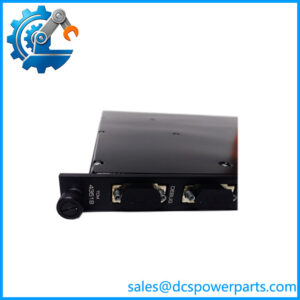
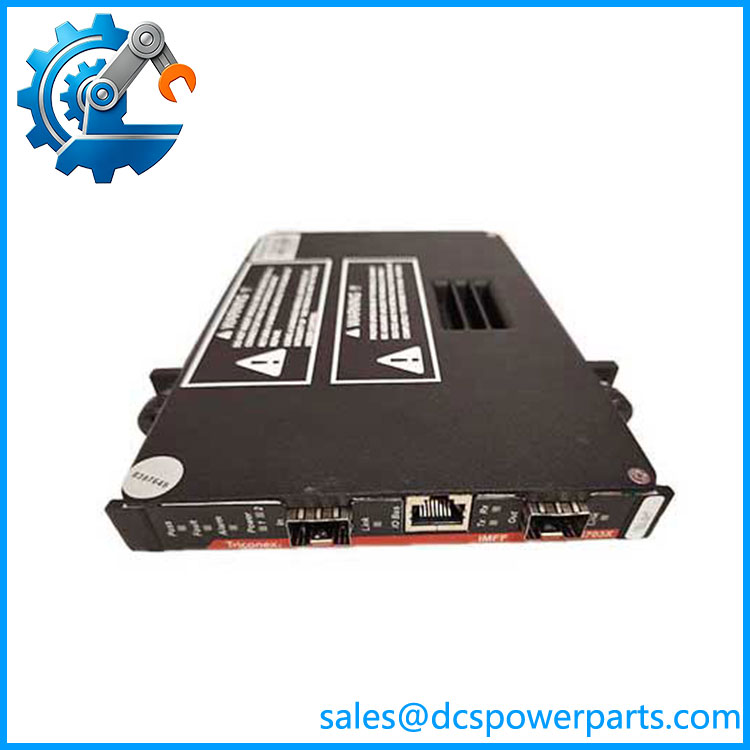
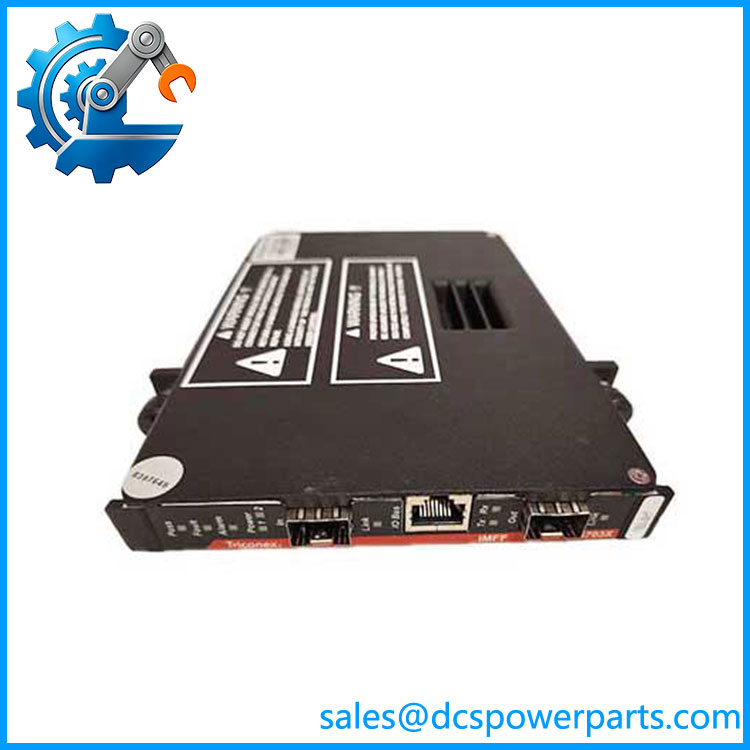
The 4703X documentation specifies three relevant interfaces: an IOP bus fiber input, an I/O bus RS-485 output, and an IOP bus fiber output. The fiber side can use different Gigabit Ethernet optical standards through SFPs, allowing the same module family to support different optical media and distance requirements.
Product Introduction
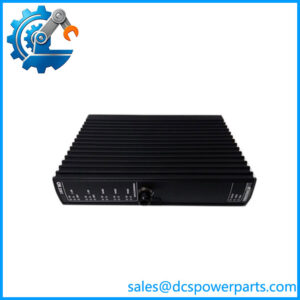
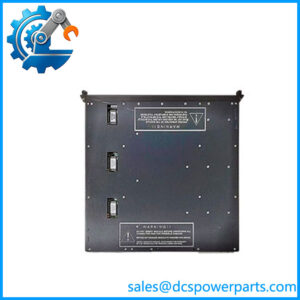
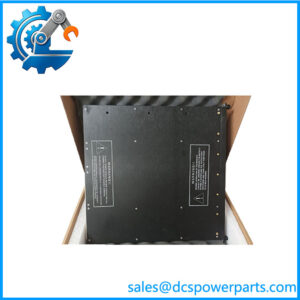
The is a Fiber-Fiber I/O Bus Interface Module used in the Tricon CX safety system to connect I/O expansion infrastructure over optical communication. It is specifically associated with the 8131X I/O Expansion Chassis, where the module provides the communication interface between the I/O bus architecture and fiber-optic links. This makes it a communication and expansion component, not a conventional DI, DO, AI, or AO module.
For plant maintenance teams, the main value of the is the ability to extend Tricon CX I/O over fiber where conventional RS-485 cabling is insufficient. The documented architecture supports single-mode or multi-mode fiber depending on the selected SFPs, with published configurations reaching considerably farther than the 30 m RS-485 connection limit. This is particularly relevant when remote I/O cabinets are separated from the main control enclosure or when electrical noise makes long copper communication links undesirable.
Application Scenarios & Field Pitfalls — The Engineer’s Perspective
Engineering Pain Point
A common problem with legacy safety-system expansions is that the distance between the main control cabinet and an I/O expansion cabinet exceeds the practical range of the installed copper I/O bus. Replacing the entire safety controller is often unnecessary and introduces a much larger validation burden. The addresses the communication portion of this problem by providing a fiber-based I/O bus interface within the Tricon CX architecture.
The 4703X is also useful where electrical isolation from long copper runs is desirable. Fiber communication removes the conductive path associated with copper communication wiring, which can be important in installations with substantial electromagnetic interference or significant physical separation between cabinets.
Typical Applications
1. Remote Tricon CX I/O expansion
The 4703X is designed for use with the 8131X I/O Expansion Chassis, allowing distributed I/O architecture where the expansion cabinet is physically separated from the main Tricon CX chassis.
2. Oil & gas and petrochemical SIS
The module can form part of legacy Tricon CX safety architectures used for distributed shutdown and process-protection I/O. The communication module itself does not perform the safety logic; that distinction belongs to the Tricon CX controller and associated safety I/O.
3. Power-generation and utility installations
Fiber-based I/O expansion can be useful where control and I/O cabinets are separated by substantial distances or installed in electrically noisy areas.
4. Legacy-system maintenance and migration
For an operating Tricon CX installation, replacing a failed 4703X can be preferable to changing the entire I/O communication architecture. The exact replacement path, however, should be confirmed against the installed system configuration and lifecycle documentation.
Technical Pitfalls
1. Do not confuse IMFF with an I/O signal module.
The 4703X does not provide the process input/output channels itself. It is an I/O Bus Interface Module. Actual signal acquisition and output functions are handled by modules such as the 3506X, 3626X, 3722X, 3723X, 3809X, and 3902X families in the Tricon CX architecture.
2. SFP selection matters.
The fiber interfaces are SFP-based, and the documented architecture supports several optical standards. Single-mode and multi-mode configurations have different distance capabilities. Do not assume that an SFP from another fiber system will automatically be compatible.
3. Fiber distance is configuration-dependent.
The documentation identifies up to 20 km for single-mode and approximately 550 m for multi-mode in specified I/O-bus configurations, while the broader IOP bus specification can reach up to 70 km with suitable optical components. These figures should not be treated as a universal distance rating for every SFP and fiber installation.
4. TMR network segregation is important.
Tricon CX I/O bus documentation specifies independent physical networks for the A, B, and C I/O buses. An installation should therefore be checked at the system-architecture level rather than treating one 4703X as an ordinary Ethernet interface.
5. Check the chassis and slot arrangement.
The 4703X is intended for the 8131X I/O Expansion Chassis. Mechanical fit alone is not sufficient evidence of compatibility with another Tricon chassis generation.
6. Inspect the optical path before replacing the module.
A reported communication fault may originate from the SFP, fiber termination, connector contamination, incorrect fiber type, or network topology rather than the 4703X electronics. The diagnostic monitor can expose module status and detected faults for Tricon CX I/O Bus Interface Modules, which is useful when separating a card problem from a communication-path problem.
Related Products
- TRICONEX 4701X IMSS — Serial-Serial I/O Bus Interface Module. It uses RS-485 communication rather than the fiber-fiber architecture of the 4703X.
- TRICONEX 8131X — Tricon CX I/O Expansion Chassis designed to accept the 4703X interface.
- TRICONEX 8120X — Tricon CX Main Chassis.
- TRICONEX 3009X — Tricon CX Main Processor.
- TRICONEX 4355X — Tricon Communication Module.
- TRICONEX 4610X — Unified Communication Module.
- TRICONEX 3506X — 32-point supervised digital input module.
- TRICONEX 3723X — 32-point HART-configurable analog input module.
- TRICONEX 3809X — 16-point HART-configurable analog output module.
- TRICONEX 3902X / 3902AX — 16-point universal I/O modules with HART capability.
Procurement Note
For a replacement , provide the complete model marking, installed SFP information, chassis model, and system revision whenever possible. The biggest procurement mistake with legacy Tricon CX communication hardware is treating the module number alone as the complete compatibility specification. Fiber type, SFP selection, chassis architecture, and the A/B/C network arrangement should be checked before installation. The 4703X documentation also identifies the need for the appropriate I/O chassis backplane and mounting hardware as part of the installation environment.