Description
Product Overview
AT-2701FX 843-000844-00 carries two identities on one label, and understanding which is which resolves most of the confusion around it. The first, AT-2701FX, is Allied Telesis’ model number for a 100 Mbps fiber Fast Ethernet network interface card on a 32-bit PCI bus. The second, 843-000844-00 with a trailing revision letter, is Triconex’s own assembly number — the number a Triconex bill of materials, spares list and inspection tag use for the same board once it has been bought into the safety system’s build. Rev D is a revision of that assembly, not a different product.
So this is not a Triconex-designed communication module, and the difference matters in a safety system. It is a commercial Ethernet NIC: a single fiber port, a host driver, and the host’s own protocol stack doing the work. There is no triplicated channel set, no voter, no hot spare, no per-channel diagnostics, and no participation in the voted I/O path. A NIC in a Triconex host node is a single point of failure for that node’s network connection — and that is a design statement, not a criticism, because the platform’s redundancy lives elsewhere.
What the board does, it does well. One 100Base-FX port at a fixed 100 Mbps, half- or full-duplex, 1310 nm over 50/125 or 62.5/125 multimode fiber, reaching 2 km full-duplex. Copper Ethernet stops at 100 m; this reaches twenty times further, and because the link is light rather than current it carries no ground reference between the two ends. In a plant where the control cabinet sits beside a motor control centre, that galvanic break is the point of the part — it ends the ground loop and stops the electrical noise that a copper run would collect.
Fiber also removes auto-negotiation as a failure mode: the port is fixed at 100 Mbps, so a link either comes up or does not, instead of settling at a speed that neither end expected. On a legacy host that is a small but real operational advantage.
The drivers are the practical constraint, and they are old. The AT-2701FX series shipped with support for Windows NT 4.0, 2000, 2003 and XP, Novell NetWare 6.5, Linux 2.4 and 2.6, and Solaris 9 — the operating systems of the era in which Triconex hosts of this generation were built. A card offered as a replacement for a host running something newer needs its driver question answered before the order, not after.
The connector variant matters as much as the model. AT-2701FX exists with SC, ST, MT-RJ and VF-45 ferrules, and the site’s patch panel decides which one is correct. 843-000844-00 is documented with this board, but the ferrule on the card in hand is what the fiber will actually mate with.
Dealer pages are, in this case, confidently wrong in three directions. One calls it a high-reliability digital I/O module with 24 VDC input, 300 × 150 × 75 mm and 2 kg. Another calls it a communication interface module with RS-485. A third describes an industrial unmanaged media converter on DIN rail with 12–48 VDC dual redundant supplies and a −40 to 75 °C range. The part is a PCI card, roughly 12.5 × 6.4 cm, powered from the slot, specified for 0 to 40 °C ambient, with no terminal block anywhere on it.
Technical Specifications
| Parameter | Value |
|---|---|
| Assembly identity | Triconex 843-000844-00 (Rev D); board is Allied Telesis AT-2701FX |
| Function | Single-port 100Base-FX Fast Ethernet network interface card for a PCI host |
| Bus interface | PCI 32-bit, PCI 2.2 compliant (usable in a PCI-X slot); low-profile bracket fitted, standard bracket included |
| Port and connector | 1 × 100Base-FX, duplex SC (SC, ST, MT-RJ and VF-45 versions exist under the same model) |
| Speed and duplex | Fixed 100 Mbps; half- or full-duplex, full-duplex as default |
| Optical specification | 1310 nm; multimode 50/125 or 62.5/125 µm; transmit −19/−14 dBm (62.5 µm), receive sensitivity −31 dBm |
| Distance | Up to 2 km full-duplex; 412 m half-duplex |
| Power | 2.5 W typical; 3.3 V signalling (3.3/5 V slot compatible) |
| Indication | One combination LED: on = link, off = no link, flashing = activity |
| Host driver support | Windows NT 4.0, 2000, 2003, XP; NetWare 6.5; Linux 2.4/2.6; Solaris 9 (per Allied Telesis installation guide for this series) |
| Additional features | PXE 2.1 remote boot; Wake-on-LAN (disabled by default); VLAN tagging; priority queuing; TCP/IP checksum offload |
| Environment and size | 0 to 40 °C operating, −25 to 70 °C storage, 5–90 % RH non-condensing; board 12.5 × 6.4 cm |
| Role in the Triconex system | Host-node network adapter carried under a Triconex assembly number; not a TMR module, no voter, no hot spare, no channel diagnostics |
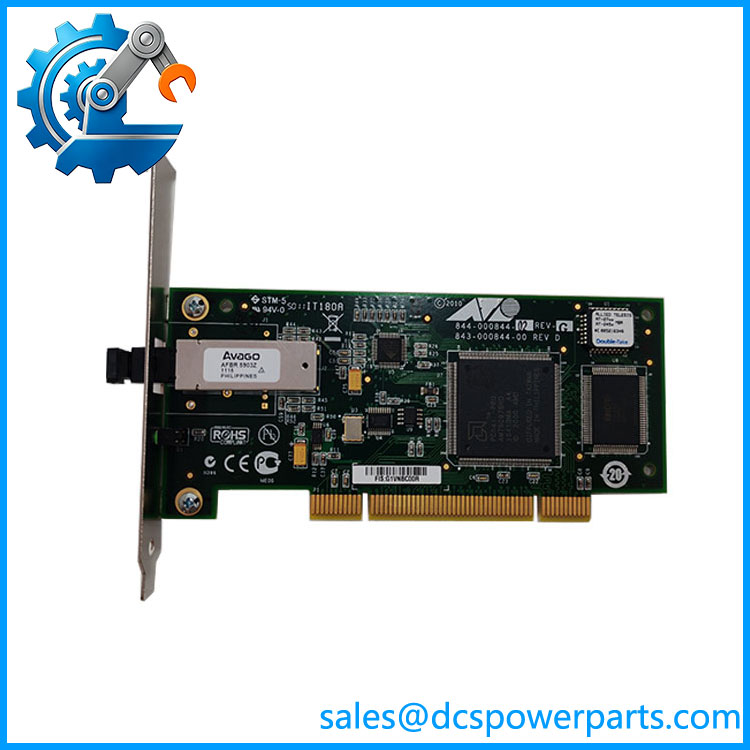
TRICONEX-AT-2701FX-843-000844-00
Key Features and Advantages
A galvanic break where copper cannot deliver one: the fiber link carries light, not current, so the host and the far end share no ground reference. In a plant room next to drives and welding equipment, that removes both the ground loop and the interference path that copper Ethernet would otherwise provide.
Distance that fits plant geometry: 2 km full-duplex on multimode takes a link from a control room to a remote rack without a repeater or a media converter in the middle — the whole reason this board was specified instead of a copper NIC in the first place.
No negotiation to go wrong: the port is fixed at 100 Mbps and defaults to full duplex. A link comes up at the expected rate or not at all, which on an old host removes a class of intermittent trouble that copper autonegotiation can produce.
Honest optical margin: −19 to −14 dBm transmit against −31 dBm receive sensitivity leaves a workable budget over 2 km, and the figure is published rather than implied — enough to check a link against measured loss before blaming the card.
Small electrical footprint: 2.5 W typical from the slot, 3.3 V signalling, no external supply, no terminal block, no DIN rail. Installation is a slot and a screw.
Legacy-host fit: the low-profile bracket ships fitted with the standard bracket in the box, so the same board drops into a slim chassis and a full-height one — relevant when the host is an older industrial computer with an unusual case.
A second number that identifies the right part: 843-000844-00 gives the Triconex BOM the exact assembly, including revision, that the system’s documentation references. Buying “an AT-2701FX” without that number risks a different ferrule, a different revision, or the later PCIe 2711 card that will not fit the slot.
Limits worth stating plainly: one port, so no link redundancy at the card level; no hot swap, because PCI is not a hot-plug bus in this generation; and diagnostic visibility limited to link and activity, with everything else left to the host driver. It is a network adapter, and it behaves like one.
Applications
Triconex host nodes that require a fiber network connection: wherever the system drawings call for the 843-000844-00 assembly, typically an industrial computer in the safety system’s network path that must reach a switch or peer over fiber rather than copper.
Control rooms separated from field racks by more than a copper run allows: a 100 m limit is short in a refinery or a large power station, and 2 km of multimode covers the distance without adding active equipment between the two ends.
Electrically hostile locations: motor control centres, variable-speed drive rooms and welding areas, where the fiber link’s immunity to electromagnetic interference and its ground isolation protect both the data and the host’s electronics.
Replacement of a failed adapter in a legacy host: an existing card with a failed port or a damaged ferrule is swapped for the same assembly number and revision, preserving the host’s driver installation and the site’s spares record — the case where matching the part exactly matters more than upgrading it.
Where the copper port is the requirement, this is the wrong card: an AT-2701FTX carries both twisted pair and fiber, and a site that needs a copper drop as well should be looking at that variant rather than adding a converter downstream.
Where the host is a newer PCIe machine, this is also the wrong card: the 2711 series is the PCIe successor, and no bracket adapts a PCI board to a PCIe slot.
Related Products
AT-2701FX/SC-901 — the Allied Telesis catalogue number for this board with the SC ferrule; the same hardware the Triconex assembly number identifies. AT-2701FX/ST-901 — ST ferrule variant of the same card; the site’s patch panel decides which one a replacement needs. AT-2701FXa/SC — later “-a” revision of the AT-2701FX design with an updated controller and driver set; compatible in role, not identical in driver support. AT-2701FTX/SC — dual-port variant with both 10/100Base-TX copper and 100Base-FX fiber, where a copper drop is also required. AT-2700FX/SC — the PCI 2.1 predecessor of this series; an older board with a narrower bus compliance. 2711FX/SC — PCI Express x1 successor; the migration path for hosts that no longer have a PCI slot. A2H124-24FX-RH — Enterasys fiber Ethernet switch that appears in the same Triconex spare-parts lists, a typical far end for these links. A2H254-16-RH — Enterasys switch from the same family, another network peer found alongside Triconex assemblies.
Installation and Maintenance
Before installation: read the label rather than the listing, and confirm three things — the assembly number 843-000844-00 with its revision letter, the ferrule on the card (SC against the site’s patchcord), and the host’s bus and driver situation. A card whose driver does not exist for the host operating system is unusable no matter how correct the fiber is. Check the host has a free 32-bit PCI slot, that the bracket matches the chassis height, and that the fiber’s core and cladding size and the link distance fall inside the published 2 km / 412 m figures.
Installation: power the host down and disconnect it, observe ESD precautions, and seat the board fully in the slot before securing the bracket screw. Clean both fiber ends before mating them — a fingerprint on an SC ferrule is a link-budget loss that no amount of troubleshooting at the software layer will find — and cap unused ports. On power-up, the single LED tells the whole card’s story: steady for link, flashing for activity, dark for no link. Bring the interface up and verify speed and duplex at 100 Mbps, then confirm the link reaches the intended peer rather than a switch port in a different VLAN.
Maintenance: treat the card as consumable electronics with a long but finite life, and keep a spare of the correct assembly number and ferrule. When a link fails, work outward — fiber end-face and connector first, then the far-end port, then the driver and interface configuration, and the board last. Do not reseat the card with the host powered; this generation of PCI is not hot-plug. Record the revision letter fitted to each host, because a spare at a different revision may install with a different driver package, and inspect the card’s edge connector and bracket for corrosion where cabinets see humidity. In a safety system, remember what this part is not: its failure removes a node’s network link but is not a safety function, and no redundancy should be assumed at the card level.
Warranty and Quality
Every AT-2701FX 843-000844-00 is supplied as the Allied Telesis 100Base-FX PCI adapter that the Triconex assembly number identifies — Rev D, single SC fiber port, PCI 2.2, 2.5 W — and its identity is confirmed by the printed assembly number and revision on the board before dispatch, because this number is sold online as a 24 VDC digital I/O module weighing 2 kg, as an RS-485 communication interface, and as a DIN-rail media converter with dual redundant power terminals, none of which describes a PCI card. Each unit is inspected for edge-connector condition, bracket and ferrule integrity, LED function, and evidence of prior use, static damage or corroded contacts. Where a compatible host is available, the card is installed, its driver bound to the correct operating system, and the link brought up against a known 100Base-FX port with link and activity confirmed and throughput checked at 100 Mbps. A 12-month repair, replacement or refund commitment applies. Technical support covers what this assembly actually raises: separating the Triconex number from the Allied Telesis model, matching the ferrule and revision to the installed card, confirming drive support for a legacy host, and judging when the PCIe 2711 successor is the only viable route.