Description
Product Overview
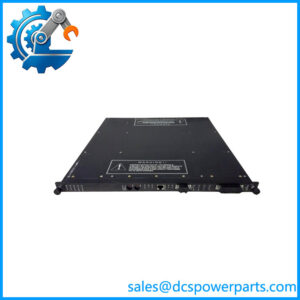
The Triconex 4201 is a Remote Extender Module (RXM) used in legacy Tricon safety-instrumented systems to place I/O hardware away from the main Tricon chassis. Its job is not to process application logic or provide conventional field I/O. Instead, the Triconex 4201 extends the Tricon I/O bus through a fiber-optic link, allowing a remote I/O chassis to communicate with the main system over a physically isolated connection. Tricon documentation identifies the 4201-3 as the remote RXM for multimode fiber, with a maximum cable length of approximately 2 km.
In a typical architecture, the remote extender operates as part of an RXM arrangement rather than as a standalone communications card. The primary-side RXM and remote-side RXM provide the optical path between the main chassis and remote expansion chassis. This arrangement is useful when field I/O must be installed closer to process equipment while the primary Tricon hardware remains in a central control or equipment room. Ground-loop isolation is another important characteristic of the RXM architecture, which can help separate the remote I/O installation electrically from the main chassis.
For procurement, the key point is that Triconex 4201 is a location-specific component. The remote module should not be confused with the 4200 primary RXM or the 4210/4211 single-mode RXM family. Tricon documentation lists 4200-3 and 4201-3 for multimode fiber, while 4210-3 and 4211-3 use single-mode fiber and support a substantially longer link distance.
This makes the Triconex 4201 relevant to legacy Tricon system maintenance, remote I/O expansion, chassis replacement, and controlled migration projects where the existing fiber architecture must remain unchanged. For an installed system, verify the complete assembly designation, chassis location, fiber type, connector arrangement, and system revision before approving a replacement.
Product Introduction (Non-Templated)
A remote I/O chassis is only useful when its communication path matches the Tricon architecture around it. The Triconex 4201 occupies the remote side of that path, using multimode fiber to extend the Tricon I/O bus over distances up to approximately 2 km.
For a DCS/SIS legacy replacement project, the distinction between 4201, 4200, 4210, and 4211 matters. They are not interchangeable simply because they share the RXM designation.
Key Technical Specifications
| Parameter | Value |
|---|---|
| Product Model | Triconex 4201 |
| Product Family | Tricon Remote Extender Module (RXM) |
| Product Type | Remote Extender Module |
| Chassis Position | Remote |
| Fiber Type | Multimode |
| Maximum Fiber Distance | Approximately 2 km / 1.2 miles |
| Communication Function | Tricon I/O bus extension |
| Optical Connection | Fiber-optic RXM connection |
| Architecture | Tricon TMR safety system remote I/O |
| Primary-Side Counterpart | 4200 / 4200-3 multimode primary RXM |
| Single-Mode Alternative Family | 4210 / 4211 |
| Typical Application | Remote I/O chassis extension |
| Lifecycle Status | Legacy / discontinued |
The Tricon product guide specifically identifies 4200-3 as the primary multimode RXM and 4201-3 as the remote multimode RXM, with the multimode link limited to approximately 2 km. The same documentation identifies 4210-3/4211-3 as the single-mode pair with a 12 km limit.
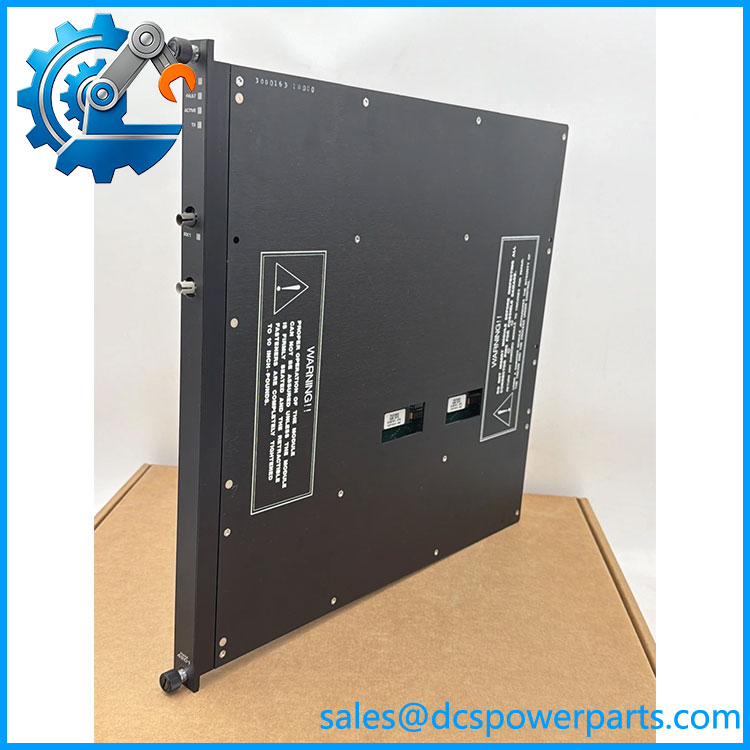
Triconex 4201
Related Products
- Triconex 4200 / 4200-3 — Primary-side multimode RXM used with the remote 4201 configuration. It occupies the main-chassis side rather than the remote chassis.
- Triconex 4210 / 4210-3 — Primary-side single-mode Remote Extender Module. It belongs to the longer-distance single-mode RXM architecture.
- Triconex 4211 / 4211-3 — Remote-side single-mode counterpart to the 4210 primary RXM. It should not be substituted for a 4201 without checking the installed fiber infrastructure.
- Triconex 8110C — Main Tricon chassis family used for the central system architecture.
- Triconex 8112C — Remote expansion chassis associated with remote I/O architecture.
- Triconex 8310/8311/8312 — Tricon power-module families used in chassis-level power arrangements; they are not substitutes for the RXM.
- Triconex 3008/3008C — Main processor family. These modules execute Tricon application logic and have a completely different function from the 4201.
FAQ
Can I replace a Triconex 4201 with a 4211?
Not as a direct drop-in replacement. The 4201 is associated with multimode fiber, while the 4211 belongs to the single-mode RXM architecture. The fiber plant, primary RXM, connectors, and system configuration all need to match.
What does the Triconex 4201 actually do?
It extends the Tricon I/O bus to a remote chassis over fiber. It is a communications/extender component, not a main processor and not a conventional analog or digital I/O module.
What is the maximum distance supported by the 4201?
The documented multimode RXM configuration supports approximately 2 km (1.2 miles). The 4210/4211 single-mode architecture extends to approximately 12 km, so the two families should not be treated as equivalent.
Is the 4201 a primary or remote module?
Remote. Tricon documentation lists the 4200-3 as the primary multimode RXM and 4201-3 as the remote multimode RXM.
Can I hot-swap this module?
Do not assume hot replacement is permitted solely from the 4201 part number. Confirm the applicable Tricon hardware revision, chassis procedure, and site maintenance procedure before removing an installed RXM from an operating safety system.
Does the 4201 retain application logic or configuration?
No. The 4201 is an RXM communication/extender component. Application logic resides in the Tricon processor architecture, not in the remote fiber extender.
How should I verify a New Surplus Triconex 4201 before installation?
Check the complete part number and hardware revision against the existing module, confirm the remote-side RXM role, verify that the system uses multimode fiber, inspect the optical connectors and module condition, and perform the site’s approved rack-level functional checks before placing the safety system back into service. For legacy safety hardware, visual similarity is not enough; configuration and architecture must match.