Description
Key Technical Specifications
| Parameter | Specification |
|---|---|
| Product Model | 3708E |
| Manufacturer | Triconex / Invensys |
| Product Type | Isolated TMR Thermocouple Input Module |
| Number of Inputs | 16 |
| Input Configuration | Differential, isolated |
| Thermocouple Types | J, K, T, E |
| Input Update Rate | 50 ms maximum |
| Input Resistance | 30 MΩ minimum DC |
| Common-Mode Range | ±200 VDC maximum |
| Input Protection | 110 VAC continuous without damage |
| Common-Mode Rejection | -100 dB minimum at DC; -90 dB minimum at 60 Hz |
| Normal-Mode Rejection | -3 dB at 8 Hz typical; -17 dB at 60 Hz typical |
| Reference-Junction Compensation | 0–60°C / 32–140°F |
| Open-Input Detection | Upscale or downscale, TriStation-configured |
| Logic Power | <15 W |
| Status Indicators | PASS, FAULT, ACTIVE, CJ |
| Safety Architecture | TMR |
| Front Color Code | Deep yellow |
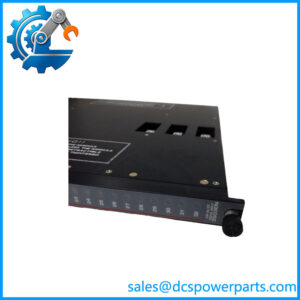
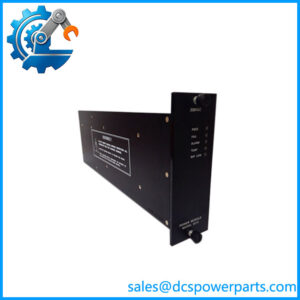
The Tricon documentation identifies the 3708E as an isolated TMR thermocouple input module with 16 differential inputs. Each input is individually converted through the triplicated I/O architecture, with dedicated signal conditioning and ADC processing on the three TMR legs.
Product Introduction
The Triconex 3708E is a 16-point isolated thermocouple input module used in Tricon safety systems for temperature measurement. It supports J, K, T, and E thermocouples, with configurable upscale or downscale open-input detection through TriStation. Its 50 ms maximum input update rate and triplicated processing make it suited to temperature measurements that participate in safety and shutdown logic rather than ordinary PLC monitoring.
The key engineering advantage is electrical isolation combined with TMR processing. The module provides a ±200 VDC maximum common-mode range and 30 MΩ minimum input resistance, reducing the impact of field-side electrical differences on measurement integrity. Reference-junction compensation is supported over 0–60°C, but the installation still needs careful attention to thermocouple termination temperature and wiring.
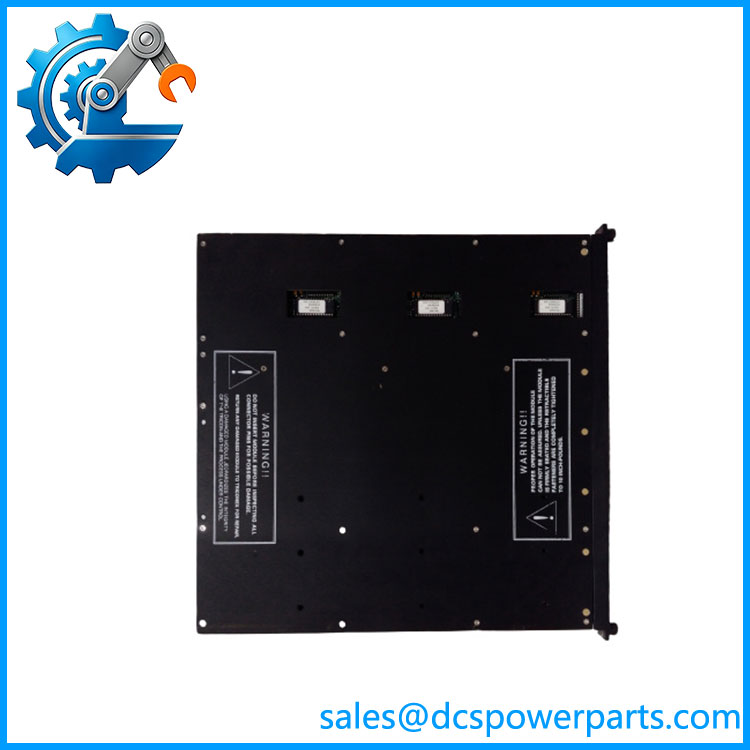
3708E
Application Scenarios & Field Pitfalls
Engineering Pain Point
Temperature inputs in a safety system cannot be treated like ordinary analog channels. A thermocouple problem can originate from the sensor, extension wire, termination panel, cold-junction measurement, grounding arrangement, or the input module itself.
The 3708E’s TMR architecture provides three processing paths, but it does not eliminate field wiring or termination problems. Tricon documentation specifically warns that excessive common-mode voltage can affect both proper operation and the accuracy of other channels.
Typical Applications
- Gas turbine temperature monitoring — exhaust and combustion-related temperature measurements.
- Steam and process turbines — bearing, casing, steam, or process temperature supervision.
- Refinery and petrochemical SIS — high-temperature process measurements used in protective logic.
- Boiler and process heating systems — thermocouple inputs associated with shutdown, permissive, and alarm functions.
Technical Pitfalls to Avoid
- Do not substitute 3706A without checking the application. The 3706A is a non-isolated thermocouple module with 32 differential inputs, while the 3708E provides 16 isolated inputs. They are not equivalent modules.
- Verify the thermocouple type in TriStation. The module supports J, K, T, and E, but the actual type must be configured correctly. A physically correct thermocouple connected with the wrong software configuration will produce incorrect temperature values.
- Check the termination panel. The Tricon documentation identifies the 9782-110F as a compatible 16-point thermocouple termination panel for 3708E installations.
- Do not ignore cold-junction conditions. The specified reference-junction compensation range is 0–60°C. Temperature gradients at the thermocouple termination can introduce additional measurement error.
- Respect the common-mode limit. The maximum specified common-mode range is ±200 VDC channel-to-channel or channel-to-ground. Exceeding it can compromise module operation and measurement accuracy.
- Check TMR health diagnostics. The module provides PASS, FAULT, ACTIVE, and CJ status indications. A CJ fault should not be dismissed as a normal thermocouple signal problem.
Related Products
- 3706A — 32-point non-isolated TMR thermocouple input module; higher channel density but substantially different isolation characteristics.
- 3703E — Isolated analog input module for non-thermocouple signals; different signal-conditioning function.
- 3700A — 0–5 V analog input module; intended for voltage signals rather than direct thermocouple measurement.
- 3720 — Tricon analog input module for process signals; not a direct thermocouple equivalent.
- 3721 — Related Tricon analog input family with different input architecture.
- 3805E — TMR analog output module; output function rather than temperature input.
- 3504E — High-density digital input module; discrete rather than temperature measurement.
- 9782-110F — 16-point thermocouple field termination panel specifically listed as compatible with the 3708E.
- TriStation 1131 — Engineering software used to configure thermocouple type and upscale/downscale open-input detection.
Procurement Check
For a Triconex 3708E replacement, verify 3708E + installed Tricon system generation + termination panel + thermocouple type + TMR configuration before purchasing.
The most important distinction is 3708E versus 3706A. Both are Tricon thermocouple modules, but 3708E is the 16-point isolated version, while 3706A is a 32-point non-isolated design. Treating them as interchangeable based only on “thermocouple input” is an avoidable commissioning risk.