Description
Siemens 6DD1660-0BB0 SIMADYN D CS13 Communication Module
Product Overview
The Siemens 6DD1660-0BB0 is a SIMADYN D CS13 communication module designed for high-speed fiber-optic coupling between SIMADYN D subracks. Siemens identifies CS13 as one of the fiber-optic coupling modules in the CS12-CS22 architecture. The module combines the CS12 coupling function with one or more ICS1 sections, providing fiber-optic connections for up to four slave subracks equipped with CS22 modules. Rather than acting as a conventional Ethernet, PROFIBUS, or serial communication card, the Siemens 6DD1660-0BB0 effectively extends the SIMADYN D backplane bus between physically separated subracks.
The architecture is built around memory-based data exchange. Siemens documentation states that the coupling uses RAM on the CS12 portion, with connected CS22 slave modules able to access that memory. The documented RAM capacity is 128 KB, while a master can distribute the basic sampling time for slave synchronization, alarm interrupts, and clock interrupts. The fiber-optic point-to-point connection can reach 200 m, giving the architecture useful physical separation between SIMADYN D subracks without extending electrical backplane wiring.
For engineers maintaining legacy drive-control or high-performance automation installations, the Siemens 6DD1660-0BB0 is a specialized architecture component. It is not a general-purpose PLC communication processor. The distinction is important when planning a SIMADYN D system upgrade or legacy replacement: the module belongs to the CS13/CS22 fiber-coupling architecture, and the connected slave hardware must be considered at the same time. Siemens documentation also notes that this coupling arrangement is not intended for SR6(V) use because data transfer is realized only through the C bus.
Product Introduction
Long cable runs between control subracks can become an architectural problem when the control platform depends on a backplane-oriented data model. 6DD1660-0BB0 addresses that requirement through SIMADYN D’s CS13 fiber-optic coupling, allowing one master to communicate with as many as four CS22 slave subracks.
The engineering numbers are useful: up to 200 m per point-to-point fiber connection, approximately 5 µs per 16-bit value under normal L/C-bus loading, and 128 KB RAM in the CS12 coupling section. Those figures describe the coupling architecture, not a general-purpose network bandwidth specification.
Key Technical Specifications
| Parameter | Specification |
|---|---|
| Product Model | 6DD1660-0BB0 |
| Manufacturer / Brand | Siemens |
| Automation Platform | SIMADYN D |
| Module Designation | CS13 |
| Product Type | Fiber-optic subrack coupling communication module |
| Coupling Architecture | CS12 / ICS1 fiber-optic coupling |
| Module Role | Master |
| Compatible Slave Module | CS22 |
| Maximum Slave Connections | Up to 4 |
| Physical Medium | Fiber-optic cable |
| Maximum Point-to-Point Fiber Length | 200 m |
| RAM | 128 KB on CS12 |
| Normal Transfer Time | Approx. 5 µs per 16-bit value |
| High-Load Transfer Time | Up to approx. 32 µs per 16-bit value |
| Bus Connections | L bus and C bus |
| Synchronization Functions | Basic sampling time, alarm interrupt, clock interrupt |
| SR6(V) Compatibility | Not intended for use in SR6(V) |
| Lifecycle | Legacy / discontinued |
The fiber distance, transfer timing, RAM, slave count, bus connections, and SR6(V) limitation are taken from Siemens SIMADYN D hardware documentation.
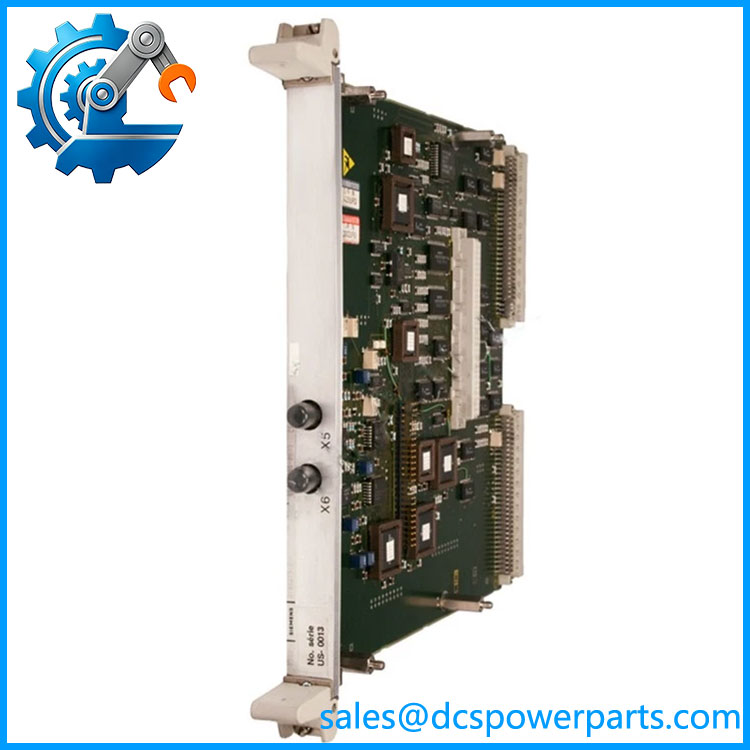
6DD1660-0BB0
Major Features and Advantages
master coupling architecture
The 6DD1660-0BB0 belongs to the fiber-optic coupling architecture rather than the ordinary SIMADYN D I/O family. Siemens defines as a master-side module used together with slave modules. A single master can support up to four fiber-optically connected slave subracks.
Fiber-optic separation between subracks
A point-to-point fiber connection can extend to 200 m according to the Siemens documentation. This provides physical separation between subracks without requiring the L/C bus to remain electrically continuous across the distance. For large machine-control installations, that can simplify the physical architecture considerably.
Backplane-bus extension rather than ordinary networking
One common procurement mistake is to describe the simply as a “fiber Ethernet module.” That is incorrect. The coupling operates as an extension of the SIMADYN D backplane bus, with data exchange implemented through the RAM associated with the section. The connected modules access that memory architecture rather than communicating as ordinary Ethernet nodes.
Real-time synchronization functions
The master can transmit the basic sampling time to synchronize slave operation. Siemens also documents alarm-interrupt and clock-interrupt transmission. These functions are important in deterministic control architectures where multiple subracks must maintain coordinated timing.
128 KB coupling RAM
The section contains 128 KB RAM used for the coupling mechanism. This is a system resource associated with the data-exchange architecture, not user-program storage equivalent to a modern PLC memory card.
High-speed transfer behavior
Siemens specifies approximately 5 µs per 16-bit value under normal L/C-bus loading and up to approximately 32 µs per 16-bit value under extremely high L/C-bus loading. These figures are more useful for system-level timing analysis than quoting an artificial “fiber bandwidth” number.
Clear distinction between and neighboring modules
The SIMADYN D family contains several similar-looking CS coupling designations. Siemens lists , , CS14, and as different elements of the fiber-optic coupling architecture. supports up to four slaves, while CS14 extends the architecture to as many as eight. The final Siemens order number therefore matters.
Related Products
- Siemens 6DD1660-0BC0 — fiber-optic coupling module used in the same – architecture; verify the exact system role before substitution.
- Siemens 6DD1660-0BA0 — CS14 fiber-optic coupling module with a larger fiber connection capacity than ; not a direct assumption-based replacement.
- Siemens 6DD1660-0BD0 — slave module used at the remote subrack side of the fiber-optic coupling.
- Siemens — Core coupling architecture incorporated into and CS14 assemblies.
- Siemens CS14 — Related master coupling configuration supporting up to eight slave connections according to Siemens documentation.
- Siemens ICS1 — Fiber-optic interface section incorporated into the /CS14 architecture.
- Siemens SIMADYN D subrack — The physical control-system environment in which the / coupling architecture is installed.
- Siemens SIMADYN D L/C Bus — Internal bus architecture extended between coupled subracks by the – fiber arrangement.
The and designations should not be treated as interchangeable: Siemens documents for up to four slave connections and for up to eight.
FAQ
What is Siemens 6DD1660-0BB0?
It is the SIMADYN D fiber-optic subrack coupling communication module. It functions as the master side of a fiber-optic coupling architecture using slave modules.
How many remote subracks can 6DD1660-0BB0 connect?
The configuration supports up to four slave connections through the corresponding modules. Siemens identifies as the related configuration for up to eight slaves.
What is the maximum fiber distance?
Siemens specifies a maximum point-to-point fiber-optic cable length of 200 m for the – coupling architecture. Actual installation distance should still account for the approved fiber type, connectors, routing, and system-specific hardware.
Can I replace 6DD1660-0BB0 with 6DD1660-0BA0?
Do not treat them as direct substitutes. Both belong to the SIMADYN D fiber-coupling family, but 6DD1660-0BB0 is while 6DD1660-0BA0 is . provides a different slave-connection capacity. The existing system topology and configuration must be checked before substitution.
Can I hot-swap 6DD1660-0BB0?
Do not assume hot-swapping. This module participates directly in the inter-subrack control-data path. Removing it can interrupt communication with connected slave subracks and potentially affect control functions. Follow the machine-specific SIMADYN D maintenance procedure and determine the process consequence before removing the module.
Does it support firmware v3.1?
A reliable source reviewed for this part does not establish a firmware-v3.1 compatibility statement for 6DD1660-0BB0. Do not infer firmware compatibility from the part number. For a replacement, compare the installed module revision and the complete SIMADYN D application configuration.
Does 6DD1660-0BB0 retain the user program?
It should not be treated as the primary user-program storage device. The documented 128 KB RAM belongs to the coupling mechanism and is used for data exchange between the master and connected slave modules. It is not equivalent to nonvolatile application storage.
Is Siemens 6DD1660-0BB0 still supported?
The part is a legacy SIMADYN D component. One Siemens-derived product record identifies the product lifecycle as discontinued, with an end-of-product-lifecycle date of October 1, 2017. Another inventory record lists a manufacturer discontinuation date of October 1, 2015, so lifecycle databases are not perfectly consistent on the exact date. For procurement purposes, it should be treated as a legacy part and its current support status verified separately.
What should I check when buying New Surplus 6DD1660-0BB0?
Verify the complete 6DD1660-0BB0 order number, identification, connector condition, board revision, fiber-optic interface condition, and evidence of proper storage. Because this is a legacy communication assembly, visual condition alone is not enough. A functional test with a compatible architecture is preferable when available. Confirm the supplier’s actual warranty terms separately.
Procurement Note
The important point with 6DD1660-0BB0 is architectural compatibility. This is not a generic fiber-optic communication card and it should not be evaluated as though it were a modern Ethernet interface. Siemens documentation defines it as , the master-side fiber-optic coupling module for connecting SIMADYN D subracks through slave modules.
For a replacement, document the complete topology first: master, number of slaves, fiber length, connected subracks, L/C-bus architecture, and application timing requirements. The 200 m fiber figure and approximately 5 µs per 16-bit transfer figure are useful engineering references, but they do not eliminate the need to verify the complete installed configuration.
One further caution: 6DD1660-0BB0 has been incorrectly described in some aftermarket listings as a SIMADYN D PM6 processor module. Siemens’ own SIMADYN D hardware documentation identifies this order number as , a fiber-optic subrack coupling module. That manufacturer documentation should take precedence over conflicting reseller descriptions.