Description
Siemens MXG461.20-5.0
Product Introduction
The Siemens MXG461.20-5.0 is an Acvatix series three-port modulating control valve designed for proportional regulation of fluid flow in HVAC and hydronic systems. Siemens identifies the MXG461 family as modulating control valves with magnetic actuators and PN16 pressure ratings. The exact MXG461.20-5.0 configuration is the DN20 version with a Kvs value of 5.0 m³/h. Siemens’ official documentation lists this exact type reference in the MXG461 series.
The valve uses a magnetic actuator for fast, continuous positioning rather than a conventional motor-driven valve mechanism. Published technical information for the exact model identifies 24 VAC supply and proportional control through 0–10 VDC, 2–10 VDC, or 4–20 mA signals. The three-port construction allows the valve to be used for mixing or diverting flow, depending on the hydraulic arrangement. The published valve characteristics include equal-percentage behavior optimized in the closing range and linear characteristics depending on the selected configuration/application.
The Siemens MXG461.20-5.0 is particularly relevant to plant HVAC systems, chilled-water circuits, heating-water systems, air-handling units, fan-coil systems, and other applications where accurate hydronic flow modulation is required. The DN20 body and Kvs 5.0 rating make it a relatively small control valve compared with the larger sizes. During replacement, engineers should verify the valve’s port arrangement, actuator supply, control signal, medium temperature, pressure differential, and required flow capacity. The similar .20-5.0P is a two-port version, so the suffix must be checked carefully before ordering.
Technical Specifications
| Specification | Details |
|---|---|
| Product Model | .20-5.0 |
| Manufacturer | Siemens |
| Product Family | Acvatix |
| Product Type | 3-port modulating control valve |
| Valve Technology | Magnetic actuator |
| Nominal Diameter | DN20 |
| Pressure Rating | PN16 |
| Kvs Value | 5.0 m³/h |
| Supply Voltage | AC 24 V |
| Control Signal | DC 0–10 V, DC 2–10 V, 4–20 mA |
| Valve Configuration | 3-port |
| Control Characteristic | Equal-percentage / linear depending on application/configuration |
| Valve Body | Gray cast iron EN-GJL-250 |
| Seal Material | EPDM |
| Typical Medium | Water, water/glycol mixtures |
| Medium Temperature | Approximately +1 to +130 °C, application dependent |
| Leakage | A → AB max. 0.02% Kvs; B → AB <0.2% Kvs |
| Actuator Response | Fast magnetic positioning |
| Communication | Analog control; no fieldbus communication |
| Mounting | Threaded pipe connection |
| Application | HVAC and hydronic flow control |
The exact DN20/Kvs 5.0 identification and family specifications are supported by Siemens documentation. Some detailed operating values above are taken from technical documentation covering the exact .20-5.0 configuration.
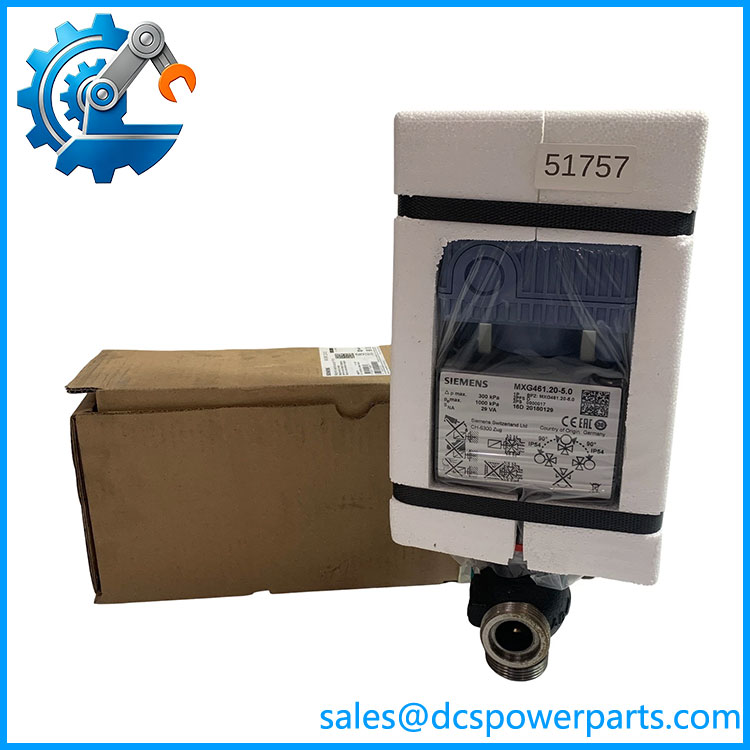
MXG461.20-5.0
Main Features and Engineering Considerations
Three-port hydraulic configuration
The key feature of the Siemens .20-5.0 is its three-port configuration. Unlike the .20-5.0P two-port model, the three-port version can be incorporated into mixing or diverting circuits. Hydraulic orientation therefore matters during installation.
Magnetic actuator technology
The series uses magnetic actuation to provide continuous proportional valve positioning. This architecture is suited to applications where the controller continuously adjusts heating or cooling flow rather than simply commanding an open/closed state.
Multiple analog control signals
The valve can accept 0–10 VDC, 2–10 VDC, or 4–20 mA control signals according to the published technical data. This makes it suitable for integration with building-management controllers, HVAC automation controllers, and analog-output modules.
DN20 / Kvs 5.0 selection
DN20 defines the nominal pipe size, while Kvs 5.0 describes the valve’s flow capacity under the applicable standard test condition. Kvs should not be selected solely from pipe diameter. The required design flow and available differential pressure should be used to confirm the correct valve size.
Pressure and temperature limits
The PN16 designation defines the nominal pressure class, but actual permissible operating pressure depends on temperature and application conditions. Engineers should use the Siemens pressure-temperature curves when operating near the upper temperature range.
Medium compatibility
The valve is intended for hydronic media such as treated water and water/glycol mixtures. Siemens documentation recommends appropriately treated water for these applications. Water quality, glycol concentration, contaminants, and system filtration can affect valve life and control performance.
Control-system integration
The valve has an analog control interface rather than a digital fieldbus interface. When replacing one in an automation system, verify the controller’s analog output type and scaling. A controller configured for 2–10 V is not equivalent from a commissioning perspective to one configured for 0–10 V.
Do not confuse similar part numbers
This is a practical procurement issue. is the three-port version. is listed by Siemens as a mixing/two-port control valve. is another variant. Do not substitute between these suffixes without checking the hydraulic and actuator configuration.
Application Scenarios
- Building HVAC control systems
- Heating-water regulation
- Chilled-water systems
- Air-handling units
- Fan-coil systems
- Hydronic mixing circuits
- Hydronic diverting circuits
- Building-management-system controlled valves
- Industrial HVAC auxiliary systems
- Proportional temperature-control loops
Engineer’s Guide: Field Pitfalls
1. Check the number of ports.
The exact .20-5.0 is a three-port valve. A two-port replacement can fundamentally change the hydraulic behavior.
2. Verify Kvs rather than matching DN alone.
A valve with the wrong Kvs can produce poor control authority even though the pipe connection fits.
3. Confirm the actuator supply.
The exact configuration is associated with 24 VAC operation. Do not assume that every variant has identical electrical requirements.
4. Verify the controller output.
Check whether the building controller provides 0–10 V, 2–10 V, or 4–20 mA and confirm the valve’s configured input.
5. Check flow direction.
Three-port valves depend heavily on correct hydraulic orientation. Incorrect piping can produce unstable or ineffective temperature control.
6. Check differential pressure.
A valve can have the correct Kvs and still perform poorly if the available differential pressure is inappropriate for the selected circuit.
7. Do not confuse MXG and MXF.
The Siemens catalog contains both and MXF461 families with overlapping DN/Kvs combinations. The exact series designation should be retained during procurement.
Frequently Asked Questions
What is Siemens .20-5.0?
It is a Siemens Acvatix , PN16, three-port modulating magnetic control valve with a Kvs value of 5.0 m³/h.
Is it a PLC or DCS component?
No. It is an HVAC/hydronic control valve with an analog control interface.
What control signals are supported?
The published configuration supports 0–10 VDC, 2–10 VDC, and 4–20 mA control signals.
What is the difference between .20-5.0 and .20-5.0P?
The .20-5.0 is the three-port configuration, while Siemens identifies .20-5.0P as a mixing/two-port control valve.
What does Kvs 5.0 mean?
It is the valve flow coefficient used to characterize the valve’s flow capacity. It is not the same thing as the nominal pipe size.
What is the pressure class?
The series configuration is rated PN16. Actual allowable pressure depends on operating temperature and the manufacturer’s pressure-temperature limits.
Procurement Note
For an exact replacement, specify Siemens .20-5.0 rather than simply ordering a Siemens Acvatix valve. Confirm the three-port configuration, Kvs 5.0, 24 VAC supply, control-signal type, pipe connection, medium temperature, and hydraulic flow direction. The Siemens catalog contains closely related and variants, so the suffix is part of the functional identification.