Description
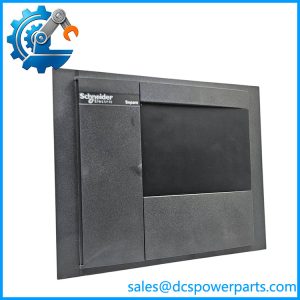
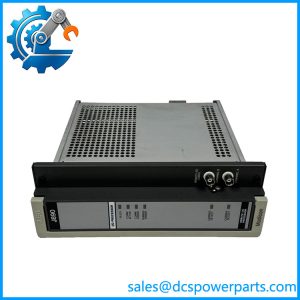
Schneider Electric SEPAM M88 Motor Protection Relay
Product Overview
The Schneider Electric SEPAM M88 is an advanced numerical motor protection relay from the Easergy Sepam Series 80 family. It is designed for demanding medium-voltage motor applications where protection extends beyond conventional phase overcurrent. Schneider’s M87/M88 documentation identifies current, voltage, frequency, differential, thermal, starting, power, ground-fault, and motor-condition protection functions, along with breaker control, event recording, waveform capture, communications, and programmable logic.
What separates the SEPAM M88 from the lower-level M87 is the ability to incorporate a two-winding transformer into the same protection zone, using the ANSI 87T transformer differential function. M88 also provides ANSI 87M machine differential protection, making it suitable for motor systems where the protection boundary includes more than the motor stator alone. Schneider lists M88 among its dedicated Series 80 motor-protection models rather than as a general-purpose feeder relay.
The Series 80 architecture is modular. Depending on the complete ordering code, the relay can use 1 A/5 A current inputs, digital I/O modules, RTD inputs, analog output, communication interfaces, Logipam firmware, and an optional synch-check module. Schneider’s ordering documentation identifies the M88 base ordering structure as SQ1M88, so “M88” alone does not define the complete hardware configuration.
Product Introduction
Large motor protection becomes complicated when starting behavior, thermal capacity, mechanical loading, ground faults, differential protection, and system voltage conditions all have to be considered in one scheme. The SEPAM M88 brings these functions into the Series 80 protection architecture while retaining breaker control, waveform capture, event recording, and expandable communications.
For a DCS system upgrade or legacy protection replacement, the complete SQ1M88... catalog number matters. Match the CT arrangement, I/O modules, communications, RTD hardware, Logipam configuration, and protection settings before treating another M88 as a replacement.
Key Technical Specifications
| Parameter | Specification |
|---|---|
| Product Model | SEPAM M88 |
| Manufacturer | Schneider Electric |
| Product Family | Easergy Sepam Series 80 |
| Product Type | Advanced motor protection relay |
| Primary Application | Medium-voltage motor protection |
| Motor Differential | ANSI 87M |
| Transformer Differential | ANSI 87T |
| Current Protection | Phase and ground overcurrent |
| Thermal Protection | ANSI 49 thermal overload |
| Motor Starting Protection | Excessive starting time / locked rotor / starts-per-hour |
| Voltage Protection | Undervoltage, overvoltage, sequence-voltage functions |
| Frequency Protection | Overfrequency and underfrequency |
| Power Protection | Directional active/reactive power functions |
| Mechanical Protection | Bearing temperature and speed-related functions |
| RTD Monitoring | Available with applicable Series 80 RTD modules |
| CT Input | 1 A / 5 A configurations |
| Digital I/O | Field-expandable Series 80 architecture |
| Temperature Inputs | Up to 16 with applicable modules |
| Relay Outputs | Series 80 architecture supports up to 23 |
| Logic Inputs | Series 80 architecture supports up to 42 |
| Communications | Modbus RTU, Modbus TCP/IP, DNP3, IEC 61850 options |
| IEC 61850 | MMS; GOOSE available with applicable configuration |
| Programmable Logic | Optional Logipam |
| Synch-Check | Optional MCS025 module |
| Memory | Removable memory cartridge for parameters/settings |
| Display | Advanced / MimicBus / remote options |
| Installation | Protection and switchgear panel |
| Firmware | Configuration-dependent |
The Series 80 platform provides up to 12 analog inputs, 42 logic inputs, 23 relay outputs, two Modbus communication ports, and 16 temperature-sensor inputs, depending on the installed modules and application. These are platform capabilities and should not be interpreted as the guaranteed I/O population of every M88.
Schneider’s M88 function matrix includes ANSI 12/14, 26, 27, 27D, 27R, 27S, 32P, 32Q/40/55, 37, 38, 40, 46, 47, 48, 49, 49T, 50/50G/50N, 50BF, 51/51G/51N, 51LR, 59, 59N, 66, 67N, 78, 81H, 81L, and 87T, with M87 using 87M while M88 uses 87T for the transformer differential application.
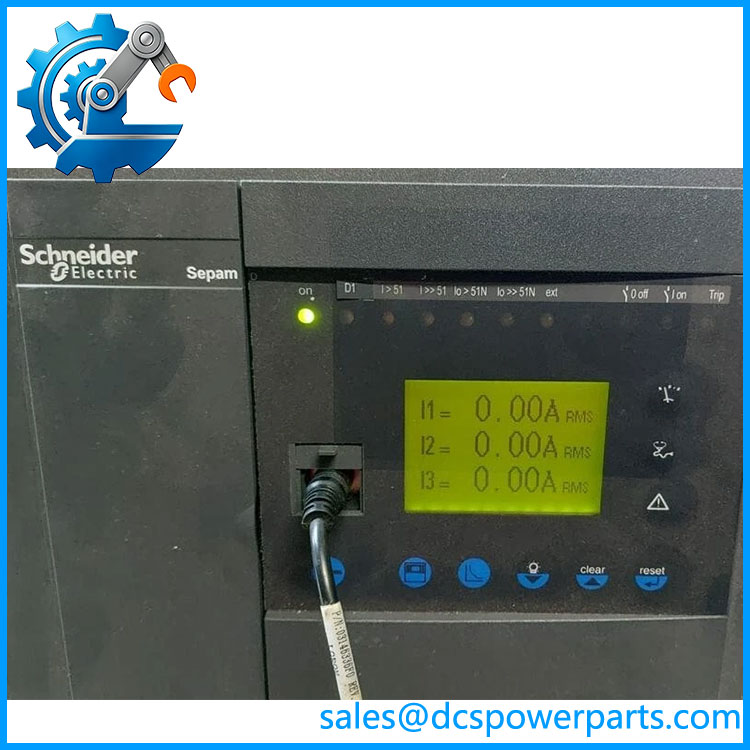
SEPAM M88
Major Features and Practical Advantages
1. Advanced motor protection
The M88 is intended for applications where a motor protection relay needs to account for electrical and mechanical operating conditions rather than simply detecting excessive current. Its function set includes thermal overload, negative-sequence current, locked rotor, excessive starting time, starts-per-hour, bearing temperature, loss of excitation, pole slip, power, voltage, and frequency protection.
That combination is useful on large motors where an incorrectly selected protection curve can either nuisance-trip during starting or fail to protect against abnormal thermal and mechanical conditions.
2. Motor differential protection
The broader M87/M88 motor-protection family supports machine-oriented differential protection, and Schneider identifies ANSI 87M as the machine differential function associated with M87. The M88 adds the two-winding transformer differential architecture described below.
For a replacement, CT polarity, ratio, wiring, and differential-zone definition should be checked against the approved protection design. A relay model match does not validate the existing CT scheme.
3. Two-winding transformer differential protection
This is the major technical distinction to understand when evaluating M88. Schneider specifically identifies ANSI 87T two-winding transformer differential protection as an M88 function and states that M88 can incorporate a transformer into the same protection zone.
That architecture can be useful for motor-fed transformer arrangements where separate protection equipment would otherwise be required. It also means that CT configuration and transformer vector-group assumptions become part of the replacement engineering review.
4. Motor starting supervision
Motor starting is a dedicated protection problem. M88 provides ANSI 48 excessive starting time, ANSI 51LR locked-rotor protection, and ANSI 66 starts-per-hour supervision.
These functions need to be coordinated with actual motor acceleration characteristics. Copying settings from another motor with a similar nameplate is not a sound commissioning method.
5. Thermal overload and RTD monitoring
The relay provides ANSI 49 thermal overload and 49T RTD monitoring, with temperature-input capability through applicable Series 80 modules. Bearing-temperature monitoring is also included in the M88/M87 function set.
For an existing installation, preserve the original thermal model and RTD mapping. Replacing the relay without transferring those details can change the effective motor protection even when the basic overcurrent settings look correct.
6. Voltage, frequency, and power supervision
M88 provides phase-to-phase, positive-sequence, remnant, and phase-to-neutral undervoltage functions, along with overvoltage, overfrequency, underfrequency, directional active power, and reactive-power-related protection.
This allows the relay to participate in schemes involving motor bus voltage disturbances, loss of supply, abnormal frequency, reverse or directional power, and other system-level conditions.
7. Breaker control and failure protection
Schneider identifies built-in circuit-breaker control and ANSI 50BF breaker-failure protection within the M87/M88 application.
That makes the relay part of the switching scheme, not merely a trip-generating measurement device. During replacement, document breaker close/trip outputs, interlocking, permissive signals, and breaker-failure logic.
8. Event recording and waveform capture
The M88 supports waveform capture and event records, which are valuable when investigating motor trips, starting problems, differential operations, and system disturbances. Schneider also lists onboard data logging as a Series 80 capability.
Before replacing an old relay, download important disturbance records and event history where practical. Those records can provide information that is otherwise lost during a hardware change.
9. Expandable communications
M88 supports a range of communication configurations including Modbus RTU, Modbus TCP/IP, DNP3, IEC 61850 MMS, and IEC 61850 MMS with GOOSE, depending on installed communication hardware.
Do not assume that an M88 automatically contains Ethernet or IEC 61850. The communication option is encoded in the complete ordering configuration.
10. Optional programmable logic
Schneider offers Logipam as an optional firmware feature for custom ladder-logic programming. This permits site-specific logic beyond the standard protection functions.
For legacy replacements, this is one of the first items worth checking. A relay can appear functionally identical while missing application-specific Logipam logic.
Related Products
- SEPAM M87 — Advanced motor protection relay with a closely related Series 80 architecture; differs from M88 in application scope, particularly the M88 two-winding transformer differential capability.
- SEPAM M81 — Motor protection model for less demanding motor applications within the Series 80 family.
- SEPAM G87 — Generator differential/protection relay; intended for generator applications rather than motor protection.
- SEPAM G88 — Advanced generator protection model within the same Series 80 platform.
- SEPAM T87 — Transformer differential protection relay for transformer applications.
- SEPAM S84 — Substation/feeder protection relay sharing the Series 80 modular architecture.
- SEPAM B83 — Busbar protection model within Series 80.
- MCS025 — Optional synch-check module used where ANSI-25 synch-check is required.
- MET1482 — Series 80 temperature-input module; two modules can provide up to 16 RTD inputs.
- MSA141 — Optional Series 80 analog-output module supporting selectable current-output ranges.
- SFT080 — Logipam firmware option for custom programmable logic.
Schneider’s ordering documentation identifies the Series 80 options including MCS025, MET1482, MSA141, and SFT080, while the motor application documentation defines the M87/M88 functional differences.
FAQ
What is SEPAM M88?
SEPAM M88 is an advanced Schneider Electric Easergy Sepam Series 80 motor protection relay. It provides current, voltage, frequency, thermal, starting, power, ground-fault, and differential-related protection together with control, recording, communications, and optional programmable logic.
Is M88 a PLC or DCS I/O module?
No. It is a power-system protection IED dedicated to motor applications. Although it has programmable logic and communication capabilities, its primary role is electrical motor protection and control.
What is the difference between M87 and M88?
The most important distinction is the protection application. Schneider identifies M87 with machine differential protection and M88 with two-winding transformer differential protection, ANSI 87T, allowing a transformer to be incorporated into the same protection zone. Both provide extensive motor-protection functions.
Does every M88 have IEC 61850?
No. IEC 61850 is configuration-dependent. Schneider’s Series 80 ordering architecture allows different communications options, including Modbus and IEC 61850 configurations. Verify the complete SQ1M88... catalog number before assuming IEC 61850 MMS or GOOSE is installed.
Can I hot-swap SEPAM M88?
Do not assume hot-swap capability. The relay is connected to CTs, voltage circuits, digital I/O, breaker-control circuits, and potentially transformer differential circuits. Use the approved protection-isolation procedure before removing it.
Does M88 support firmware v3.1?
The short designation M88 does not establish a specific firmware revision. Firmware and application configuration depend on the installed unit. Verify the actual firmware before attempting a replacement or configuration transfer.
Can M88 monitor motor bearing temperature?
Yes. Schneider’s M87/M88 function matrix includes ANSI 38 bearing temperature and ANSI 49T RTD monitoring. RTD inputs depend on the applicable Series 80 temperature modules installed in the particular relay.
Can M88 perform synch-check?
Yes, but synch-check is an optional configuration. Schneider identifies the MCS025 module as the module required for ANSI-25 synch-check in applicable Series 80 configurations.
Is SEPAM M88 still available?
The Series 80 platform is in a discontinuation phase. Schneider’s product page for catalog reference 59738 identifies M88 as discontinued in one market, while another Schneider regional listing gives a future discontinuation date of December 31, 2026 and end of standard service of December 31, 2030. Lifecycle dates therefore depend on the exact catalog reference and market.
What should I verify before purchasing a replacement M88?
Check the complete SQ1M88 catalog number, CT input arrangement, digital I/O module, RTD modules, communication hardware, display type, analog output, Logipam firmware, synch-check module, firmware revision, and existing protection settings.
Also preserve the motor’s thermal model, starting characteristics, CT ratios, RTD mapping, breaker-control logic, and communication configuration.
Procurement Note
The Schneider Electric SEPAM M88 should be procured as a complete configured protection system component, not simply as an “M88 relay.” Schneider’s ordering structure uses the SQ1M88 base model followed by configuration characters covering display, CT input type, communications, I/O, RTD inputs, analog output, Logipam, and synch-check.
For legacy replacement, the first procurement step should be photographing the existing nameplate and recording the full catalog number. The second is recovering the existing protection configuration. Pay particular attention to 87T transformer differential settings if the M88 is protecting a motor-transformer zone.
New Surplus condition alone does not establish configuration equivalence. Inspect the memory cartridge, connectors, display, communication ports, I/O modules, RTD interfaces, and physical condition. Where possible, verify the installed firmware and configuration before commissioning.
The lifecycle situation also deserves attention. Schneider currently identifies Sepam Series 80 as a discontinuing range, and the exact M88 lifecycle date varies by catalog reference and market.
For a plant with an existing M88 installation, the practical replacement target is therefore the same complete SQ1M88 configuration and application, not merely another relay carrying the M88 designation.