Description
Modicon AS-B883-200
Product Introduction
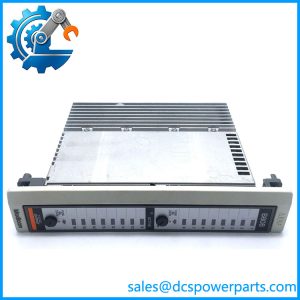
The Modicon AS-B883-200 is a 10-channel smart thermocouple input module designed for the legacy Modicon 800 Series I/O architecture. Its primary purpose is to acquire temperature signals from thermocouples and make the processed values available to the PLC through the 800 Series backplane. The module supports Type B, E, J, K, R, S, T, and N thermocouples, as well as linear millivolt operation from approximately -20 to +80 mV. This makes it suitable for temperature monitoring in industrial processes where several thermocouple types may be used within the same control system.
The Modicon AS-B883-200 includes reference-junction temperature compensation, thermocouple linearization, open-circuit detection, self-calibration, and internal diagnostics. Up to ten thermocouple inputs are multiplexed into three consecutive input registers, with associated output registers used for module configuration and control. The PLC can receive temperature values in degrees Celsius, degrees Fahrenheit, or compensated millivolts together with module-health and open-circuit information. The module uses a dedicated isothermal terminal arrangement for thermocouple wiring, which is important because the reference junction is part of the measurement system rather than simply a conventional analog input terminal.
From a maintenance perspective, the Modicon AS-B883-200 should be treated as a legacy 800 Series component. Schneider’s modernization documentation maps the older AS-B883-200 family toward newer X80 architecture, but the migration is not necessarily a simple module-for-module replacement. Existing thermocouple wiring, register mapping, scaling, channel configuration, and control-system logic should be reviewed before modernization.
Technical Specifications
| Parameter | Specification |
|---|---|
| Product Model | AS-B883-200 |
| Manufacturer | Modicon / Schneider Electric |
| Product Family | Modicon 800 Series I/O |
| Product Type | Thermocouple Input Module |
| Number of Inputs | 10 |
| Input Types | B, E, J, K, R, S, T, N thermocouples |
| Linear Input | Approximately -20 to +80 mV |
| Maximum Common-Mode Voltage | 200 VDC/VAC peak |
| Standard Resolution | 1°C, 1°F, 10 mV |
| Programmable Resolution | 0.1°C, 0.1°F, 1 mV |
| Update Time | 100 ms per selected channel |
| Maximum All-Channel Update | 1 second |
| Power-Up Time | 13 seconds maximum |
| Warm-Up Time | 2 minutes maximum |
| Reference Junction Compensation | Yes |
| Open-Circuit Detection | Yes |
| Self-Calibration | Yes |
| Internal Diagnostics | Yes |
| 800-Series Bus Diagnostics | Yes |
| +5 VDC Consumption | 400 mA |
| +4.3 VDC Consumption | 5 mA |
| -5 VDC Consumption | 0 mA |
| Installation | 1 × 800 Series I/O slot |
| Terminal Connector | Included; dedicated isothermal thermocouple connection |
| Weight | Approximately 4 lb / 1.8 kg |
The original Modicon documentation is the preferred reference for these specifications. Some current reseller pages contain inconsistent descriptions or unrelated specifications, so values such as 24 VDC input, Modbus, PROFIBUS, or generic IP ratings should not be attributed to without additional evidence.
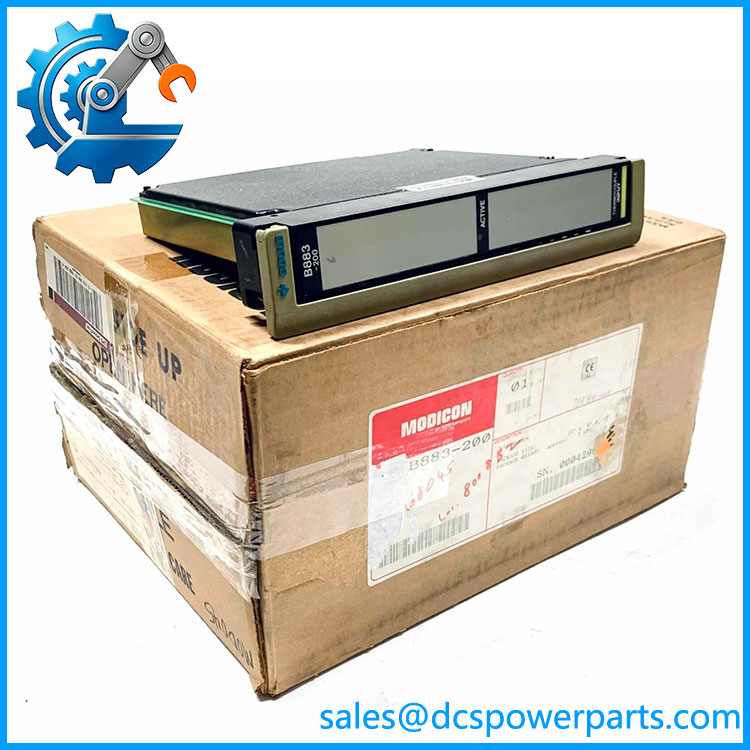
AS-B883-200
Main Features and Engineering Considerations
Ten Thermocouple Channels
The provides ten thermocouple inputs in one 800 Series module. It supports B, E, J, K, R, S, T, and N thermocouple types, allowing different temperature measurement requirements to be handled within the same module. The channel configuration is programmable rather than requiring separate hardware for each thermocouple type.
Reference-Junction Compensation
Thermocouples produce a voltage that depends on the temperature difference between the sensing junction and reference junction. The incorporates reference-junction temperature compensation, making the module substantially different from a basic millivolt input card. Correct terminal assembly and thermocouple wiring therefore matter directly to measurement accuracy.
Thermocouple Linearization
The module performs thermocouple linearization internally. The PLC can receive temperature values rather than requiring the control program to perform all thermocouple conversion calculations. This reduces application-level processing and preserves the original 800 Series architecture’s intended data format.
Open-Circuit Detection
The module includes open-circuit detection. This is useful for identifying broken thermocouple wires or disconnected sensors rather than allowing an open input to be interpreted simply as a process temperature.
Programmable Resolution
Standard resolution is specified as 1°C, 1°F, or 10 mV, while higher resolution settings of 0.1°C, 0.1°F, or 1 mV can be selected under program control. The appropriate setting should be considered together with sensor type, process requirements, noise level, and the actual accuracy requirements of the measurement loop.
Multiplexed Register Architecture
The ten physical channels are multiplexed into three consecutive input registers, with three corresponding output registers used by the module. This is an important point when replacing the module or migrating the control system. A modern analog input card should not be assumed to use the same register organization or scaling.
Dedicated Isothermal Terminal
Thermocouple wires terminate through a special isothermal connector assembly. This is not interchangeable with a generic terminal block without considering the reference-junction measurement arrangement. Incorrect terminal hardware can introduce temperature-measurement errors even when the thermocouple itself is correctly wired.
Application Scenarios
Industrial Furnaces
The module can acquire multiple thermocouple signals from furnace zones, allowing several temperature measurements to be integrated into an existing Modicon 800 Series controller.
Process Heating
Chemical, food, plastics, metals, and other process industries can use thermocouple inputs for vessel, pipe, heater, or process-zone temperature monitoring.
Kilns and Ovens
Multiple thermocouple types can be configured within the module where different temperature ranges or sensor characteristics are required.
Legacy Modicon Process Systems
The is especially relevant for maintenance of installed Modicon 800 Series systems where the original rack, backplane, terminal arrangement, and PLC application are still in service.
Temperature Monitoring
The module can provide temperature data to PLC logic for alarms, interlocks, control loops, trending, and supervisory monitoring.
Engineer’s Guide: Field Pitfalls
1. Do not treat it as a conventional analog input card.
The contains thermocouple-specific compensation and linearization functions. A generic analog input replacement will not automatically reproduce the same behavior.
2. Verify thermocouple type channel by channel.
The module supports B, E, J, K, R, S, T, and N. The configured type must agree with the actual sensor and extension wire.
3. Check the isothermal terminal assembly.
Thermocouple measurement depends on the reference junction. Incorrect terminal hardware or poor thermal arrangement can introduce errors that are not caused by the thermocouple itself.
4. Preserve register mapping during migration.
The original module uses three consecutive input and three output registers. Modernizing the hardware may require changes to PLC logic, scaling, diagnostics, and register addressing.
5. Allow for warm-up.
The original specification gives a maximum warm-up time of approximately two minutes. Do not evaluate temperature stability immediately after energizing the module.
6. Check open-circuit diagnostics.
A failed thermocouple should be distinguished from a genuine low-temperature process condition. Review how the existing PLC program handles the module’s open-circuit and health information.
7. Do not use generic 24 VDC specifications from reseller pages.
The documented module power requirements are primarily 5 VDC and 4.3 VDC through the 800 Series architecture. This is a rack/backplane module, not a standalone 24 VDC field transmitter.
8. Consider migration status.
If the system is being maintained rather than merely repaired, compare the cost and risk of another legacy module against a planned migration to current Schneider architecture.
Frequently Asked Questions
What is Modicon?
It is a 10-channel thermocouple input module for the Modicon 800 Series I/O system.
How many thermocouples can handle?
It supports 10 thermocouple inputs per module.
Which thermocouple types are supported?
Types B, E, J, K, R, S, T, and N are supported. The module can also accept linear millivolt signals.
Does provide cold-junction compensation?
Yes. The module provides reference-junction temperature compensation as part of its thermocouple measurement functions.
What is the maximum common-mode voltage?
The documented maximum is 200 VDC/VAC peak.
What is the resolution?
The documented standard resolution is 1°C, 1°F, or 10 mV, with programmable higher resolution of 0.1°C, 0.1°F, or 1 mV.
Is a 24 VDC module?
No. The original Modicon documentation specifies +5 VDC at 400 mA and +4.3 VDC at 5 mA, with no -5 VDC consumption. It is designed for the 800 Series rack/backplane architecture.
Can it be replaced by a modern Schneider analog input module?
Not as a simple assumption. Schneider modernization documentation identifies newer X80 solutions for migrating 800 Series functions, but the application must be reviewed for thermocouple type, channel count, wiring, register mapping, scaling, diagnostics, and control-system configuration.
Procurement Note
For , the complete part number should be specified because the module belongs to the legacy Modicon 800 Series architecture. When purchasing used or refurbished stock, request photographs of the front label and terminal assembly and confirm that the unit is actually the thermocouple module, not the visually similar -201 RTD module.
For a functional replacement, verify the existing rack, terminal connector, thermocouple wiring, channel configuration, PLC register mapping, and application diagnostics. The original documentation confirms that is a specialized 10-channel thermocouple module with integrated reference-junction compensation and linearization, so a generic analog input card should not be considered an equivalent substitute without engineering validation.