Description
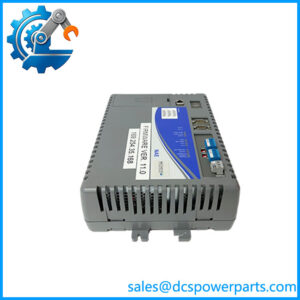
RTK Instruments UC625-32-AM-HH-R
Key Technical Specifications
| Parameter | Specification |
|---|---|
| Product Model | UC625-32-AM-HH-R |
| Manufacturer | RTK Instruments |
| Product Family | UC625 |
| Product Type | Alarm annunciator / fault alarm controller |
| Number of Channels | 32 |
| Primary Function | Discrete fault/alarm monitoring and annunciation |
| Indication | LED alarm indication |
| Input Type | Discrete alarm inputs; exact electrical interface requires verification |
| Supply Voltage | Verify against the nameplate/datasheet for the AM-HH-R configuration |
| Alarm Logic | Configuration-dependent |
| Reset/Acknowledge | Configuration-dependent |
| Communication Protocol | Not established from available documentation |
| Installation | Industrial control / annunciator panel |
| Protection Rating | Verify exact enclosure/configuration |
| Operating Temperature | Verify exact RTK configuration |
The UC625 product family is explicitly described in available records as an alarm annunciator, and trade records identify UC625 variants as multi-channel fault-alarm controllers. A separate current listing specifically identifies UC625-32-AM-HH-R as an RTK Instruments product, but does not publish enough electrical detail to safely infer its supply voltage or input circuit from the model number alone.
Product Introduction
The RTK Instruments -32-AM-HH-R is a 32-channel industrial alarm annunciator from the family. Its role is to collect discrete fault or alarm conditions and provide local visual indication so operators can identify abnormal equipment states from a dedicated annunciator panel. Trade documentation also identifies variants as fault-alarm controllers used in control systems, including transformer-station applications.
The exact suffix matters here. RTK offers multiple configurations using different channel counts, LED colors, input voltages, and option codes. For example, public records show 24-channel, 32-channel, 36-channel, and 40-channel variants, with 24 VDC, 110 V, and other electrical configurations represented in the product family. That makes it unsafe to assign the specifications of another variant to -32-AM-HH-R without checking the actual nameplate or RTK documentation.
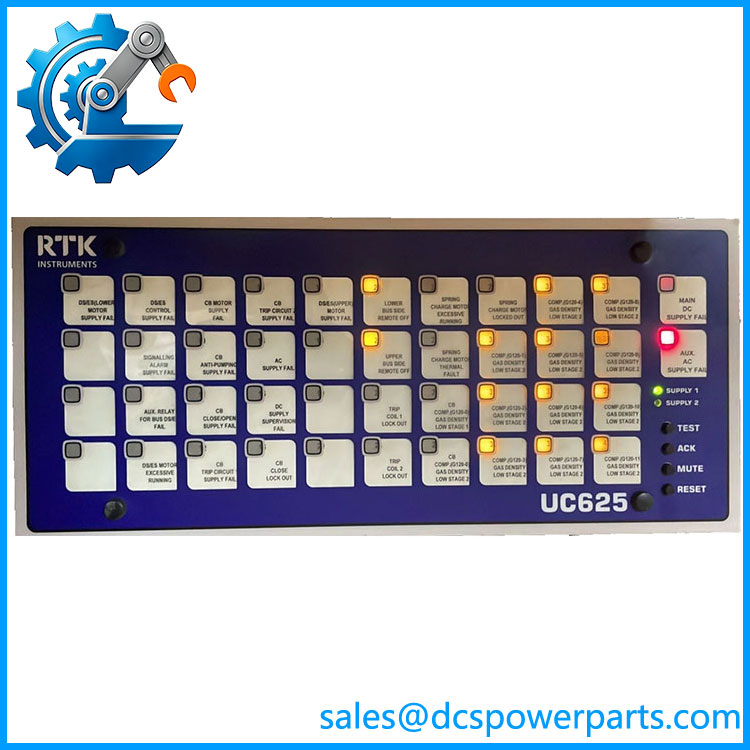
UC625-32-AM-HH-R
Engineering Pain Point
Alarm annunciators are easy to misidentify because several variants can have nearly identical front-panel dimensions while using different input voltage and indication configurations. A replacement can appear operational while failing to recognize the field alarm voltage correctly. Before energizing a replacement, compare the original wiring diagram, alarm input voltage, common/return arrangement, acknowledge/reset logic, and LED behavior.
Typical Applications
- Transformer-station alarm panels — monitoring discrete equipment fault conditions.
- Industrial electrical switchgear — local indication of breaker, protection, and equipment alarms.
- Plant auxiliary systems — centralized annunciation of multiple discrete fault contacts.
- Distributed control panels — local alarm indication where a dedicated annunciator is preferred over a general-purpose HMI.
Technical Pitfalls to Avoid
- Do not assume the input voltage from another .
variants exist with different voltage configurations, including documented 24 VDC and 110 V versions. Verify the exactAM-HH-Rconfiguration before connection. - Do not substitute by channel count alone.
A 32-channel with a different LED or input configuration may not be electrically equivalent to-32-AM-HH-R. - Check the alarm contact architecture.
Determine whether the field devices provide dry contacts, voltage signals, normally energized circuits, or normally de-energized circuits. The annunciator logic must match the original scheme. - Document acknowledge/reset behavior.
In a plant alarm system, acknowledge, silence, first-out, lamp-test, and reset functions can be integral to the operating philosophy. Do not assume these functions are identical across variants. - Verify the complete model marking.
The family contains numerous suffix combinations. Records show examples such as-32-YW-HH-024-R-M3,-32-RD-HH-024D-R-M3, and-32YL-HH-024-R-M3. These should not be treated as interchangeable with. - Check the field wiring before commissioning.
A wiring fault can be mistaken for an annunciator failure. Test each alarm input individually and confirm the indication, acknowledge, and reset sequence against the plant alarm philosophy.
Related Products
- RTK -32-YW-HH-024-R-M3 — 32-channel variant with a documented 24 VDC configuration; not automatically equivalent to the AM-HH-R version.
- RTK -32-RD-HH-024D-R-M3 — another 32-channel alarm annunciator configuration using a different suffix and electrical specification.
- RTK -24-RD-HH-024D-R-M3 — 24-channel variant; useful where the application has fewer alarm points, but channel capacity and configuration differ.
- RTK -40-RD-HH-110-R — 40-channel variant with a documented 110 V configuration; illustrates why channel count and input voltage must both be checked.
- RTK -40-RD-HH-024D-R-M3 — 40-channel, 24 V-class variant in the same product family.
- RTK -36-RD-HH-024-R-M3 — 36-channel configuration.
- RTK -28RD-HH-024-R-M3 — 28-channel alarm annunciator variant.
- RTK P725 Series — RTK’s broader annunciator family; architecture and channel configuration differ from .
Procurement Note
For , do not publish an assumed supply voltage or input rating unless you have the original nameplate or RTK technical sheet for this exact suffix. The available evidence confirms the RTK Instruments , 32-channel alarm-annunciator identity, but the public records I found do not establish the complete electrical specification for AM-HH-R.
For a replacement purchase, record the complete model, input voltage, alarm contact arrangement, LED color, acknowledge/reset behavior, terminal layout, and any M3/M4 or other option suffix shown on the original unit. This is one of those cases where the suffix is an engineering specification, not just an ordering detail.