Description
Product Introduction (Non-Templated)
Spanning extended distances between remote safety equipment cabinets and central power distribution units can introduce severe voltage drops if standard commercial cabling is used, risking intermittent brownouts on high-integrity processor racks. Maintaining continuous loop voltage across multi-bay configurations demands specialized, low-resistance cabling engineered explicitly to handle high-availability safety architectures—which is precisely where this custom-length power lead steps in.
Engineers managing large-scale safety system layouts or cabinet expansion phases rely on these pre-fabricated distribution lines to ensure proper voltage delivery without field-splicing risks. Integrating the correct length variant into the enclosure layout prevents ground reference discrepancies and protects sensitive TMR processor rails during heavy operational switching cycles.
Key Technical Specifications
- Manufacturer: ICS Triplex (Rockwell Automation)
- Cable Type: Type TC-001 Chassis Power Cable
- Length Designation: 4.5 meters (4M5)
- Conductor Specification: Heavy-duty multi-strand copper designed for low voltage drop
- Rated Voltage: Up to 125 VAC / 24 VDC system distribution
- Source Connection: Connects from Power Distribution Unit (PDU) MCB (such as T8292)
- Destination Connection: Trusted Controller or Expander Chassis power input terminals
- Operating Temperature: -20 °C to +70 °C (-4 °F to +158 °F)
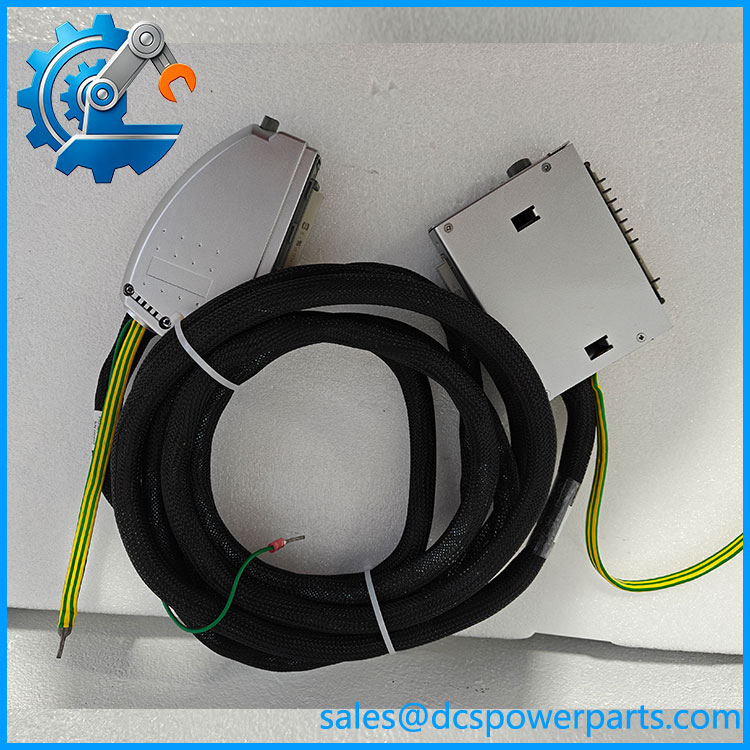
TC-004-02-4M5
Application Scenarios & Pain Points
When an extended control room layout forces power lines to run across multiple split cabinets, voltage attenuation over poorly rated cables can cause erratic resets on primary safety logic controllers.
- Petrochemical Complex Enclosures: Deployed to bridge power distribution units across extended multi-bay safety instrumented system (SIS) cabinets.
- Offshore Production Platforms: Installed in cramped instrument houses where exact cable runs prevent dangerous wire coils and excess slack near high-voltage lines.
- Power Generation Facilities: Used to link auxiliary termination cabinets back to central turbine safety processor racks reliably.
A natural gas compression facility in Western Canada needed to route DC power across two adjacent massive cabinets during an urgent safety system upgrade. Utilizing a precision-length 4.5-meter factory cable avoided dangerous field-termination mistakes, ensuring a clean power-up sequence and passing loop checks ahead of schedule.
6. Related Products
- TC-001-02-1M5: 1.5m variant of the chassis power cable for short-distance cabinet routing.
- TC-001-02-6M0: 6.0m variant designed for connecting expander chassis located in separate adjacent bays.
- T8292: Trusted Power Distribution Unit (PDU) featuring integrated Miniature Circuit Breakers (MCB).
- T8110B: Trusted TMR Main Processor Module powered through these cabinet backbone lines.
- T8431: Trusted Analog Input Module residing in chassis rows fed by the main power distribution architecture.
- T8270: Fan assembly unit relying on auxiliary distribution configurations within the safety rack.
The Engineer’s Guide: Field Pitfalls to Avoid
- WARNING: Routing Power Cables Parallel to High-Voltage VFD Traces. Laying DC power leads directly alongside unshielded variable frequency drive motor cables induces high-frequency electromagnetic interference into the logic bus. How to avoid: Maintain strict physical separation and cross instrumentation power pathways at 90-degree angles inside wireways.
- WARNING: Forcing Mismatched Pin Connectors. Pushing keyed backplane power plugs into terminal blocks with excessive force can warp contact pins and create high-resistance micro-arcs. How to avoid: Align the connector housing keys carefully and check that locking mechanisms engage smoothly before tightening.
- WARNING: Ignoring Total Circuit Resistance Drops. Assuming longer non-standard runs can handle unlimited current draws can result in cumulative voltage sags below the 24Vdc threshold. How to avoid: Verify that your total loop distance matches the engineered cable part number specification to guarantee proper voltage at the controller input terminals.
Frequently Asked Questions (FAQ)
- Can I custom-cut a longer TC-001 cable down to size in the field if it is too long? Well, technically you could splice or cut a cable, but doing so voids factory certifications, risks introducing high-resistance joints, and violates strict safety instrumented system (SIS) wiring guidelines. Always order the exact required length variant (such as the 4.5m model).
- What is the exact physical pathway this specific cable supports in a cabinet?This cable runs directly from the output side of a Power Distribution Unit (PDU) Miniature Circuit Breaker (such as the T8292) to the power input terminals of a Trusted Controller or Expander Chassis.
- Does this cable provide any data communication, or is it strictly for power?The TC-001 series is strictly designated for power distribution wiring; data communication and system health monitoring across the Trusted architecture are handled via separate dedicated backplane and network links.
- What kind of documentation or traceability comes with surplus replacement cables?Reliable industrial automation suppliers provide full visual inspection reports, material condition verification (such as new surplus), and a standard 12-month operational warranty.
- How do I verify if a power delivery failure is caused by the cable or the PDU breaker? Measure the DC voltage dynamically at both the source MCB output terminals and the destination chassis input plug using a calibrated multimeter; a significant delta points directly to a damaged conductor or loose crimp connection.