Description
Phoenix Contact 2744429 PSM-ME-RS485/RS485-P RS-485 Repeater
Product Introduction
The Phoenix Contact 2744429 is a PSM-ME-RS485/RS485-P industrial RS-485 repeater designed for 2-wire bus systems where signal regeneration, galvanic isolation, or network segmentation is required. It is an interface converter rather than a protocol gateway: the unit transparently passes supported serial data between two electrically isolated RS-485 segments. Phoenix Contact specifies compatibility with UART/NRZ data formats using 10- or 11-bit character lengths, making the device suitable for a wide range of industrial serial networks.
The main engineering value of the Phoenix Contact PSM-ME-RS485/RS485-P 2744429 is the separation of the two RS-485 network sections. The power supply, RS-485 A interface, and RS-485 B interface are electrically isolated from one another, with a specified 1.5 kVrms test voltage between the data interface and supply. This arrangement can help prevent ground-potential differences and electrical disturbances on one bus segment from directly propagating into another. The repeater also regenerates the signal, allowing a long RS-485 installation to be divided into multiple segments. Phoenix Contact specifies transmission distances up to 1200 m, subject to baud rate, cable characteristics, and the particular bus system.
For plant maintenance, the Phoenix Contact 2744429 should be treated as a physical-layer network component, not as a Modbus master, slave, PLC, or intelligent protocol conversion gateway. It supports transparent communication and provides automatic direction control for the half-duplex RS-485 link. Integrated selectable termination resistors are provided, and Phoenix Contact specifies cascade capability that decreases as transmission speed increases. Correct termination, cable topology, shielding, grounding, and baud-rate selection remain the responsibility of the system designer.
Technical Specifications
| Parameter | Specification |
|---|---|
| Product Model | PSM-ME-/-P |
| Phoenix Contact Item Number | 2744429 |
| Manufacturer | Phoenix Contact |
| Product Type | RS-485 repeater / interface converter |
| Application | RS-485 2-wire bus systems |
| Interface Standard | EIA/TIA-485 / DIN 66259-4 |
| Transmission Mode | Half-duplex |
| Transmission Channels | 2 isolated RS-485 segments |
| Signal | Modbus / transparent serial transmission |
| Data Format | UART / NRZ |
| Character Length | 10 or 11 bits, selectable |
| Transmission Speed | 1.2 / 2.4 / 4.8 / 9.6 / 19.2 / 38.4 / 57.6 / 75 / 93.75 / 115.2 / 136 / 187.5 / 375 / 500 / 1500 kbps |
| Maximum Transmission Length | ≤1200 m, dependent on speed, bus system, and cable |
| Electrical Isolation | VCC // RS-485 A // RS-485 B |
| Isolation Test Voltage | 1.5 kVrms, 50 Hz, 1 min |
| Supply Voltage | 18–30 VAC/DC |
| Nominal Supply | 24 VAC/DC ±20% |
| Typical Current Consumption | 25 mA at 24 VDC |
| Maximum Power Dissipation | 2.16 W |
| Termination Resistors | Integrated, selectable; 390 Ω / 180 Ω / 390 Ω options |
| Connection | Pluggable COMBICON screw terminals |
| Mounting | DIN rail |
| Dimensions | 22.5 × 99 × 114.5 mm |
| Operating Temperature | -40°C to +70°C |
| Storage/Transport Temperature | -40°C to +85°C |
| Humidity | 10–95%, non-condensing |
| Protection Rating | IP20 |
| Housing | PA 6.6-FR |
| Weight | Approximately 188.8 g net |
| Maximum Altitude | Up to 5000 m, subject to manufacturer restrictions |
The electrical, interface, dimensional, and environmental specifications above are based primarily on Phoenix Contact’s current product documentation.
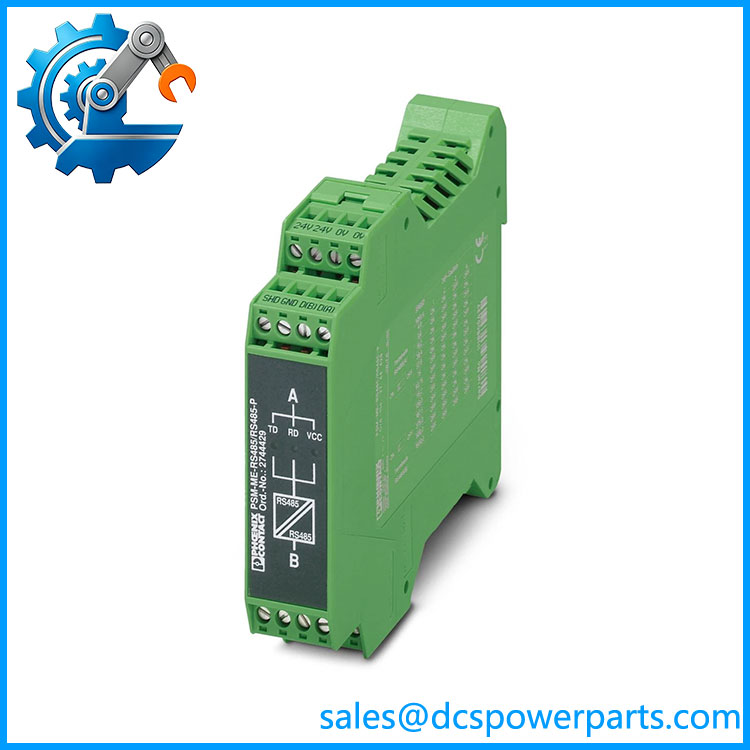
Phoenix Contact 2744429 PSM-ME-RS485/RS485
Main Features and Engineering Considerations
Three-Way Electrical Isolation
The defining feature of the PSM-ME-RS485/RS485-P is isolation between the power supply and each RS-485 segment. Phoenix Contact specifies the isolation arrangement as VCC // RS-485 A // RS-485 B. This is particularly useful when separate parts of an industrial network operate at different ground potentials or when a long cable run creates a greater risk of common-mode interference.
Signal Regeneration and Bus Segmentation
A repeater does more than simply extend a pair of wires. It receives the RS-485 signal, regenerates it, and retransmits it onto the next segment. This allows the network topology to be divided into electrically separate sections. Phoenix Contact specifies cascade capability of up to nine repeaters at lower transmission rates, with the permitted number decreasing as the baud rate increases.
Broad Baud-Rate Range
The unit supports serial speeds from 1.2 kbps through 1500 kbps. That range covers many conventional industrial serial applications, but the maximum cable distance is not independent of baud rate. A 1200 m specification should therefore never be interpreted as a guaranteed 1200 m run at 1.5 Mbps. Cable type, termination, electromagnetic environment, and network topology all matter.
Transparent Communication
The repeater is not intended to interpret application-level messages. Phoenix Contact specifies transparent protocol handling and identifies Modbus as a supported signal. This makes it useful in systems where the existing master/slave or controller configuration should remain unchanged while the physical RS-485 network is segmented.
Integrated Termination
Selectable termination resistors are integrated into the device. This can simplify installation, but the resistor should only be enabled where the network topology requires termination. Randomly enabling termination on intermediate devices can reduce signal quality rather than improve it.
Application Scenarios
- Modbus RTU RS-485 networks
- Industrial PLC serial communication
- DCS serial instrument networks
- Long-distance RS-485 communication
- RS-485 bus segmentation
- Electrical isolation between serial network sections
- Ground-potential difference mitigation
- Industrial machine communication networks
- Remote I/O serial networks
- Process instrumentation networks
- Serial networks requiring DIN-rail installation
- Legacy equipment networks requiring physical-layer extension
Engineer’s Guide: Field Pitfalls
1. Do not treat it as a protocol converter.
The 2744429 does not convert Modbus RTU into Ethernet or another application protocol. It operates at the serial physical/interface level and transparently passes supported data.
2. Do not use the 1200 m figure without checking baud rate.
Phoenix Contact’s maximum transmission length is dependent on transmission speed, bus system, and cable type.
3. Termination must match the topology.
RS-485 generally requires appropriate termination at the ends of a bus segment. Enabling termination on every repeater or node can create an incorrect effective impedance.
4. Keep the network physically linear where required.
An RS-485 repeater does not make an arbitrary star topology electrically correct. Stub length, cable impedance, shielding, and device placement still need to follow the requirements of the underlying RS-485 network.
5. Check the supply before installation.
The unit accepts 18–30 VAC/DC, with 24 VAC/DC nominal. Do not assume that a 24 VDC label on the cabinet means every connected device has been wired correctly.
6. Remember that isolation does not eliminate poor grounding practice.
The three-way isolation is valuable, but cable shields, protective earth, cabinet bonding, and surge protection still need to be engineered correctly.
7. Check the hazardous-area requirements separately.
Phoenix Contact documents ATEX and IECEx approvals for the product, but hazardous-area installation must follow the applicable installation instructions and certification conditions. The product page also notes specific restrictions for potentially explosive areas in China.
Frequently Asked Questions
What is Phoenix Contact 2744429?
Phoenix Contact 2744429 is the PSM-ME-RS485/RS485-P, an industrial RS-485 repeater/interface converter for 2-wire bus systems.
Is 2744429 a Modbus converter?
Not in the usual protocol-gateway sense. It supports Modbus signaling and transparently transfers serial data between two isolated RS-485 segments. It does not convert Modbus RTU to Ethernet or another protocol.
Does the 2744429 provide galvanic isolation?
Yes. Phoenix Contact specifies three-way electrical isolation between the supply, RS-485 A, and RS-485 B.
What supply voltage does it require?
The specified supply range is 18–30 VAC/DC, with 24 VAC/DC as the nominal supply voltage. Typical current consumption is 25 mA at 24 VDC.
What is the maximum RS-485 communication speed?
The unit supports transmission speeds up to 1.5 Mbps.
What is the maximum cable distance?
Phoenix Contact specifies up to 1200 m, but the actual permissible distance depends on transmission speed, bus system, and cable type.
Can the 2744429 be mounted in a control cabinet?
Yes. It is designed for DIN-rail mounting and has a compact 22.5 mm housing width.
Procurement Note
For purchasing or spare-stock identification, specify the complete item as:
Phoenix Contact 27444/-P — RS-485 2-Wire Repeater / Interface Converter
For replacement work, verify the existing RS-485 baud rate, cable type, termination arrangement, shield/grounding scheme, supply voltage, network topology, and whether the application depends on hazardous-area approvals. The exact 2744429 item should not be confused with other PSM-ME serial interface products that may have similar housings but different electrical functions.