Description
Product Overview
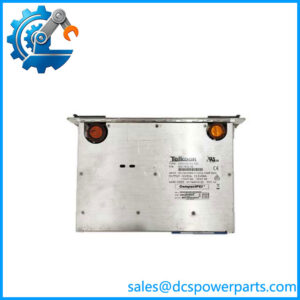
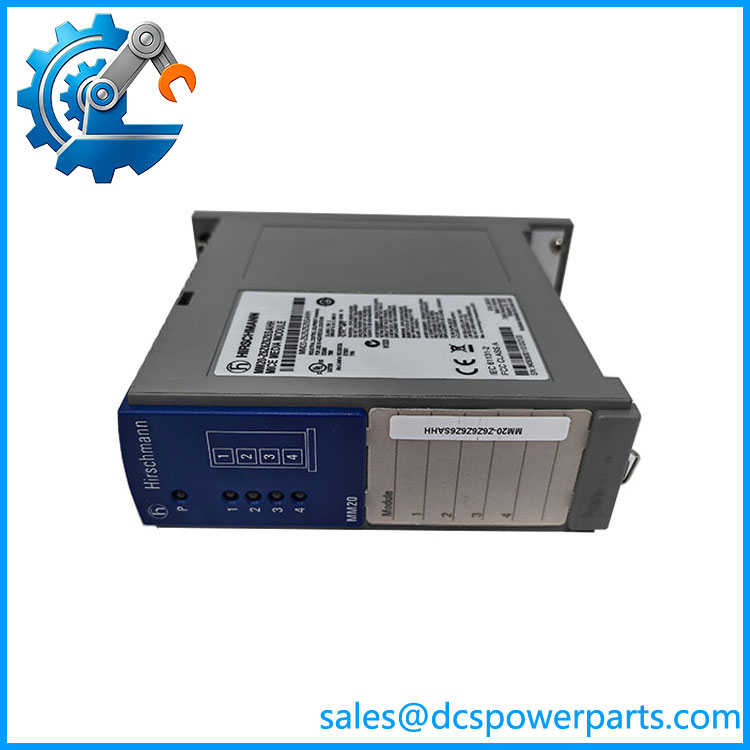
MM20-Z6Z6Z6Z6SAHH is the open-variant form of Hirschmann’s four-slot Fast Ethernet optical media module — in Hirschmann’s own documentation the same hardware is designated MM3-4SFP (MM20-Z6Z6Z6Z6). It carries no optics of its own. It is a socket carrier: four SFP cages into which 100 Mbit/s transceivers are inserted at commissioning, which means the fiber type, the wavelength, the connector and the reach are decisions made on site rather than fixed at the factory.
The type code is unusually explicit because this is an open variant — a product whose port mix is spelled out in the ordering string instead of hidden in a catalogue number. MM20 is the standard 10/100 Mbit/s media module (MM21 adds PTP, MM22 adds PoE, MM30 is the gigabit generation). Z6Z6Z6Z6 is four identical 100 Mbit/s SFP slots — Z6 is the Hirschmann code for a fiber SFP cage, and an unused position would be written 99. S is the temperature class: standard, 0 to +60 °C operating, −40 to +70 °C storage. A is the approval code: CE, UL 508 and ISA 12.12.01 Class I Division 2. The trailing HH closes the code.
That decode matters more than the port count, because both of the last two letters are where projects go wrong. The temperature letter is the difference between this unit and the EAHH version: E means extended, −40 to +70 °C operating with conformal coating on the boards, and T means the same extended range without the coating. A SAHH module in a −40 °C roadside cabinet or a salt-air, hydrogen-sulphide atmosphere is the wrong choice even though its ports are exactly right. The approval letter is the second trap: A gives North American Class I Division 2 and nothing else — no GL/DNV maritime certification, no ATEX, no IEC 61850-3 or IEEE 1613. A substation or a vessel needs approval code H, S, B or E, not A.
Physically the module is a large-housing MICE card, 38 × 110 × 119 mm, mounted on the switch backplane and hot-swappable — it can be fitted and removed with the switch running. Power comes from the backplane as a NEC Class 2 load, so there is no terminal block, no fuse and no separate 24 V feed. The switch recognises the module, reports its type and version, and applies port defaults; each of the four ports then appears in the management interface with its own link, duplex, speed and — once an SFP is fitted — the transceiver’s temperature and optical power readings.
Belden has closed this generation out. The type was subject to a discontinuation announcement dated 7 December 2022 and is listed as obsolete by the major distributors, with MM20-Z6Z6Z6Z6EAHH and TAHH siblings sharing the same fate. Hirschmann’s modular switch line has moved on to the MSP30/MSP40 platform. For an installed MS20, MS30, MS4128 or MICE 2000/3000/4000 network, though, the four-slot SFP carrier remains the most flexible optical module in the family — and the reason a passive-status part still commands attention.
Technical Specifications
| Parameter | Value |
|---|---|
| Model / part number | MM20-Z6Z6Z6Z6SAHH / 943 938-001 |
| Manufacturer / series | Hirschmann (Belden), MICE MM20 open-variant media modules |
| Product type | SFP carrier media module for MS20, MS30, MS4128 and MICE 2000/3000/4000 |
| Ports | 4 × SFP slots, 100 Mbit/s Fast Ethernet (code Z6); no copper ports on this variant |
| Optical reach, multimode | With M-FAST-SFP-MM/LC at 1310 nm: 0–11 dB budget, 0–5 km on 50/125 µm, 0–4 km on 62.5/125 µm |
| Optical reach, singlemode | With M-FAST-SFP-SM/LC: 0–13 dB, 0–25 km on 9/125 µm; SM+ 25–65 km; M-SFP-LH/LC at 1550 nm up to 40–104 km |
| SFP requirement | Hirschmann-approved 100 Mbit/s Fast Ethernet SFP modules only; gigabit SFPs belong in the MM4 modules |
| Power supply / consumption | Via the MICE switch backplane, NEC Class 2, no external supply |
| Dimensions / housing | 38 × 110 × 119 mm, large housing, backplane slot mounting, IP20 |
| Operating temperature | Standard class S: 0 to +60 °C operating; −40 to +70 °C storage and transport |
| Approvals (code A) | CE; UL 508; ISA 12.12.01 Class I Division 2; no marine, ATEX or IEC 61850-3 rating |
| Diagnostics | Per-port LEDs plus management display of SFP type, support status, temperature, Tx and Rx power |
| Lifecycle | Discontinued — announcement 07 Dec 2022; obsolete at DigiKey, Mouser and RS |
MM20-Z6Z6Z6Z6SAHH
Key Features and Advantages
The optical decision is deferred to the site: a fixed-optic module such as MM3-2FXM2/2TX1 commits you at order time to multimode SC at 1300 nm. MM20-Z6Z6Z6Z6SAHH commits you to nothing but the socket. A run of 300 m to the next cabinet, a 4 km multimode span across a plant, a 25 km singlemode link to a remote pump station — all three can be served from the same carrier with three different SFPs.
One module type, a small SFP inventory: for a maintenance store this is the whole argument. Instead of stocking six fixed-optic module variants against six different link types, the store holds one carrier and a handful of transceivers, and the transceiver is the cheap, small, easily replaced half of the pair. A failed link is cleared by changing an SFP, not a media module.
Four ports in a single slot: on an MS20-1600 or MS30-1602, slots are the constraint, not ports. A four-slot optical carrier turns one slot into four fiber drops, which is how a ring plus two spur links plus a spare leg fits into hardware that was specified years before the network grew.
Optical diagnostics from inside the switch: with an SFP fitted, the management interface reports the transceiver type, whether the module supports it, its temperature, and its transmit and receive power in both mW and dBm. That converts a fiber problem from a guessing game into a measurement — you watch receive power fall across months as a connector degrades, and replace the patch cord before the link drops.
Hot-swap with no separate supply: the module is inserted with the switch running, recognised by the backplane, and configured with port defaults automatically. There is no 24 V terminal, no fuse and no external adapter to wire, so adding four optical ports costs a few minutes of cabinet time rather than a shutdown.
Standard-class temperature with the honest caveat: the S code is 0 to +60 °C, and that is the correct rating for the inside of a ventilated cabinet, a control room or a container with climate control. It is not the rating for an unheated outdoor enclosure in winter. The point of the letter is that it tells you which case you are in before the hardware does.
GL-certified optics as an option, not a claim: the module’s own approval code A does not include maritime certification, so a vessel or an offshore platform needs a different code. Saying so plainly is more useful than implying the part is universally approved.
Applications
Mixed-fiber plant networks: a site built over decades ends up with 62.5/125 µm multimode in one building, 50/125 µm in another, and singlemode to a remote metering station. The four-slot carrier accepts the right transceiver per run, which is the only way to build that network without stocking three module variants.
Ring topologies with spur links: two SFP ports form a HIPER-Ring or RSTP ring across cabinets, and the remaining two take spurs — an engineering workstation, a gateway, a camera. In an MS30 with four module slots, that is a complete network backbone in one slot.
Substation and utility auxiliary networks: fiber between protection buildings for distances beyond copper’s 100 m, with each switch’s optical budget monitored from the control room. Note the approval code carefully here — A covers Class I Division 2, not IEC 61850-3, so a station bus application should be specified against approval code H or S.
Water, wastewater and tunnel installations: cabinets distributed along a linear route, each holding a small managed switch, the inter-cabinet link on fiber chosen to match the distance. The 0 to +60 °C rating fits a sealed but ventilated roadside or tunnel cabinet; an unheated outdoor kiosk in a cold climate does not.
Machine cells needing optical isolation: a cell whose drives inject noise into copper, connected to the line backbone by fiber. The carrier’s four slots let one module serve the cell’s uplink and its cross-cell link without a media converter and its separate power supply.
Brownfield capacity expansion: the commonest real use. An installed MS20 or MS4128 has a free slot, the plant needs four more fiber ports, and there is no project to replace the switch. MM20-Z6Z6Z6Z6SAHH fills the slot — with the SFP choice made to match whatever fiber the field already has.
Related Products
MM20-Z6Z6Z6Z6EAHH — identical port layout with extended temperature (−40 to +70 °C) and conformal coating; the correct code for cold or corrosive locations. MM20-Z6Z6Z6Z6TAHH — extended temperature range without conformal coating, for cold but clean environments. -Z6Z6Z6Z6SBHH — standard temperature with approval code B, adding GL maritime and ATEX to the Class I Division 2 listing. MM3-4SFP (-Z6Z6Z6Z6) — the catalogue designation of this same four-slot carrier; the type to quote when the ordering system expects the fixed name. MM3-2FXM2/2TX1 — fixed-optic alternative, two multimode SC fiber plus two 10/100BASE-TX copper ports, when the optical type is already known. MM4-4TX/SFP and MM4-2TX/SFP — gigabit generation combo modules with SFP slots, for 1000 Mbit/s links; inserting an SFP there deactivates the paired copper port. M-FAST-SFP-MM/LC, M-FAST-SFP-SM/LC, M-FAST-SFP-SM+/LC, M-SFP-LH/LC — the approved 100 Mbit/s transceivers that populate these slots, from 5 km multimode to 104 km singlemode long haul. MS20-1600 / MS30-1602 / MS4128-5 — basic modules that accept the carrier and provide the management, CPU and power behind it. MB20 expansion module — adds two media-module slots to MS20-1600, MS30-1602, MS3124-4 and MS4128-5 when the four on-board slots are occupied. MM22-T1T1T1T1 — PoE media module for the same slots, the alternative when the requirement is powered devices rather than fiber.
Installation and Maintenance
Before installation: confirm the host is an , , MS4128 or MICE 2000/3000/4000 basic module and that the slot is free and enabled in the management interface. Read the type code against the site conditions — S means 0 to +60 °C, so an unheated outdoor enclosure or a hot roofspace needs a different letter, and A means Class I Division 2 only, so a vessel or a substation bus needs a different approval code. Decide the four SFP types before opening the cabinet: Hirschmann-approved 100 Mbit/s modules only, with the reach and budget taken from the transceiver’s own figures rather than from the carrier’s, and with multimode versus singlemode settled by what the installed fiber actually is.
Installation: slide the carrier into the slot and secure the four corner screws, then refresh the management view and confirm the slot reports the module type and four ports. Fit the SFPs with the latch closed until each seats audibly, cap any slot that stays empty, and label the ports. Verify link, speed and duplex on each port, and check the SFP status page for type, support flag, temperature and receive power — a receive level within a decibel or two of the transmitter’s output at short range, and consistent with the link budget at long range, is the confirmation that the optical plant is healthy.
Maintenance: there is nothing serviceable inside the module — no fan, no battery, no fuse — so the work is cleanliness and measurement. Keep unused cages capped, clean ferrules before condemning a link, and trend the receive power readings every few months; a slow decline is a dirty or degraded connector, a sudden drop is a broken strand or a failed transceiver. Verify after any cabinet work that the module still reports as physical and enabled, and that no SFP has been left unsupported by a firmware revision. Because the type has been obsolete since the 2022 announcement, hold one verified carrier per switch family and a small stock of the SFPs actually deployed, rather than assuming either can be bought when a link fails at 3 a.m.
Warranty and Quality
Every MM20-Z6Z6Z6Z6SAHH is supplied against Hirschmann part number 943 938-001 — the four-slot 100 Mbit/s SFP carrier with standard temperature class and approval code A — and is identified by that code before dispatch, because the neighbouring variants differ in ways that matter: EAHH and TAHH change the temperature class and coating, SBHH changes the approvals, and a fixed-optic module such as MM3-2FXM2/2TX1 changes the ports entirely. Units are inspected for housing and backplane connector condition, cage alignment and latch function on all four SFP slots, label legibility and evidence of prior removal. Where a MICE switch is available, the carrier is inserted in a live slot and verified: the switch must recognise the module, report four ports, accept an approved SFP and establish link with a known-good partner at the expected optical power. A 12-month repair, replacement or refund commitment applies. Technical support covers what this part actually raises — decoding the type string, choosing between S, T and E for a given enclosure, matching approval code to the installation, selecting an SFP against a real link budget, and planning a spares strategy for a platform that is no longer manufactured.