Description
Key Technical Specifications
| Parameter | Value |
|---|---|
| Product Model | IS420ESWBH2A |
| Manufacturer | General Electric (GE) |
| Series | Mark VIe / Mark VIeS |
| Functional Designation | ESWB |
| Product Type | Industrial Ethernet / IONet Switch |
| Network Type | Unmanaged Ethernet Switch |
| Copper Ports | 16 × 10/100Base-TX |
| Fiber Ports | 2 × 100Base-FX Multimode Fiber |
| Fiber Connector | LC Type |
| Ethernet Standards | IEEE 802.3 / 802.3u / 802.3x |
| Duplex Mode | Full/Half Duplex Auto Negotiation |
| Power Input | 24/28 VDC |
| Power Input Design | Redundant Diode-OR power inputs |
| Mounting | DIN Rail |
| Operating Temperature | -40°C to +70°C typical |
| Hazardous Area Rating | Class 1 Div 2 / Zone 2 / ATEX capable |
| Application | Mark VIe turbine control communication networks |
Application Scenarios & Pain Points
A communication switch failure inside a turbine cabinet can create a chain reaction. One failed network component may disconnect several I/O packs at once, leaving technicians to separate genuine field faults from network interruptions.
Typical applications:
- Gas Turbine Control: Used as the Ethernet switching point between Mark VIe controllers and distributed I/O packs. A stable communication path is required for turbine sequencing, monitoring, and protection functions.
- Steam Turbine Systems: Supports industrial Ethernet communication inside turbine control panels where multiple controllers and I/O devices share the same network infrastructure.
- Power Generation Plants: Installed in Mark VIe and Mark VIeS architectures requiring copper and fiber communication connections between cabinets or remote equipment.
- Control System Upgrade Projects: Maintains existing GE turbine automation networks when replacing aging communication hardware rather than redesigning the complete control system.
Field note: A generating facility experienced repeated loss-of-communication alarms affecting several I/O packs. Network testing showed the controllers were healthy, but the Ethernet switch was intermittently resetting. Replacing the ESWB switch and checking the 24 VDC supply stability corrected the communication interruptions.
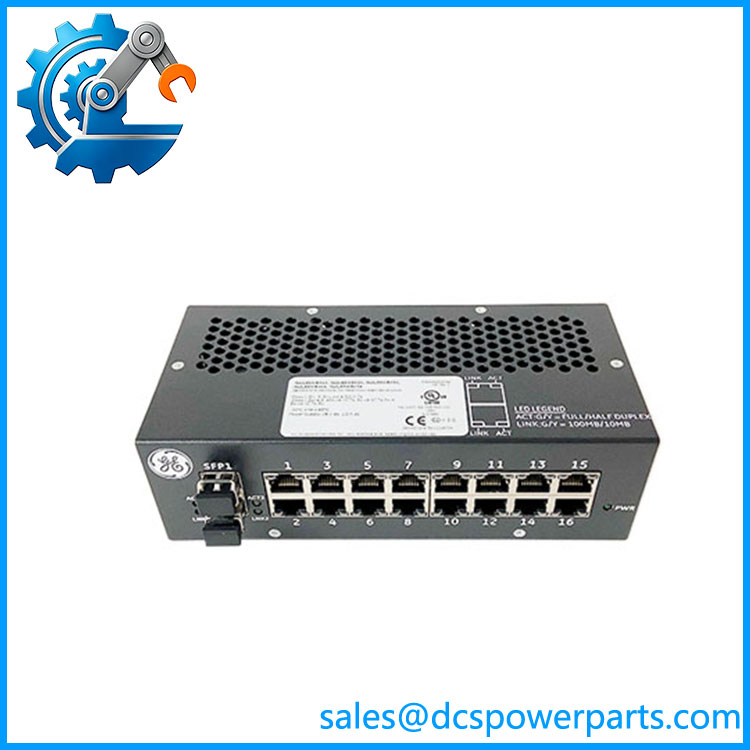
IS420ESWBH2A
Related Products
- GE IS420ESWBH1A — ESWB Ethernet switch variant with a different fiber configuration. Used where the installed Mark VIe network requires different optical connectivity.
- GE IS420ESWBH3A — ESWB switch version with alternate fiber port arrangement. Requires matching network design before substitution.
- GE IS420ESWBH5A — Higher fiber-oriented ESWB variant for applications requiring extended optical communication paths.
- GE IS420ESWAH2A — Smaller ESWA Ethernet switch family. Provides similar IONet switching functions but with fewer copper ports than ESWB models.
- GE IS420UCSBH1A — Mark VIe UCSB controller module. Communicates through the IONet infrastructure supported by ESWB switches.
- GE IS420PPDAH1B — Mark VIe PDM system feedback module. Uses the control network architecture supported by Mark VIe communication hardware.
- GE IS420PVIBH1B — Mark VIe vibration monitoring I/O pack. Connects through the same distributed control network environment.
- GE IS410JPDHG1A — Mark VIe DC power distribution hardware. Supports cabinet power infrastructure rather than network communication.
The Engineer’s Guide: Field Pitfalls to Avoid
⚠️ Using the Wrong Fiber Configuration
ESWB switches may look identical while having different fiber port arrangements. A multimode fiber requirement cannot be assumed from the model family alone.
How to avoid: Verify the exact suffix, fiber type, connector style, and installed network drawings before replacement.
⚠️ Ignoring Power Quality Problems
A failing 24 VDC supply can mimic an Ethernet switch failure. Repeated resets may come from unstable cabinet power rather than the switch electronics.
How to avoid: Check voltage stability under load and inspect terminal connections for heat marks or oxidation.
⚠️ Replacing Without Documenting Network Connections
Removing a switch without recording port assignments can create unnecessary startup delays.
How to avoid: Label copper ports, fiber links, and network paths before disconnecting cables.
Frequently Asked Questions (FAQ)
What is the GE IS420ESWBH2A used for?
The GE IS420ESWBH2A is an industrial Ethernet/IONet switch used in Mark VIe and Mark VIeS turbine control systems. It provides communication switching between controllers, I/O packs, and industrial Ethernet devices.
How many ports does the IS420ESWBH2A have?
The switch provides:
- 16 copper Ethernet ports supporting 10/100Base-TX
- 2 multimode fiber ports supporting 100Base-FX communication
Is the IS420ESWBH2A a managed Ethernet switch?
No. It is an unmanaged industrial Ethernet switch designed specifically for GE Mark VIe control network applications.
Can the IS420ESWBH2A replace another GE ESWB switch?
Not automatically. Confirm:
- Complete part number
- Fiber port configuration
- Network topology
- Cabinet wiring
- Mark VIe hardware revision
before installation.
What are common failure symptoms of an ?
Typical symptoms include:
- Multiple I/O pack communication alarms
- Network link loss
- Intermittent controller communication recovery
- Switch power resets
GE documentation notes that network switch failures can appear as loss of communication from groups of I/O packs when the switch resets.
Does the require software configuration?
The switch itself is unmanaged and does not require application programming. Correct physical connections, network design, and cabinet installation are the primary requirements.
Is a refurbished GE suitable for turbine service?
A tested refurbished unit can be suitable when Ethernet ports, fiber interfaces, power inputs, LED diagnostics, and compatibility with the existing Mark VIe network design are verified before installation.