Description
Product Overview
The Honeywell CC-PAIX01 is a Series-C analog input module used in Honeywell Experion process-control systems to acquire high-level current and voltage signals from transmitters and sensing devices. The module provides 16 analog input channels, arranged as 12 single-ended and 4 differential inputs, with a 16-bit A/D converter. Supported input ranges include 0–5 V, 1–5 V, 0.4–2 V, and 4–20 mA through an external 250 Ω conversion path. Honeywell specifies a 50 ms input scan rate for this analog-input function.
For Honeywell CC-PAIX01, the IOTA selection is an important part of the system configuration. Honeywell’s Series-C documentation associates the CC-PAIX01 with CC-GAIX21 for non-redundant installations and CC-GAIX11 for redundant installations. The module supports current and voltage inputs from 2-wire or self-powered transmitters and includes individually protected transmitter field-power conditioning for specified non-incendive applications.
The Honeywell CC-PAIX01 is also different from the similarly named CC-PAIH01. The CC-PAIX01 provides analog input capability without HART support, while Honeywell’s function matrix identifies the CC-PAIH01 as the HART-capable alternative. That distinction matters during an Experion PKS I/O replacement because a physically compatible installation does not necessarily provide the same field-device communication functions. For procurement, match the IOM, IOTA, channel wiring, redundancy architecture, and transmitter requirements together.
Product Introduction
A 4–20 mA loop is only useful to the control system if the I/O hardware matches the transmitter and field-power arrangement. Honeywell CC-PAIX01 provides 16 analog channels, 16-bit conversion, and a 50 ms input scan rate for high-level voltage and current signals.
For an Experion PKS analog input replacement, the IOTA cannot be ignored. The documented CC- pairing differs between redundant and non-redundant installations, so the complete IOM/IOTA combination should be verified before installation.
Key Technical Specifications
| Parameter | Value |
|---|---|
| Manufacturer | Honeywell |
| Model | |
| Product Family | Experion Series-C I/O |
| Product Type | Analog Input Module |
| Input Channels | 16 |
| Channel Arrangement | 12 single-ended / 4 differential |
| Input Type | Voltage and current |
| Supported Voltage Ranges | 0–5 V, 1–5 V, 0.4–2 V |
| Current Input | 4–20 mA through 250 Ω |
| A/D Resolution | 16 bits |
| Input Scan Rate | 50 ms |
| CMRR | 70 dB, DC–60 Hz |
| Common-Mode Voltage | −6 to +5 V peak |
| Normal-Mode Rejection | 19 dB at 60 Hz |
| Normal-Mode Filter | Single-pole RC, −3 dB at 6.5 Hz |
| Maximum Differential Input | ±30 V, no damage |
| Channel-to-Channel Crosstalk | −60 dB |
| Voltage Input Impedance | >10 MΩ |
| Hardware Accuracy | ±0.075% FS at 23.5°C ±2°C |
| Hardware Accuracy, 0–60°C | ±0.15% FS |
| Non-Redundant IOTA | CC-GAIX21 |
| Redundant IOTA | CC-GAIX11 |
| HART Support | No |
| Field Power | Non-incendive transmitter power conditioning |
| Typical Application | Experion process analog acquisition |
The core specifications above are taken from Honeywell’s Series-C I/O specification.
Engineering note: The 4–20 mA input specification is described as using a 250 Ω conversion path. Do not assume that every Series-C analog input module uses the same field termination arrangement.
Related Products
- CC-PAIX02 — Closely related high-level analog input module. Honeywell’s documentation groups it with the CC- function, but the exact IOM and IOTA configuration should be checked before substitution.
- CC-PAIH01 — HART-capable Series-C analog input module. It is the more appropriate choice when digital HART communication with field transmitters is required.
- CC-PAIH51 — Another Series-C HART analog-input option for applications with different system requirements. Honeywell identifies it separately in the Series-C function matrix.
- CC-GAIX21 — Non-redundant IOTA associated with CC-. It provides the field termination/interface portion of the I/O assembly.
- CC-GAIX11 — Redundant IOTA associated with CC-. Select it when the Series-C architecture requires redundant I/O.
- CC-TAIX01 — IOTA used with other Series-C analog input modules such as CC-PAIH01. It is not simply interchangeable with the CC-GAIX21 arrangement.
- CC-TAIX11 — Redundant counterpart used with the corresponding HART-capable analog input architecture.
- CC-PAIN01 — Another Series-C analog input family member with a different functional arrangement. It should be selected according to the required input function rather than channel count alone.
- Experion Series-C I/O Carrier/IOTA Assembly — Required mounting and field-interface architecture for the IOM. A CC- replacement should be matched to the existing carrier/IOTA arrangement.
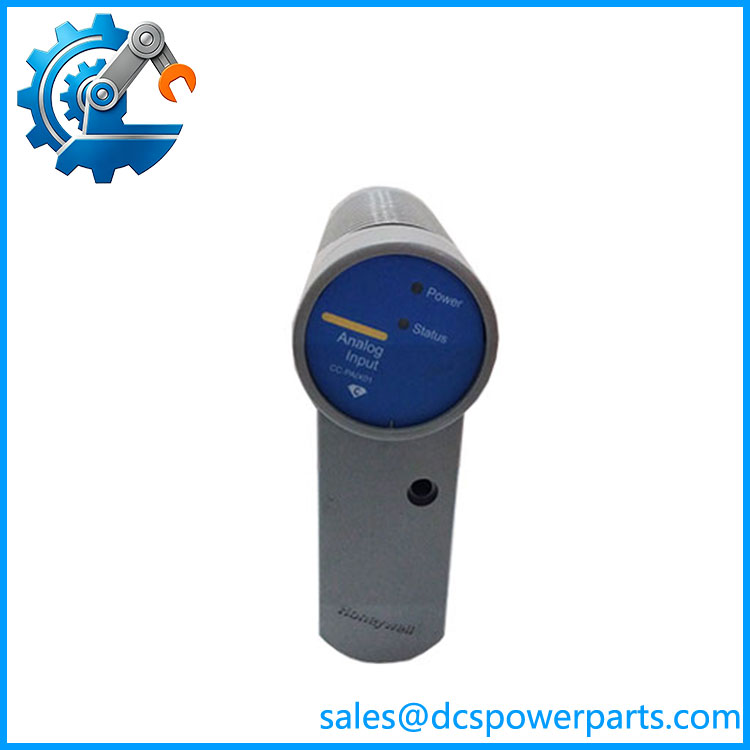
CC-PAIX01
Frequently Asked Questions
What is Honeywell CC- used for?
The CC- is a 16-channel high-level analog input module for Experion Series-C I/O systems.
It accepts voltage and current signals from process transmitters and sensing devices. Honeywell specifies 0–5 V, 1–5 V, 0.4–2 V, and 4–20 mA through a 250 Ω conversion path.
Typical signals include:
- Pressure transmitters
- Temperature transmitters with analog output
- Flow transmitters
- Level transmitters
- Process analyzers
- Other high-level analog instruments
Is CC- a HART analog input module?
No.
This is an important distinction when upgrading an Experion system. Honeywell’s function matrix shows CC- without HART, while CC-PAIH01 is identified as the HART-capable analog input option.
If the control strategy only needs the analog process value, CC- can be appropriate. If the engineering team needs HART variables or remote instrument diagnostics through the I/O path, the HART-capable module should be evaluated instead.
What IOTA is required for CC-?
Honeywell identifies two primary IOTA configurations:
- Non-redundant: CC-GAIX21
- Redundant: CC-GAIX11
Do not order the CC- based on the IOM number alone. The installed IOTA, carrier arrangement, field termination, and redundancy architecture should be checked against the existing cabinet.
Can I hot-swap the Honeywell CC-?
Do not assume hot-swap compatibility simply because the Series-C architecture permits online maintenance functions.
Before removing the module, confirm the specific Experion Series-C hardware configuration, redundancy arrangement, controller state, and plant maintenance procedure.
For a live process, the safer procedure is to establish what happens to the affected loops during IOM removal before physically disturbing the module.
Will replacing CC- erase my Experion control logic?
Replacing the physical I/O module does not normally erase the control application stored in the Experion system.
The important risk is configuration and channel mapping. Before replacement, document:
- IOM slot
- IOTA type
- Channel assignments
- Input range
- Engineering-unit scaling
- Alarm limits
- Transmitter power arrangement
- Redundancy configuration
A replacement with the wrong IOTA or input configuration can leave the hardware apparently operational while producing incorrect process values.
Does CC- support firmware v3.1?
Firmware v3.1 cannot be treated as a universal compatibility criterion for CC-.
For a legacy Experion installation, verify the specific IOM hardware revision, Experion release, Series-C I/O architecture, IOTA type, and system configuration.
If this is an upgrade rather than a direct replacement, compatibility should be checked at the complete I/O-system level rather than against the module name alone.
How should I verify a New Surplus CC-?
For a surplus Series-C analog input module, a power-on test is only the first step.
I would verify:
- Exact model identification.
- Hardware revision and serial number.
- Connector and backplane condition.
- Correct IOTA compatibility.
- 24 V/field-power behavior through the proper Series-C assembly.
- All 16 input channels.
- 4–20 mA signal acquisition.
- Voltage input acquisition.
- Differential-channel operation where applicable.
- Accuracy against a calibrated source.
- Diagnostic status.
- Experion channel mapping and scaling.
Honeywell specifies ±0.075% of full scale at 23.5°C ±2°C and ±0.15% of full scale from 0–60°C for the analog-input hardware. For a process-critical replacement, a documented signal test is much more useful than simply confirming that the module appears online.