Description
Product Overview
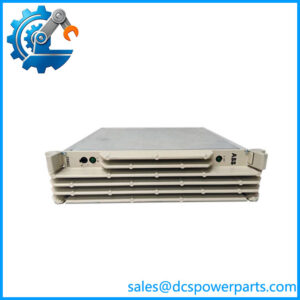
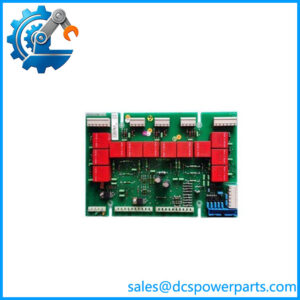
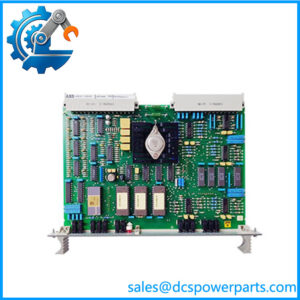
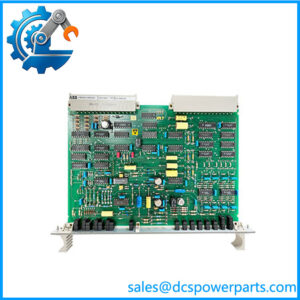
GVC704AE01 and 5SHX1060H0001 are two different objects that are almost always ordered, quoted and shipped as one line: a gate unit board and the IGCT it drives. The board carries ordering code 3BHB003230R0101; the semiconductor carries 5SHX1060H0001 as its device type and 3BHL000392P0101 as the assembly number under which a complete, mounted device is supplied. In an ACS 1000 or ACS 6000 phase module they sit together on the same stack, separated by a few millimetres of copper and a fibre-optic cable.
An IGCT is a thyristor that can be turned off, and it can only be turned off because the gate unit does something a thyristor gate never had to do: it commutates the entire anode current into the gate in under a microsecond, then holds it there. That is why the board is not an accessory. It contains the energy storage that delivers the gate current pulse, the fibre receiver that takes the command from the drive controller, the monitoring that decides whether the device is desaturating, and the interlock that blocks firing when something upstream is wrong.
The device itself is an asymmetric 4.5 kV IGCT of roughly the 600 A average class — a press-pack puck, clamped rather than soldered, with a turn-off capability around 1 kA and a surge rating near 6 kA. It is the smaller sibling of the devices used in high-power phase modules, which is the detail that decides most ordering mistakes: 5SHX1445H0001, supplied as 3BHL000391P0101, looks identical in a photograph and belongs to a different current class.
The genuinely useful piece of knowledge about this pair is that the gate unit is shared. The same 3BHB003230R0101 board is documented against 5SHX1060H0001, against the reverse-conducting 5SHX14H4502, and against 5SHX10H6004. One board code, several devices, matched by version and configuration rather than by shape. Ordering a gate unit by its own number, without stating which device it must drive, is how a phase module ends up with a board that fires cleanly into the wrong gate.
Technical Specifications
表格
| Parameter | Value |
|---|---|
| Gate unit designation | GVC704AE01 |
| Gate unit ordering code | 3BHB003230R0101 |
| IGCT device type | 5SHX1060H0001 |
| IGCT assembly code | 3BHL000392P0101 |
| Manufacturer | ABB |
| Product type | IGCT gate unit board + asymmetric IGCT, press-pack |
| Blocking voltage | 4500 V (Vdrm) |
| Average on-state current | ≈630 A at 60 Hz, 85 °C case |
| Turn-off current | ≈1.0 kA (ITGQ) |
| Surge on-state current | ≈6.0 kA (ITSM) |
| Gate-cathode voltage | ±20 V (VGK) |
| Package | Press-pack disc, clamped mounting |
| Gate unit interface | Fibre-optic command input, 24 VDC auxiliary supply |
| Companion boards | 5SXE050152, 3BHB003023P201 |
| Host platform | ACS 1000 / ACS 6000 medium-voltage drives |
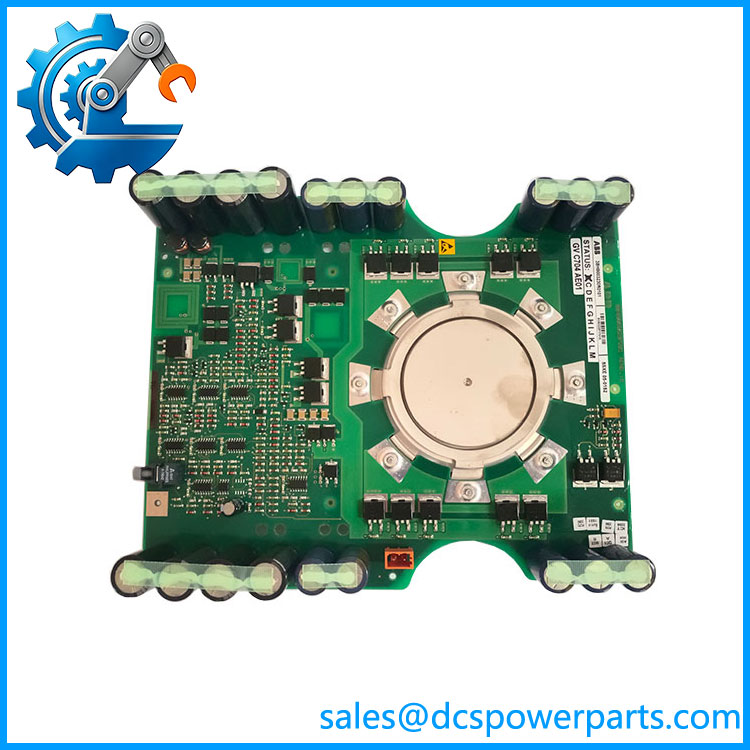
GVC704AE01 5SHX1060H0001
Key Features and Advantages
Triage that separates two failure signatures: a phase module that reports gate faults, fibre loss, “Gate Not Ready” or unit blocking is usually telling you about GVC704AE01; one that reports overcurrent, desaturation or a ruptured device is telling you about 5SHX1060H0001. Treating the two as a single “IGCT failure” is the most expensive habit in IGCT maintenance, because the board costs a fraction of the puck and fails far more often.
The gate unit as the phase module’s consumable: gate drive stress — repeated commutating pulses, supply droop, thermal cycling of the local storage — degrades the board long before the semiconductor. That makes 3BHB003230R0101 the item a plant should hold as a spare in quantity, while the device is held singly.
Turn-off that is defined by the board, not the silicon: the device’s 1 kA turn-off rating only exists if the gate unit can source and sink the commutating current fast enough, which is why ABB matches board versions to device types. Fitting a differently-versioned board to a 5SHX1060H0001 produces a stack that switches, passes a no-load test, and fails at the first real current step.
Press-pack construction that fails short, not open: like every IGCT, this device loses its blocking capability in the conducting direction when it fails, which is why the protection concept around it is detection and isolation — desaturation monitoring in the gate unit, fast fuses in the phase module, and the drive’s ability to block the whole leg — rather than any hope of a graceful open circuit.
Shared platform hardware across the device family: GVC704AE01 appears in service against 5SHX1060H0001, 5SHX14H4502 and 5SHX10H6004, so the board is not tied to one device. That is convenient for stocking and dangerous for ordering, and it is the reason a correct purchase order names both numbers.
Fibre command, galvanically dead control path: the firing command arrives on an optical link and the board’s auxiliary supply is derived locally, so the low-voltage control side and the 4.5 kV stack share no conductor at all — the property that lets these drives sit in steel mills and mine hoists without control-side damage during a device failure.
Applications
Medium-voltage drives in metals: rolling mill main drives, descaling pumps and mine hoists running on ACS 1000 or ACS 6000 phase modules, where the stack is exposed to continuous load steps and the gate unit is the part that ages first.
Cement and minerals: kiln drives, raw mill fans and conveyors on medium-voltage IGCT drives, often in hot, dusty electrical rooms where the board’s thermal margin rather than the semiconductor’s is the limiting factor.
Marine and offshore propulsion: thrusters and drilling drives where a phase module failure strands a vessel, and where holding a GVC704AE01 spare changes the repair from a dry-dock event to a shift’s work.
Pumping stations and large fans in water and power: high-power variable-speed duty where the drive runs continuously at part load, a regime that stresses gate drive supplies through long hours at elevated cabinet temperature rather than through current peaks.
Converter life extension: ACS 1000 installations well past their original design life, supported by board-level and device-level spares — with 5SHX1060H0001 and 3BHB003230R0101 sourced together so that a rebuilt stack is matched rather than merely assembled.
Test and repair benches: because the gate unit is the interchangeable half of the pair, workshops use a known-good GVC704AE01 to prove a suspect device and vice versa, which is the fastest way to avoid replacing both when only one has failed.
Related Products
5SHX1445H0001 / 3BHL000391P0101 — neighbouring asymmetric IGCT of a different current class; same appearance, not interchangeable. 5SHX14H4502 — reverse-conducting IGCT driven by the same 3BHB003230R0101 gate unit. 5SHX10H6004 — another device documented against the same gate unit board code. 5SXE050152 — companion logic/interface board that frequently travels with in the same phase module. 3BHB003023P201 — system interface board listed alongside the gate unit in ACS 6000 cabinets. GVC736BE101 / 3BHE019719R0101 — higher-power gate unit used with the large-frame 91 mm IGCTs; different board family, not a substitute. 5SHY3545L0014 / 3BHE023784 — 4.5 kV high-power IGCT of the larger phase modules, same technology, different class. ACS 1000 phase module — the stack assembly the pair is mounted in; replaced and tested as a unit when a device ruptures. ACS 6000 phase module — the higher-power sibling cabinet using the same gate-unit concept at a larger frame.
Installation and Maintenance
Before installation: decide which half has failed before touching either. Read the drive’s fault log for gate, fibre or desaturation events, inspect the fibre ends and the board’s supply, and only then plan the replacement — because and 5SHX1060H0001 require entirely different work. For the board, isolate the phase module, discharge the DC link, observe ESD discipline, and confirm the replacement’s version matches the device it will drive. For the device, the press-pack clamp is part of the electrical specification: surface flatness, cleanliness, correct clamping force and a verified thermal interface decide whether a new 5SHX1060H0001 survives its first current step.
Maintenance practice: hold 3BHB003230R0101 as a stocked spare and the IGCT as a single spare per drive, and replace them as a matched pair when either shows stress — an aged board firing a new puck is the classic route to a repeat failure. Photograph the stack, the clamp and the fibre routing before disassembly, keep fibre connectors capped, and record which device type each gate unit is configured for, since the same board code serves several devices. Treat any removed device as failed-short until proven otherwise, and never test a suspect IGCT by energising the phase module without the gate unit’s protection active.
Warranty and Quality
Every (3BHB003230R0101) and 5SHX1060H0001 (3BHL000392P0101) is supplied with both numbers stated on the quotation, so the buyer receives the gate unit and the device class they actually intend rather than a visually identical cousin from the same family. Boards are checked for supply integrity, fibre interface condition and evidence of gate-drive stress; devices are verified for type marking, clamp-face condition and packaging integrity before dispatch. Both carry a 12-month repair, replacement or refund commitment. Support concentrates on the decisions that determine whether the repair holds: separating gate-unit faults from device faults, matching board version to the IGCT it drives, and confirming that the part ordered belongs to the ACS 1000 or ACS 6000 stack in front of you.