Description
Product Overview
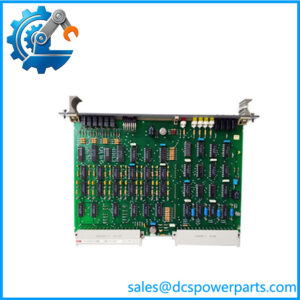
PC D237 A101, ordered as 3BHE028915R0101, is a controller board of ABB’s AC 800PEC platform — the high-performance controller family that ABB built specifically for power electronics rather than for process control. Its catalog description is unusually precise about what it is: “Controller Board: PEC80-INTM Box”, meaning this part is the board that sits inside the PEC80-INTM controller box, not the box itself.
That distinction is the whole point of the part number. In ABB’s PCS6000 medium-voltage converter for wind turbines, the controller is a sealed box carrying connectors, a backplane and the non-volatile medium on which the converter’s application and grid-code files live. The box is the identity; PC D237 A101 is the computing and signal-processing card inside it, and the two are ordered, stocked and replaced as different items. A technician who swaps the board to cure a fault inherits the box’s configuration, and a technician who swaps the box inherits the board’s hardware — neither operation is a “controller replacement” in the sense the plant’s documentation means.
The PEC80 family also explains why this board is so easily confused with its neighbours. PC D230 A101, PC D231 B101 and PC D232 A101 are the same height, the same 73.5 mm slot width and the same 142 mm depth; they differ only in what they do inside the rack — the CCM, CCI and CIO functions of the platform. Net weight is the only field on the label that reliably separates them, and it is the reason a “PEC80 board” bought by photograph is a lottery.
The platform these boards serve is demanding in a specific way. A PCS6000 is a 3.3 kV, three-level NPC converter built around IGCT semiconductors, water-cooled, rated from 4 to 15 MW, with efficiency above 98 % and a control loop that has to keep the generator-side and grid-side conversion coordinated while staying inside a grid code. The board that runs that loop is not a general-purpose PLC card with a converter program bolted on; it is the reason AC 800PEC exists as a separate product line.
Technical Specifications
| Parameter | Value |
|---|---|
| Board designation | PC D237 A101 |
| Ordering code | 3BHE028915R0101 |
| Manufacturer | ABB |
| Platform | AC 800PEC / PEC80 |
| ABB catalog description | Controller Board: PEC80-INTM Box |
| Product type | Controller board, plug-in card for the controller box |
| Net height | 373 mm |
| Net width | 73.5 mm |
| Net depth / length | 142 mm |
| Net weight | 1.93 kg |
| Package volume | 3.893 dm³ |
| Customs tariff number | 85371092 |
| Host converter system | PCS6000, 3.3 kV, 4–15 MW, IGCT three-level NPC |
| Sibling boards, same form factor | PC D230 A101 (-CCM), PC D231 B101 (-CCI), PC D232 A101 (-CIO) |
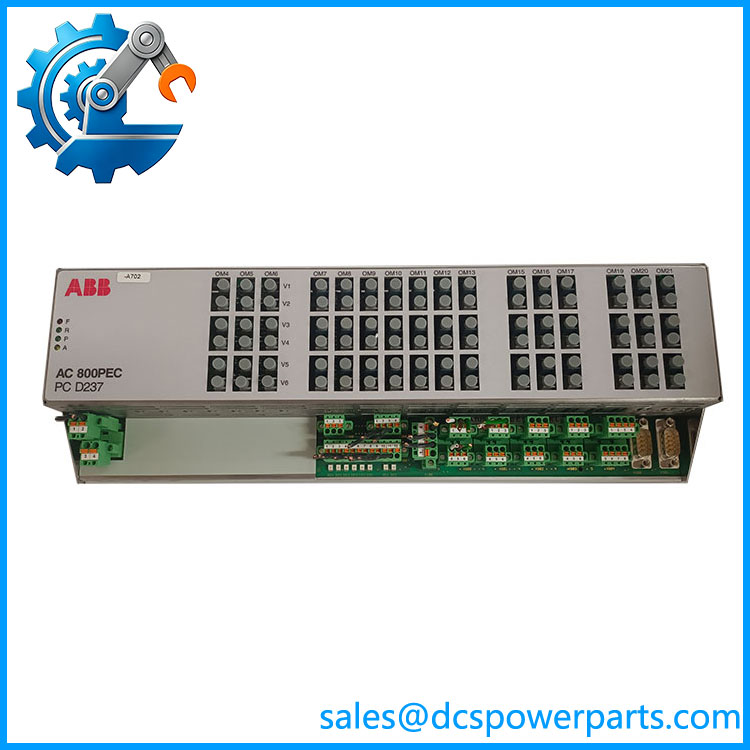
PC D237 A101
Key Features and Advantages
One slot, one function, no substitution: every board in this family measures 373 × 73.5 × 142 mm, so PC D237 A101 slides into a slot occupied by a completely different board and powers up without complaint. The differences live in function and in weight — 1.93 kg here against 1.43 kg and 1.53 kg for the CCI and CCM boards — which makes the label, not the fit, the acceptance criterion.
Board-level sparing instead of box-level sparing: because the catalog treats the controller as “PC D237 A101” plus the INTM box, a plant can hold the card as a spare and keep the box in service, provided the replacement is from the same firmware generation. That is a materially cheaper sparing policy than replacing a sealed controller every time a channel or a processing element fails, and it is only possible if the maintenance team knows which of the two objects the fault belongs to.
Built for the control loop, not for the cabinet: AC 800PEC boards are designed around deterministic execution with the converter’s switching cycle as the deadline, in an environment of high dV/dt and dI/dt. The practical consequence for a maintenance engineer is that a marginal board does not usually fail outright — it produces jitter, an occasional loss of synchronisation, or a grid-code limit excursion that the converter reports as a generic control fault.
Diagnostics through the box, not the card: there are no meaningful front-panel indications on the board itself. Status, event logs and fault history are surfaced through the controller box and the commissioning tool, which means the board’s health is judged from the box’s records and from the behaviour of the converter, not by looking at it.
A platform with a documented sibling set: the ability to compare PC D237 A101 against PC D231 B101, PC D232 A101 and on paper — same dimensions, different function, different weight — is what makes correct ordering possible in a market where almost every resale listing describes these boards as “communication modules” or “excitation controllers” without evidence.
Applications
Wind turbine converters are the defining application: PCS6000 units in onshore and offshore machines, where this board runs the generator-side and grid-side conversion, keeps the DC bus where it should be, regulates active and reactive power, and holds the machine inside the grid code the site is contracted to. When a turbine trips on a control fault rather than a power fault, the board is one of the first suspects and the last thing anyone wants to change unnecessarily.
Converter retrofits and life extension: PCS6000 fleets that are a decade into service are supported by board-level spares, and 3BHE028915R0101 is the part that lets a controller box stay in its cabinet while its processing card is renewed — practical where the box’s configuration and grid-code files are validated and cannot simply be recreated.
Test benches and repair workshops: because the board is the unit of exchange in the controller, repair houses and OEM test facilities hold it to bring a converter controller back to a known state before returning it to a site.
Other medium-voltage power-electronics systems built on AC 800PEC: the platform is shared across ABB’s power-electronic product lines, so the same board family appears wherever converter control, fast protection and deterministic I/O meet — static compensators, large drives, and high-power rectifier controls.
Spares and obsolescence planning: platforms of this class stay in service far longer than their marketing life, and the useful question for a plant is not “is this board available” but “which board, from which generation, matches the box I have” — the question forces you to answer before you buy.
Related Products
PC D230 / 3BHE022291R0101 — -CCM board, same form factor, different function; 1.53 kg. PC D231 B101 / 3BHE025541R0101 — -CCI board, converter control interface, 1.43 kg. PC D232 / 3BHE022293R0101 — -CIO board, the communication I/O member of the same rack. PC D235 / 3BHE032025R0101 — additional controller board of the same generation. PEC80-INTM box — the controller enclosure this board is built for; ordered, configured and replaced as a separate item. PPD113 B01-26-111000 / 3BHE023784R1023 — AC 800PEC controller module, the platform’s processing unit in other racks. PPD114 B1022 / 3BHE020570R1022 — higher-capability AC 800PEC controller module, same platform generation. GFD233 / 3BHE022294R0103 — fieldbus interface board of the same platform, for connecting the controller to plant networks. PCS6000 phase module — the IGCT power stage the controller drives; the two are matched as a system rather than as parts. 5SHY3545L0014 / 3BHE023784 — IGCT device of the same converter generation, related at system level rather than as a spare.
Installation and Maintenance
Before installation: establish which object has actually failed — board or box. Read the box’s event log and configuration version first, confirm that the replacement carries the same hardware generation the box’s firmware expects, and only then isolate the controller, discharge and lock out the converter, and observe the ESD discipline these boards require. Seat the card fully in its guides, confirm the backplane engagement before tightening the retaining screws, and re-check that the converter’s grid-code and application files are intact after power-up rather than assuming they travelled with the box.
Maintenance practice: keep the board as a card-level spare and the box’s configuration backed up separately, because one without the other restores nothing. Treat any replaced 3BHE028915R0101 as repairable rather than scrap — these boards are often recovered and re-tested, which matters on a platform where the alternative is a controller-level replacement. Log the board’s designation and weight against the slot it came from so a future order is made on evidence, and hold at least one matching spare per converter type in a fleet, since a single controller board can otherwise stop a multi-megawatt machine for as long as the supply chain takes.
Warranty and Quality
Each PC (3BHE028915R0101) is supplied as the controller board identified by ABB’s catalog description “Controller Board: -INTM Box”, with the board designation, ordering code and physical identity verified against the label — dimensions, 1.93 kg net weight and slot form factor — so that a differently-functioned board of identical size is not substituted. Units are inspected for connector condition, card-edge integrity and evidence of thermal stress before dispatch, and carry a 12-month repair, replacement or refund commitment. Support concentrates on the questions this platform actually raises: separating a board fault from a box configuration fault, matching the replacement to the controller’s firmware generation, and confirming that the part ordered is the controller board and not one of its identically-sized CCM, CCI or CIO siblings.