Description
Product Overview
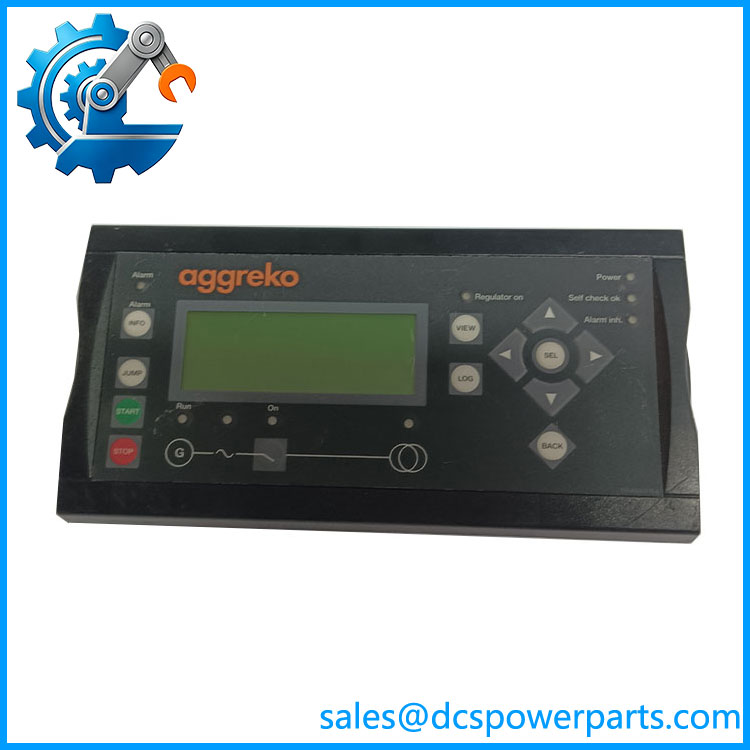
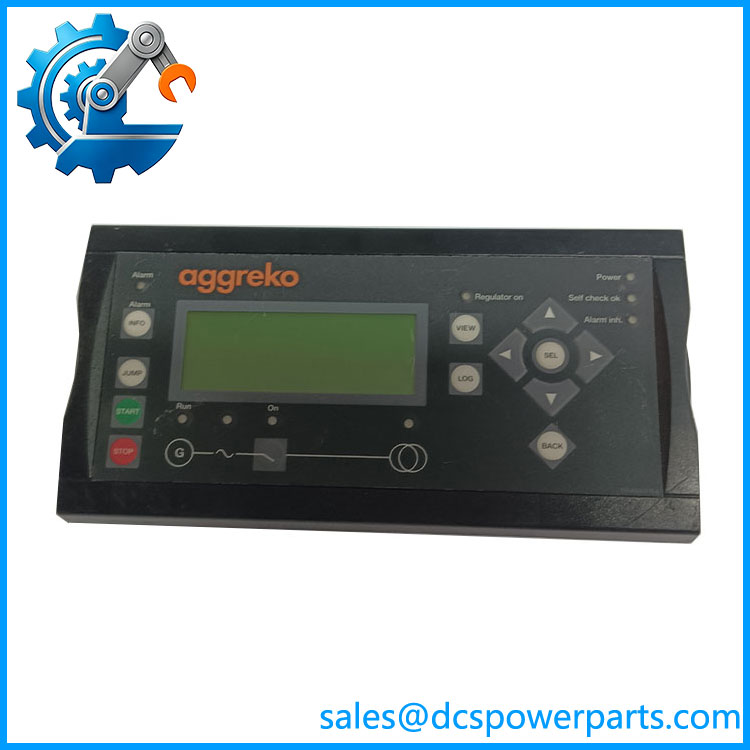
DU-2/MKIII is the face of a DEIF Multi-line 2 controller. It is a display unit: an LCD, a membrane keypad, ten LEDs and a small amount of interface electronics, mounted in the front of a switchboard or directly on a PPM base, connected to the controller that does the actual thinking. On its own it measures nothing, protects nothing and controls nothing — and that single sentence eliminates most of the wrong information circulating about this part number, including descriptions that call it a multi-instrument with protection functions, an automatic voltage regulator, or a device with a 30 kHz output.
What it does is give an operator a way into the controller. Four lines of twenty characters is the entire interface: line one and two carry the running values, line three explains what the cursor is on, line four is where you select a view or a setup item. Three view menus — V1 and V2 configured by the designer, V3 dynamic and dependent on operating state — sit alongside a setup menu that is password-protected, an event log, an alarm list and a battery log. Pressing LOG is how a technician finds out why the genset tripped at 03:00; pressing INFO is how a current alarm is read; and menu number 9150 is how the backlight gets dimmed on a dark bridge.
The panel is shared across a whole family of DEIF controllers — the AGC-4 Mk II genset controller, the AGC plant management controller, and the PPU/PPM protection and power management units — which is why the same hardware can present three quite different faces depending on what it is plugged into and which application is loaded. It also explains a behaviour that surprises people: where more than one DU-2 is fitted, each can be a display, and holding the leftmost key for about two seconds makes the unit in your hand the main display. On a vessel with a panel in the engine room and another on the bridge, that is a real operating decision and not a menu curiosity.
MKIII marks the third revision of the panel. The revision matters because what the screen offers is defined by the controller’s software: parameter numbering, alarm texts, view contents and the LED colour scheme (selected by parameter 6082, which applies to the DU-2 only) all come from the controller generation. A DU-2 from a mismatched generation will light up and show values, and its alarm texts and view set may not correspond to the controller behind it. Where a modern replacement is wanted rather than a like-for-like panel, DEIF’s own documentation names the TDU 107 touch display unit as the substitute for the DU-2.
Technical Specifications
| Parameter | Value |
|---|---|
| Model | DU-2/MKIII |
| Manufacturer | DEIF A/S, Denmark |
| Product type | Operator display unit (HMI panel) |
| Used with | Multi-line 2 controllers: AGC-4 Mk II, AGC PM, PPU/PPM |
| Display | Backlit LCD, 4 lines × 20 characters |
| Backlight control | Parameter 9150, up/down keys |
| Keys | LOG, VIEW, BACK, INFO, JUMP, SEL, MODE plus start/stop and breaker keys |
| Status indication | 10 LEDs, two selectable colour schemes (parameter 6082) |
| Logs accessible | Event log, alarm list, battery log, held in the controller |
| Multiple panels | Several DU-2 units may be fitted; one is designated main display |
| Mounting | Switchboard front or PPM base |
| Dimensions | 220 mm × 115 mm, approximately 30 mm deep |
| Mass | ~0.25 kg |
| Direct substitute | TDU 107 touch display unit |
| Configuration | Follows the controller’s software generation |
DEIF DU-2MKIII
Key Features and Advantages
A face for the controller, not a controller: everything the DU-2/MKIII shows comes from the unit behind the panel. That makes diagnosis simpler than it looks — a dark screen with a live controller is a panel, cable or supply problem, while a live screen showing wrong or missing values is a configuration or application problem. Understanding which of the two you have saves the cost of a panel that was never at fault.
Four lines that are enough: twenty characters per line forces a controller to present information in a disciplined way, and DEIF’s design uses that constraint well — status on top, values beneath, then context, then a selectable action. An operator who has used one Multi-line 2 panel can read any of them, on any controller in the family, without retraining.
Ten LEDs as an at-a-glance annunciator: power, self-check, power-management communication, AUTO, SEMI, mains present or failed, breaker position, busbar healthy, and alarm acknowledgement state are visible from across a switchboard without touching a key. The two colour schemes exist because green-for-everything is not readable on every panel overlay, and the choice is made per panel through parameter 6082 rather than by ordering a different part.
The log as the maintenance tool: the event and alarm lists reached through LOG turn a trip into a sequence of timestamped facts — which breaker operated, which alarm came first, whether the battery log shows a weak start. On a plant where the genset is one of twenty, being able to read the sequence at the panel instead of extracting it from a PC is the difference between a ten-minute answer and a half-day one.
Multi-panel installations handled properly: a switchboard, an engine-room repeater and a bridge station can each carry a DU-2, with the main-display designation chosen at the panel. The alternative — one panel and long cable runs to everywhere an operator might stand — is more expensive and less useful.
A documented upgrade path: DEIF states that the TDU 107 can replace the DU-2. That matters for a plant facing a dead panel: the choice is not only like-for-like replacement of a character display, but a touch interface that presents the same controller with more room for information.
Applications
Genset control in standby and prime power plants: the local interface on AGC-4 Mk II controlled sets, where the operator starts, stops, synchronises and acknowledges alarms, and the engineer reads the event log after a failed start.
Power management installations: panels on AGC PM plant controllers and group controllers, where the display is how start priority, load-dependent start/stop and plant mode changes are observed and overridden.
Marine and offshore electrical systems: bridge and engine-room panels on vessels where DEIF protection and power management units supervise generators and busbars, and where the DU-2’s LED annunciation is the quickest check after a blackout.
PPU/PPM protection panels: front-panel indication and alarm reading on protection and paralleling units where a compact 220 × 115 mm panel is the only interface in the switchboard.
District heating, CHP and biogas plants: small generating units whose operation is supervised locally rather than from a control room, with the display serving as both HMI and fault recorder.
Retrofit and life extension: replacement of failed or faded panels in existing Multi-line 2 switchboards, where keeping the same panel type avoids re-cutting the front plate and retraining operators.
Related Products
TDU 107 — DEIF touch display unit named in DEIF documentation as the substitute for the DU-2. DU-2/MKII — previous revision of the same panel; menu and parameter numbering follow an earlier controller generation. AGC-4 Mk II — genset controller the panel is most commonly fitted to. AGC PM (plant management) — plant and group controller using the same display unit, with plant-specific LED functions. PPU-3 — protection and paralleling unit that uses the DU-2 as its front panel. PPM-3 — power management unit on which the panel may be mounted directly on the base. AGC 200 series — smaller controller family with its own integrated display, not a DU-2 host. MIC-2 MKII — a genuine DEIF multi-instrument with measurement, Modbus and optional Ethernet/Profibus; a different product that is frequently mistaken for the DU-2. Multi-line 2 controller harness and display cable — the link between panel and controller; the first thing to check on a dark screen.
Installation and Maintenance
Before installation: confirm which controller generation the panel will serve, because MKIII menus and alarm texts belong to a software generation and a mismatched panel produces a display that works but misleads. Record the existing panel’s revision and the controller’s software version before ordering, check the front-plate cut-out and depth against the 220 × 115 mm format, and confirm the display cable and its connector type rather than assuming a like-for-like harness. On multi-panel systems, note which unit is currently designated main display so the replacement can be given the same role.
Maintenance practice: the panel has no calibration and few wear items, so attention belongs to the front face and the connection. Clean the overlay with a soft damp cloth and no solvents, since the membrane keypad and the printed overlay are the parts that fail with age and aggressive cleaning. Check the display cable and connector seating whenever a panel shows intermittent blanking, and confirm LED colour scheme and brightness settings after any replacement, because a panel restored to defaults will look wrong to operators who rely on the colour convention. Keep the controller’s parameter backup current — the panel is replaceable in minutes, but the configuration behind it is not, and no replacement panel restores settings it does not hold.
Warranty and Quality
Every DU-2/MKIII is supplied as the DEIF Multi-line 2 operator display unit, with the revision and the intended controller generation confirmed before dispatch, since a working panel of the wrong generation is a misleading one. Units are inspected for overlay condition, keypad response, display contrast and connector integrity, and are checked for correct identification against the panel they replace; they carry a 12-month repair, replacement or refund commitment. Support concentrates on the questions this part actually raises: distinguishing a failed panel from a controller or cabling fault, matching revision to the installed controller software, designating a replacement as main display on multi-panel systems, and advising where the TDU 107 touch unit is the better answer than another character display.
免费
今天 16:36