Description
Product Overview
G-TUB30/480FEHSNA2 is a Gold Tuba drive: Elmo’s answer to the problem of putting a 480 V-class, 30 A axis into a cabinet that has no room left for a traditional book-sized amplifier. The family name shows up in the customs record in its long form — “G-TUBA 30A/480VAC ECT ENC SRC STO-O SERVODRIVE” — which is a useful reminder that the number before the slash is current and the number after it is the voltage class, not a power rating.
The important reading of this part number is that the string after 480 is the actual specification. F, E, H, S, N, A2 encode the feedback interface, the fieldbus, the I/O arrangement and whether Safe Torque Off is fitted — precisely the attributes that decide whether a drive will talk to a given controller and accept a given encoder. Two Gold Tuba drives labelled 30/480 can be entirely different products: one EtherCAT with absolute feedback and STO, the other CANopen with incremental feedback and no safety function. Ordering on “G-TUB30/480” alone is the standard way to receive a drive that fits the cabinet and not the machine.
Physically, this is a drive meant to be bolted into a panel next to the axis it drives, fed from a 480 V-class DC bus shared with the rest of the machine, with its own 24 V control supply and its own heatsink doing the thermal work that a larger cabinet-mounted drive would have delegated to a fan. That architecture is why Gold-series drives displaced a whole class of amplifier: the same current in a fraction of the volume, at the cost of demanding a properly designed DC bus and a properly designed thermal path.
Elmo’s ecosystem is the other half of the product. Commissioning happens in Elmo Application Studio, where the motor’s parameters are identified and the current, velocity and position loops are tuned against the actual mechanics; the drive stores the result, so a replacement unit needs its configuration restored rather than merely installed. On a machine with dozens of axes, that configuration — not the hardware — is what determines how long a repair takes.
Technical Specifications
| Parameter | Value |
|---|---|
| Model | G-TUB30/480FEHSNA2 |
| Manufacturer | Elmo Motion Control |
| Product family | Gold Tuba, Gold series high-voltage servo drive |
| Product type | Single-axis servo drive, panel-mounted |
| Current rating | 30 A continuous (code digit 30) |
| Voltage class | 480 VAC (code digit 480), high-voltage DC bus |
| Communication | EtherCAT, encoded in the option string |
| Feedback | Encoder interface, type defined by the option string |
| Safety function | STO per the option string (STO-O in the customs description) |
| Auxiliary supply | 24 VDC control supply |
| Cooling | Natural convection via drive heatsink; cabinet airflow required at rated current |
| Mounting | Panel mount inside an IP-rated enclosure |
| Commissioning tool | Elmo Application Studio (EAS) parameter identification and tuning |
| Customs classification | HS 8503.00.90 as declared for this family |
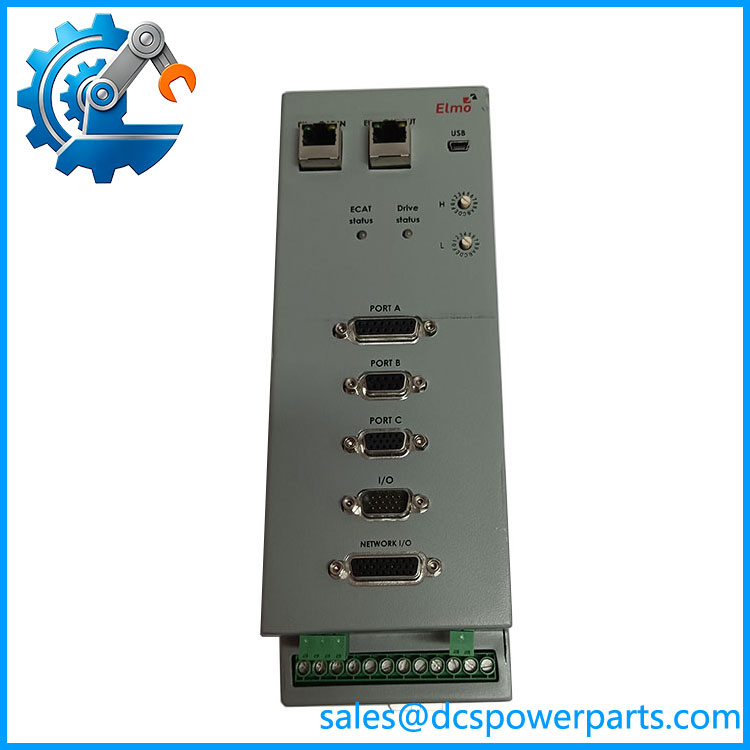
G-TUB30480FEHSNA2
Key Features and Advantages
Current per unit volume: 30 A continuous at 480 V class in a housing that mounts beside the axis removes the long motor cable run and the cabinet real estate that a conventional amplifier consumes. The gain is not cosmetic — shorter power cables mean lower leakage and less radiated noise from the PWM, which on a 480 V bus is the difference between a clean encoder signal and an intermittent one.
Network-native motion: EtherCAT in the option string puts the drive on the same cycle as the rest of the machine, with distributed clocks keeping multi-axis interpolation aligned. For a gantry or a converting line, that removes the analog command and the separate handshake wiring that older amplifier architectures needed, and it is what allows the drive’s own diagnostics to reach the controller instead of a maintenance laptop.
The option string as the real datasheet: FEHSNA2 is not decoration. It decides the encoder interface (incremental versus absolute, and therefore whether the axis can home without a reference switch), the fieldbus, the digital I/O count used for limits and interlocks, and whether STO is available for the machine’s safety circuit. Buying by the short form of the code is the most common cause of a drive that arrives healthy and unusable.
Elmo tuning as an asset: EAS identifies the motor — resistance, inductance, back-EMF, cogging — from a few test moves, then tunes against the load. On a 480 V axis with a high-inertia load, that turns a week of hand-tuning into an afternoon, and it produces a parameter file that can be archived and restored, which is the only reliable way to bring a replacement drive back to the behaviour the machine was validated with.
Designed around a shared DC bus: at this power level the drive expects to be fed from a common rectifier with other axes, which is what makes regenerative energy from a stopping load available to a accelerating one instead of being dissipated in a brake resistor — a real efficiency and thermal argument on machines with coupled axes.
STO rather than a contactor: where the option is fitted, the safety function removes torque without removing power, so a guard-door stop no longer requires a main contactor to open under load — fewer wear items in the safety circuit and a faster restart.
Applications
Converting and web-handling lines: unwind and rewind stands, draw rolls and registration axes where a 480 V bus and 30 A of continuous current drive a large roll, and where EtherCAT synchronization between tension and register axes is the difference between saleable product and waste.
Packaging machinery: form-fill-seal, cartoners and case packers running multi-axis with frequent recipe changes — the case where restored Elmo parameters make a changeover a menu selection rather than a retuning exercise.
Machine tools and metal processing: feed axes and auxiliary spindles on machines with a 480 V DC bus, where the drive’s compact form allows it to sit in a smaller cabinet closer to the mechanical work.
Semiconductor and electronics assembly: gantries and precision positioning stages needing encoder-based full-closed-loop control and tight multi-axis synchronization.
Intralogistics and material handling: sorters, lifts and high-dynamic conveyors where the 30 A rating drives a large motor but the duty cycle is dominated by starts and stops, and where regenerative energy from the shared bus matters more than peak current.
Retrofit of legacy amplifier cabinets: replacing analog-commanded amplifiers with a networked Gold Tuba while keeping the existing motor and mechanics, using the drive’s own encoder interface and STO to simplify the surrounding wiring.
Related Products
G-TUB30/480 with other option strings — same 30 A / 480 V rating, different communication, feedback or safety options; not interchangeable without checking the suffix. G-TUB48/480 and G-TUB65/480 — higher-current members of the Gold Tuba family, same voltage class and architecture. G-TUB30/480EESS0-style variants — EtherCAT builds documented in customs and export records under the same family name. Elmo Gold Twitter (G-TWI) — the smaller sibling family for lower-current axes on the same network. Elmo Application Studio (EAS) — the commissioning tool that identifies the motor and produces the parameter file the drive depends on. Elmo multi-axis DC-bus rectifier / power supply units — the front end that feeds 480 V-class Gold drives from a shared bus. Elmo brake resistor options — used where the bus cannot absorb regenerated energy; a thermal decision, not an electrical accessory. Elmo Platinum series — the higher-functionality drive line for applications needing more advanced control features than Gold.
Installation and Maintenance
Before installation: read the full option string against the machine’s requirements — encoder type, fieldbus, I/O and STO — before the drive leaves the stores. Confirm the DC bus voltage and pre-charge arrangement, provide the 24 VDC control supply separately from the power path, and respect the creepage and clearance the 480 V class demands. Mount the drive so that the heatsink has unobstructed airflow, bond the protective earth at the panel’s star point, and route motor and encoder cables shielded and separated from the bus bars.
Maintenance practice: archive the G-TUB30/480FEHSNA2 parameter file after commissioning and keep it with the machine’s documentation, because a replacement drive without the file is a retuning job, not a swap. Check connector torque and heatsink cleanliness at each planned shutdown, watch cabinet temperature rather than trusting the drive’s own thermal margin, and investigate any repeated overcurrent on one axis as a mechanical or tuning problem before replacing hardware. On a 480 V drive, treat a failed unit as a diagnostic event: the log and the parameter history usually identify the cause faster than a spare does.
Warranty and Quality
Each G-/480FEHSNA2 is supplied with its full option string confirmed in writing, so the communication, feedback and safety configuration matches the machine rather than merely the current rating. Units are inspected for connector condition, heatsink integrity and evidence of bus-side stress before dispatch, and carry a 12-month repair, replacement or refund commitment. Support covers the practical points this part number raises: decoding the suffix letters against the application, confirming compatibility with the existing motor and encoder, and restoring the drive’s parameter file so that a replacement axis behaves as the validated machine did.