Description
GE SLN042 IC086SLN042-A Industrial Ethernet Switch
Key Technical Specifications
| Parameter | Specification |
|---|---|
| Model | SLN042 IC086SLN042-A |
| Part Number | SLN042 IC086SLN042-A |
| Manufacturer | GE |
| Product Type | Unmanaged Industrial Ethernet Switch |
| Ethernet Ports | 4 × 10/100Base-T(X) |
| Fiber Ports | 2 × 100Base-FX |
| Ethernet Standards | IEEE 802.3, IEEE 802.3u, IEEE 802.3x |
| Switching Method | Store-and-forward |
| MAC Address Table | 2,048 addresses |
| Power Input | Dual 12–48 VDC |
| Typical Power Consumption | 7 W |
| Protection | Overload and reverse-polarity protection |
| Operating Temperature | -40°C to +70°C |
| Storage Temperature | -40°C to +85°C |
| Humidity | 5–95% RH, non-condensing |
| Enclosure Rating | IP30 |
| Mounting | DIN rail / wall mounting |
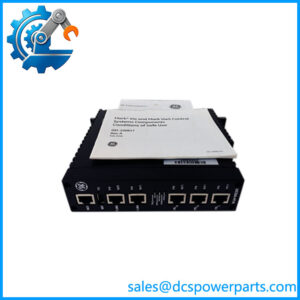
The published technical information consistently identifies the GE as a six-port industrial Ethernet switch. Its port arrangement is particularly important when checking a replacement: four ports are copper 10/100Base-T(X), while two are 100Base-FX fiber interfaces. This is materially different from the GE SLN080 family, which is an eight-port copper-oriented switch.
Product Introduction
The GE is an unmanaged industrial Ethernet switch intended for Ethernet connectivity within industrial automation and control networks. Rather than performing PLC logic or process I/O, it provides the network layer through which controllers, operator stations, remote equipment, and other Ethernet devices exchange data. Its combination of copper Ethernet and 100Base-FX fiber interfaces makes it useful where an automation cabinet needs both conventional twisted-pair connections and fiber-based links.
For plant engineers and procurement teams, the important point is that this is network infrastructure hardware, not a controller or I/O module. A failed switch can appear at first to be a PLC communication problem because several downstream devices may disappear simultaneously. Correct identification of the and its port arrangement can therefore shorten troubleshooting and prevent an incorrect substitution.
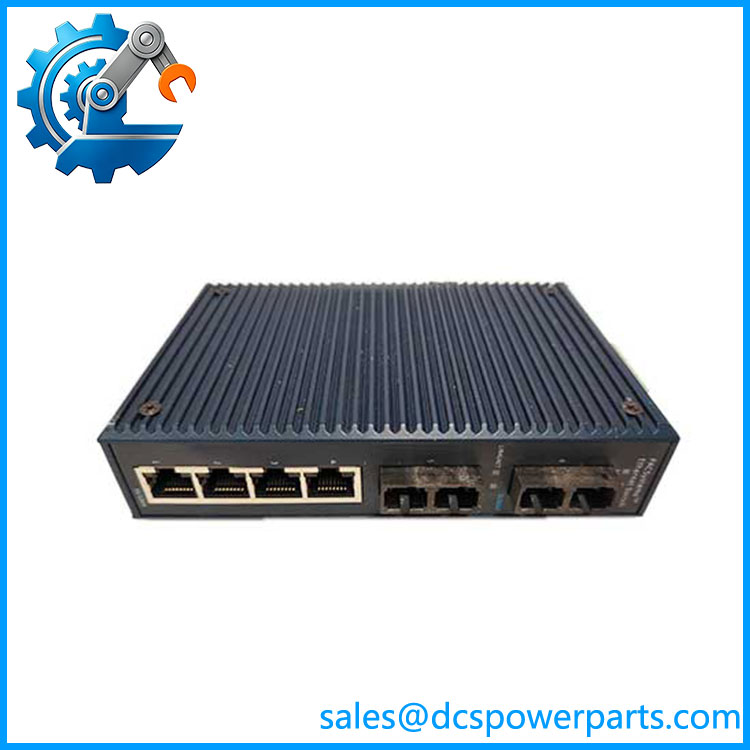
SLN042 IC086SLN042-A
Application Scenarios & Field Pitfalls — The Engineer’s Perspective
Engineering Pain Point
When several PLCs, HMIs, drives, or remote network devices suddenly lose communication, the first instinct is often to inspect the controller or communication module. In an industrial Ethernet architecture, however, the switch can be the common failure point. A power-feed problem, failed copper port, damaged fiber link, or switch hardware fault can isolate multiple devices at once without producing a PLC diagnostic that clearly identifies the physical cause.
The GE is useful in this type of architecture because its six-port design combines copper and fiber connectivity in one industrial switch. The dual DC input arrangement also gives engineers a practical way to connect two DC supply sources where the cabinet design calls for redundant feeds.
Typical Applications
1. PLC and PAC Network Segmentation
The switch can connect PLC/PAC controllers, HMIs, remote stations, and other Ethernet equipment within an automation cabinet or process area.
2. Copper-to-Fiber Industrial Links
The four 10/100Base-T(X) copper ports can serve local Ethernet devices while the two 100Base-FX interfaces can be used for fiber-based network connections. This can be useful when electrical isolation or longer inter-cabinet runs are required.
3. Legacy Factory Ethernet Networks
The is relevant when maintaining an existing industrial Ethernet installation where replacing the entire network architecture is not justified simply because one switch has failed.
4. Distributed Control and Monitoring Networks
It can provide the physical Ethernet switching layer between controllers, supervisory systems, and networked equipment without requiring the configuration overhead associated with a managed switch.
Technical Pitfalls
Do not confuse with an I/O module.
Some secondary listings incorrectly classify this part as a digital output module. The technical evidence instead identifies as an Ethernet switch.
Check the fiber interface before ordering.
The two fiber ports are 100Base-FX, while the four copper ports are 10/100Base-T(X). A visually similar industrial Ethernet switch with different fiber specifications may not be a direct replacement.
Do not assume managed-switch functionality.
The is documented as an unmanaged switch. Claims found on some reseller pages regarding SNMP, VLAN configuration, or other managed-network functions should not be treated as universal specifications for this exact part number.
Verify the power architecture.
The published specification identifies dual 12–48 VDC inputs, with overload and reverse-polarity protection. Confirm the cabinet’s actual wiring and terminal arrangement before installing a replacement.
Inspect the physical network, not only the PLC diagnostics.
When multiple Ethernet nodes disappear simultaneously, check switch power LEDs, link/activity indicators, copper patch cables, fiber connectors, and upstream network equipment before replacing controller hardware.
Check the exact suffix.
should be matched against the installed unit’s nameplate. Do not automatically substitute another listing simply because the model number appears similar; hardware revision, port configuration, and network architecture should all be confirmed.
Related Products
- GE SLN080 IC086SLN080-A — An eight-port industrial Ethernet switch used where more copper Ethernet connections are required. It should not be treated as a direct six-port replacement without reviewing the existing topology.
- — The family designation associated with the hardware.
- GE IC200GBI001 — VersaMax Ethernet-related interface hardware; functionally different from a standalone industrial Ethernet switch.
- GE IC697LAN731 — Series 90-70 Ethernet interface hardware for legacy GE PLC architectures; it is not a direct switch replacement.
- GE PACSystems Ethernet Modules — Controller-side Ethernet hardware that works at the device/interface level rather than replacing the physical switching function of the .
- GE D20 Ethernet Communication Hardware — Networking hardware associated with GE D20 control systems; application and architecture must be checked before substitution.
- GE IS420ESWBH1A — Industrial Ethernet switch hardware associated with GE Mark VIe systems; different system family and should not be assumed electrically or functionally interchangeable.
Procurement Note
For a replacement , the most useful information to capture from the installed unit is the complete part number, revision/suffix, port arrangement, fiber type, terminal-block configuration, and cabinet power wiring. For an operating legacy network, replacing the switch with a visually similar six-port industrial Ethernet unit is not necessarily sufficient; the fiber standard and physical topology are often the decisive compatibility points.
For surplus or previously installed hardware, request clear photographs of the nameplate, front-panel port labels, terminal block, and PCB/revision markings. Those details can distinguish a genuine configuration from similarly labeled industrial Ethernet hardware and reduce the risk of installing the wrong network component.