Description
GE IS230PCAAH1B Core Analog I/O Module
Product Overview
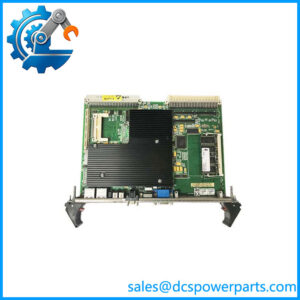
The GE IS230PCAAH1B is a Core Analog I/O module used in the Mark VIe turbine control architecture. Its role is broader than that of a conventional PLC analog input card. The PCAA assembly handles a substantial portion of the analog signal interface required by turbine control, including thermocouple signals, 4–20 mA instrumentation, seismic inputs, LVDT excitation and feedback, pulse-rate signals, and servo-related outputs. The module works with the associated TCAS and, where the system configuration requires signal fanning, TCAT terminal boards.
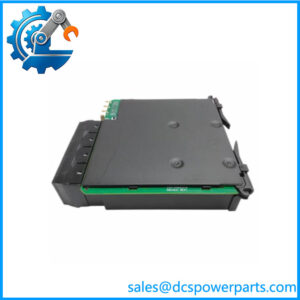
The GE IS230PCAAH1B contains a BPPC processor board, two application I/O boards, and a TCAS terminal board within the assembly. Field wiring is presented through 120 Euro-style box-type terminals, while dual RJ-45 Ethernet connections provide the Mark VIe I/O network interface. A 28 VDC power connection supplies the module. In simplex, dual, or TMR configurations, signal routing depends on whether the signal is dedicated to one PCAA module or needs to be fanned through the TCAT architecture.
For replacement work, the GE IS230PCAAH1B should be treated as a complete Mark VIe I/O assembly rather than a generic analog card. The exact terminal-board arrangement, cable connections, network assignment, system redundancy, and ControlST configuration all affect interchangeability. GE-related documentation and current technical records identify IS230PCAAH1B as the B-revision Core Analog module; the supplied spelling IS230PCAAHIB should therefore be checked against the physical nameplate before procurement.
Technical Specifications
| Parameter | Specification |
|---|---|
| Product Model | IS230PCAAH1B |
| Manufacturer | General Electric |
| Product Type | Core Analog I/O Module (PCAA) |
| Control Platform | Mark VIe / Mark VIeS |
| Functional Revision | B |
| Analog Function | Core analog input/output processing |
| Supported Signals | Thermocouple, 4–20 mA, seismic, LVDT, pulse-rate, servo-related signals |
| Thermocouple Types | E, J, K, T, S |
| Power Input | 28 VDC connection |
| Network Interface | Dual RJ-45 Ethernet |
| Field Termination | 120 Euro-style box-type terminals |
| Terminal Board | Integrated TCAS; compatible with optional TCAT architecture |
| Redundancy | Simplex, dual, and TMR applications |
| Status Indicators | 3 front-facing LEDs |
| Chassis | Vented chassis assembly |
| Operating Temperature | -30°C to +65°C reported in secondary technical records |
| Manual Reference | GEH-6721L reported by technical sources |
The 28 VDC input, dual Ethernet ports, 120 field terminals, integrated board architecture, and thermocouple support are consistently reported across available technical records. Some third-party sources publish detailed accuracy figures and channel counts, but those figures are not treated here as definitive without the applicable GE hardware revision documentation.
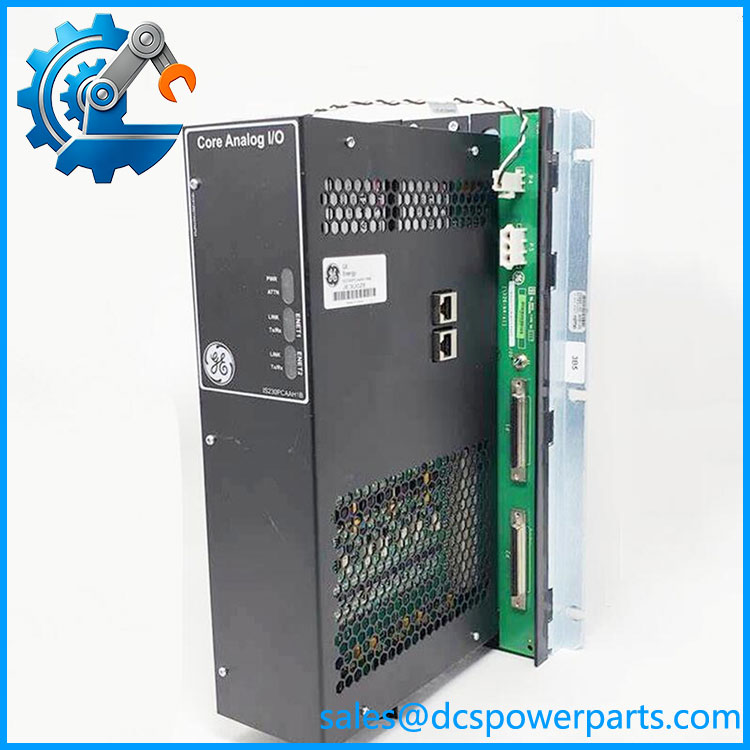
IS230PCAAHIB
Main Features and Engineering Considerations
The main engineering characteristic of the is that it combines processing and application I/O functions into one Mark VIe Core Analog assembly. The internal BPPC processor board and application boards are part of the complete module architecture, so replacement should not be approached like swapping an isolated analog daughtercard. The available technical documentation describes the PCAA as the least-changeable component at this assembly level.
Signal architecture is equally important. Signals dedicated to one PCAA can terminate directly at the module, while signals requiring distribution across simplex, dual, or TMR PCAA modules can use the TCAT terminal-board arrangement. The TCAT therefore affects more than physical termination; it can determine how redundant signal paths are distributed to the I/O modules. A technically similar-looking analog assembly is not automatically interchangeable if the terminal-board and redundancy architecture differs.
The dual RJ-45 connections should also not be interpreted as ordinary plant Ethernet ports. They belong to the Mark VIe I/O communications architecture. Before replacement, record the existing network connections, module identification, configuration, and associated controller/I/O topology rather than assuming that reconnecting the cables alone will restore operation.
Field wiring deserves particular attention. Thermocouple polarity, LVDT excitation/feedback wiring, seismic circuits, pulse inputs, servo outputs, shields, and 24 V field-power arrangements have different electrical requirements. A wiring error can produce a plausible but incorrect process signal, which is a more serious commissioning problem than an obvious communication failure.
Procurement and Replacement Checks
- Confirm the physical marking is , not IS230PCAAHIB.
- Verify Mark VIe versus Mark VIeS application.
- Record the existing TCAS/TCAT configuration.
- Confirm simplex, dual, or TMR architecture.
- Photograph and document the P1/P2 cable arrangement before removal.
- Verify both RJ-45 network connections and module configuration.
- Preserve the existing ControlST configuration and applicable software baseline.
- Match the hardware revision rather than assuming an A/B revision is interchangeable.
- Inspect terminal blocks and field wiring for heat, looseness, or oxidation before commissioning the replacement.
- Perform controlled I/O testing before returning the turbine to normal operation.
Application Scenarios
- GE Mark VIe gas turbine control systems
- Turbine analog instrumentation
- Thermocouple temperature acquisition
- 4–20 mA process instrumentation
- LVDT position measurement and excitation
- Seismic/vibration signal acquisition
- Pulse-rate measurement
- Servo actuator control interfaces
- Simplex, dual, and TMR turbine control architectures
Engineer’s Guide: Field Pitfalls
Part-number transcription: The difference between IS230PCAAHIB and is visually small but procurement-critical. Use the numeral 1 in the validated catalog number.
Terminal-board mismatch: PCAA, TCAS, and TCAT are related but are not interchangeable names for the same hardware. Verify the actual assembly and cable configuration.
Redundancy assumptions: A PCAA installed in a simplex system does not have the same replacement considerations as one operating in a dual or TMR architecture.
Configuration loss: The physical module is only one part of the replacement task. Network identity, I/O configuration, controller association, and software compatibility must also be preserved.
Signal testing: Do not rely solely on Ethernet communication tests. Validate representative thermocouple, current-loop, LVDT, pulse, and output circuits according to the actual turbine configuration.
Temperature and accuracy claims: Several commercial listings publish detailed numerical specifications that are not consistently supported by the available GE-related records. For critical replacement decisions, use the applicable GE documentation and the module nameplate rather than copying unverified reseller specifications.
Frequently Asked Questions
Is IS230PCAAHIB the correct GE part number?
The documented part number is , with the numeral “1” after H. The supplied “IS230PCAAHIB” should be treated as a likely transcription/OCR error until the physical module marking confirms otherwise.
What does do?
It is a Mark VIe Core Analog I/O module used for substantial portions of the turbine’s analog signal acquisition and output functions. It works with TCAS and TCAT terminal-board architecture.
Does it support thermocouples?
Yes. Available technical records identify support for Type E, J, K, T, and S thermocouples.
Is a communication module?
No. It is a Core Analog I/O module. Its dual RJ-45 interfaces are part of the Mark VIe I/O communications architecture rather than making the product a general-purpose Ethernet communication module.
Can it be used in TMR systems?
Yes. Available documentation describes PCAA application in simplex, dual, and TMR architectures, with TCAT providing signal fanning where required.
What should be checked before purchasing a replacement?
At minimum, verify the complete part number and revision, Mark VIe/VIeS platform, TCAS/TCAT configuration, redundancy architecture, network connections, field-terminal arrangement, cable configuration, and software/configuration compatibility.
Procurement Note
For a turbine-control replacement, purchase identification should be based on the complete assembly and installed system configuration, not simply the phrase “Core Analog Module.” Preserve the removed module’s configuration information and verify the replacement against the existing terminal-board and redundancy architecture before energization.