Description
Key Technical Specifications
| Parameter | Value |
|---|---|
| Manufacturer | GE |
| Model | IS220PRTDH1A |
| Part Number | 336A4940CSP6 |
| Product Family | Mark VIe |
| Product Type | RTD Input I/O Pack |
| Number of Channels | 8 |
| Input Sensor | RTD |
| A/D Converter Resolution | 14-bit |
| Common-Mode Voltage Range | ±5 V |
| Maximum Lead Resistance | 15 Ω |
| Input Application | Temperature measurement |
| Terminal Boards | IS200TRTDH2D, IS200SRTDH1A, IS200SRTDH2A |
| Nominal Supply | 28 VDC |
| Maximum Supply Current | 0.24 A |
| Network Interface | Dual Ethernet / I/O network |
| Installation | Mark VIe I/O architecture |
| Hazardous Location Use | Yes, when paired with specified terminal boards |
| Manual | GEH-6721L |
GE’s Mark VIe certification documentation specifically lists IS220PRTDH1A with IS200TRTDH2D, IS200SRTDH1A, and IS200SRTDH2A terminal boards and specifies 28 VDC, 0.24 A maximum input power for the H1A configuration.
The 14-bit conversion resolution, ±5 V common-mode range, and 15 Ω maximum lead resistance are documented in technical references for this specific RTD I/O pack.
Product Introduction
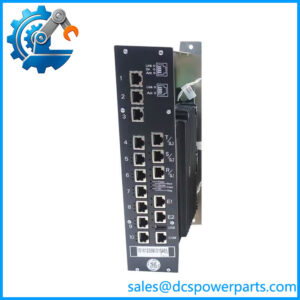
GE IS220PRTDH1A 336A4940CSP6
The GE IS220PRTDH1A 336A4940CSP6 is an 8-channel RTD input I/O pack for the Mark VIe turbine-control platform. It receives temperature signals from resistance temperature detectors and converts them into digital data for the Mark VIe control architecture. It is designed to operate with specific RTD terminal boards rather than as a standalone field device.
The module is particularly relevant to turbine temperature monitoring, where accurate RTD acquisition is used for bearing, winding, exhaust, casing, lube-oil, and other temperature measurements. Its 14-bit A/D conversion and specified lead-resistance limit make the field wiring itself part of the measurement calculation.
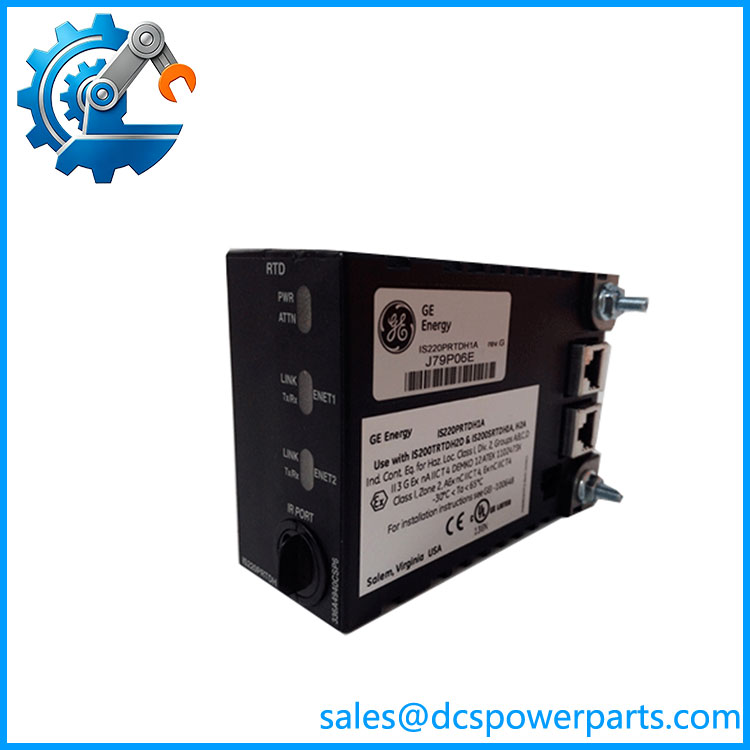
IS220PRTDH1A
Application Scenarios & Field Pitfalls
Engineering Pain Point
A temperature channel that suddenly reads high, low, or open circuit is not automatically a failed RTD input pack. RTD troubleshooting has to start at the sensor and cable. Lead resistance, terminal connections, excitation circuitry, sensor configuration, and the input channel all affect the final temperature value. Replacing the IS220PRTDH1A before checking the loop can waste a good spare.
Typical Applications
- Gas Turbine Control — Monitoring bearing, exhaust, compressor, lube-oil, and casing temperatures.
- Steam Turbine Systems — RTD measurement for bearings, steam-system components, and auxiliary equipment.
- Power Generation — Temperature monitoring of generators, transformers, auxiliary machinery, and balance-of-plant equipment.
- Industrial Turbomachinery — Temperature acquisition for compressors, pumps, and other rotating equipment integrated into Mark VIe control systems.
Technical Pitfalls to Avoid
- Do not confuse PRTD with a general analog-input pack.
This module is specifically intended for RTD temperature measurement. A standard voltage/current analog input module is not a direct substitute. - Verify the terminal board.
GE’s certification documentation identifies IS200TRTDH2D, IS200SRTDH1A, and IS200SRTDH2A as compatible terminal boards for IS220PRTDH1A. The I/O pack and terminal board should be treated as one engineered interface. - Watch lead resistance.
The specified maximum lead resistance is 15 Ω. Long cable runs, undersized conductors, or poor termination can introduce measurement errors. - Check the RTD wiring configuration.
Do not assume that every RTD channel is wired identically. Verify the actual sensor type and terminal arrangement against the Mark VIe configuration. - Do not connect arbitrary active voltage sources to the RTD channels.
These inputs are intended for RTD sensing. Applying an incompatible external source can damage the input circuitry. - Check sensor resistance before condemning the I/O pack.
Measure the RTD at the field end and again at the terminal board when practical. A significant difference points toward cable or termination problems. - Check the common-mode condition.
The documented common-mode voltage range is ±5 V. Grounding faults and shield problems can push a field circuit outside the expected measurement conditions. - Verify the power supply.
The certified H1A configuration specifies 28 VDC and 0.24 A maximum. Do not automatically substitute a generic 24 VDC assumption based solely on the fact that the device is an I/O pack. - Check the Mark VIe network connection.
A healthy RTD channel does not help if the I/O pack cannot communicate with the controller. Check network status and I/O pack diagnostics separately from the sensor circuit. - Perform channel-by-channel verification after replacement.
Do not stop at a normal boot indication. Compare actual RTD resistance, calculated temperature, configured sensor type, and displayed engineering value for every affected channel.
Related Products
- GE IS200TRTDH2D — RTD terminal board specifically identified as compatible with the . It provides the field termination/interface between RTD wiring and the I/O pack.
- GE IS200SRTDH1A — Serial RTD terminal board option associated with the . It is another supported terminal-board configuration for the RTD input pack.
- GE IS200SRTDH2A — Alternative RTD terminal board listed with the . Confirm the actual cabinet configuration before substitution.
- GE IS220PAICH1A — Mark VIe analog input I/O pack. It serves conventional analog process inputs rather than dedicated RTD acquisition, making it relevant when the field signal is 4–20 mA or voltage instead of resistance temperature sensing.
- GE IS220PSCAH1A — Mark VIe serial communication I/O pack. It provides serial communications rather than temperature acquisition and is complementary to PRTD in systems that integrate external serial devices.
- GE IS220PTCCH1A — Mark VIe thermocouple input I/O pack. It is the more appropriate family member when the temperature sensor is a thermocouple rather than an RTD.
- GE IS220PTURH1A — Mark VIe turbine-specific I/O hardware. It belongs to the same turbine-control ecosystem but performs a different acquisition/control function from the RTD input pack.
- GE IS220PDIAH1A — Mark VIe discrete input I/O pack. It handles binary field signals rather than continuous RTD measurements.
- GE IS220PDOAH1A — Mark VIe discrete output I/O pack. It provides discrete control outputs and is functionally different from the PRTD temperature-input module.
- GE IS220PAOCH1A — Mark VIe analog output I/O pack. It provides analog control outputs for actuators and process devices rather than RTD measurement.